McClure Leslie A, Lee Nora L, Sand Katherine, Vivanti Giacomo, Fein Deborah, Stahmer Aubyn, Robins Diana L
Drexel University, 3215 Market Street, Philadelphia, PA, 19104, USA.
AJ Drexel Autism Institute, Drexel University, 3020 Market Street, Philadelphia, PA, 19104, USA.
Trials. 2021 May 2;22(1):319. doi: 10.1186/s13063-021-05286-6.
Autism spectrum disorder (ASD) affects one in 54 children in the United States of America, and supporting people with ASD across the lifespan presents challenges that impact individuals, families, and communities and can be quite costly. The American Academy of Pediatrics has issued recommendations for routine ASD screening at 18 and 24 months, but some research suggests that few pediatricians perform high-fidelity, standardized screening universally. Furthermore, the United States Preventive Services Task Force (USPSTF) found insufficient evidence to recommend for or against universal ASD screening. The objective of this study is to test the hypothesis that children with ASD who have high fidelity; standardized screening will achieve superior outcomes at 5 years of age compared to children receiving usual care ASD detection strategies.
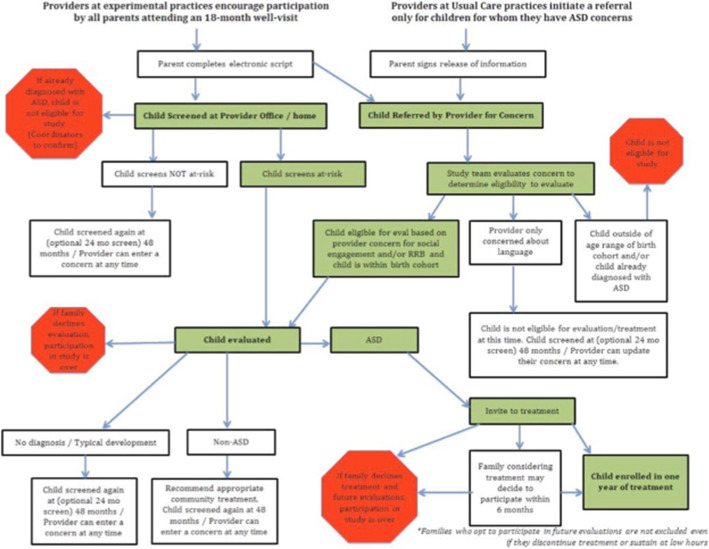
This is a cluster-randomized, controlled clinical trial in 3 sites in the USA. Pediatric practices will be randomized to implement universal, standardized, high-fidelity toddler screening or usual care, with randomization stratified by the practice size. The study will enroll 3450 children, approximately half in each group. From this sample, we anticipate 100 children to be diagnosed with ASD. Children in both groups receiving an ASD diagnosis will be administered the Early Start Denver Model, an evidence-based early intervention addressing social, communication, and cognitive functioning. Treatment will last for 1 year, with up to 20 h per week of therapy for children with ASD.
Primary outcomes measured at baseline, following treatment, and at 4 and 5 years of age include ASD symptom severity (Brief Observation of Social Communication Change (BOSCC)) and cognitive functioning (Mullen Scales of Early Learning (MSEL) and Differential Abilities Scale-II (DAS-II)). Secondary outcomes in children include measures of adaptive functioning, ASD symptoms, and kindergarten readiness; secondary analyses will also examine stress and empowerment among parents. Several novel exploratory measures will be included as well. The study will utilize a modified intention-to-treat analysis.
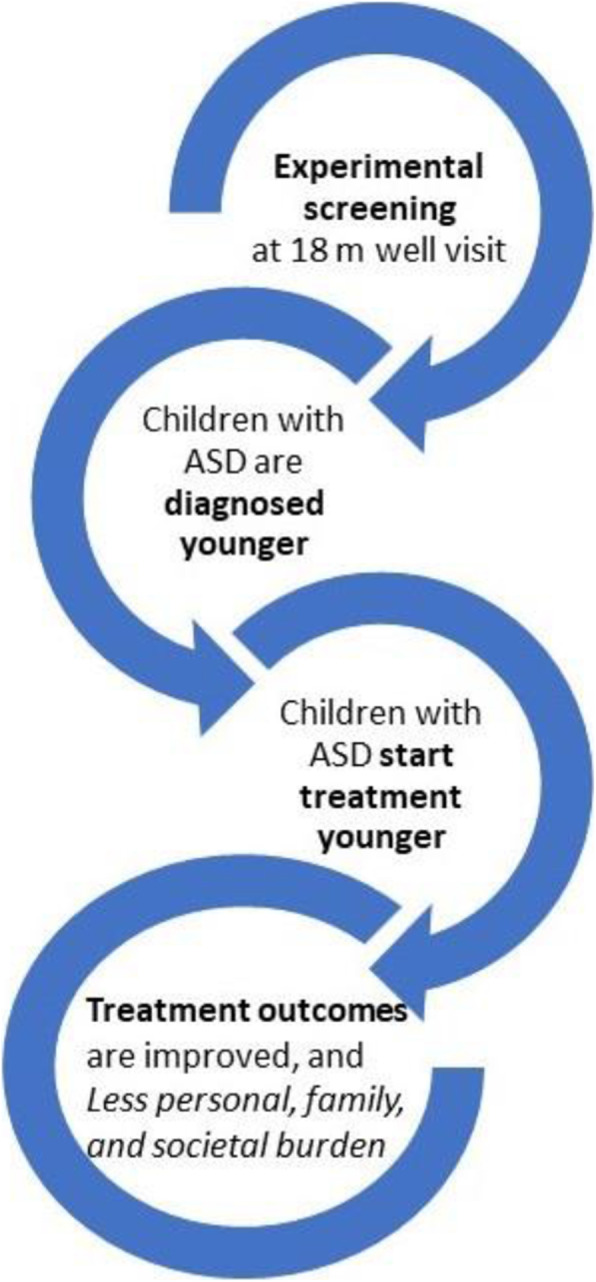
This trial will evaluate the impact of universal, standardized, high-fidelity screening for ASD among children at 18 months of age, with a goal of providing evidence to support this strategy to detect ASD in toddlers in order to start treatment as young as possible and maximize outcomes.
This study was approved by the Institutional Review Board at Drexel University (IRB protocol: 1607004653). All findings will be provided by the principal investigator via email; data will be available through the NIMH Data Archive ( https://nda.nih.gov/ ).
ClinicalTrials.gov NCT03333629 . Registered on November 7, 2017.
在美国,每54名儿童中就有1人患有自闭症谱系障碍(ASD),为患有ASD的人提供一生的支持面临诸多挑战,这些挑战会影响个人、家庭和社区,且成本高昂。美国儿科学会已发布在18个月和24个月时进行常规ASD筛查的建议,但一些研究表明,很少有儿科医生能普遍进行高保真、标准化的筛查。此外,美国预防服务工作组(USPSTF)发现证据不足,无法建议支持或反对普遍进行ASD筛查。本研究的目的是检验以下假设:与接受常规ASD检测策略的儿童相比,接受高保真、标准化筛查的ASD儿童在5岁时会取得更好的结果。
这是一项在美国3个地点进行的整群随机对照临床试验。儿科诊所将被随机分配实施普遍、标准化、高保真的幼儿筛查或常规护理,并按诊所规模进行分层随机分组。该研究将招募3450名儿童,每组约1725名。从这个样本中,我们预计有100名儿童被诊断为ASD。两组中被诊断为ASD的儿童都将接受丹佛早期干预模式,这是一种基于证据的早期干预,用于解决社交、沟通和认知功能问题。治疗将持续1年,ASD儿童每周最多接受20小时的治疗。
在基线、治疗后以及4岁和5岁时测量的主要结局包括ASD症状严重程度(社交沟通变化简短观察量表(BOSCC))和认知功能(早期学习穆伦量表(MSEL)和差异能力量表第二版(DAS-II))。儿童的次要结局包括适应性功能、ASD症状和幼儿园入学准备情况的测量;二次分析还将检查父母的压力和赋权情况。还将纳入一些新的探索性测量指标。该研究将采用改良的意向性分析。
本试验将评估对18个月大儿童进行普遍、标准化、高保真ASD筛查的影响,目标是提供证据支持这种在幼儿中检测ASD的策略,以便尽早开始治疗并使结果最大化。
本研究已获得德雷塞尔大学机构审查委员会的批准(IRB协议:1607004653)。所有研究结果将由主要研究者通过电子邮件提供;数据将通过美国国立精神卫生研究所数据存档库(https://nda.nih.gov/)获取。
ClinicalTrials.gov NCT03333629。于2017年11月7日注册。