Abramova Olga, Ushakova Valeria, Zorkina Yana, Zubkov Eugene, Storozheva Zinaida, Morozova Anna, Chekhonin Vladimir
Department of Basic and Applied Neurobiology, V.P. Serbsky National Medical Research Center for Psychiatry and Narcology, Moscow, Russia.
Mental-health Clinic No. 1 Named After N.A. Alexeev of Moscow Healthcare Department, Moscow, Russia.
Front Physiol. 2021 Apr 15;12:659366. doi: 10.3389/fphys.2021.659366. eCollection 2021.
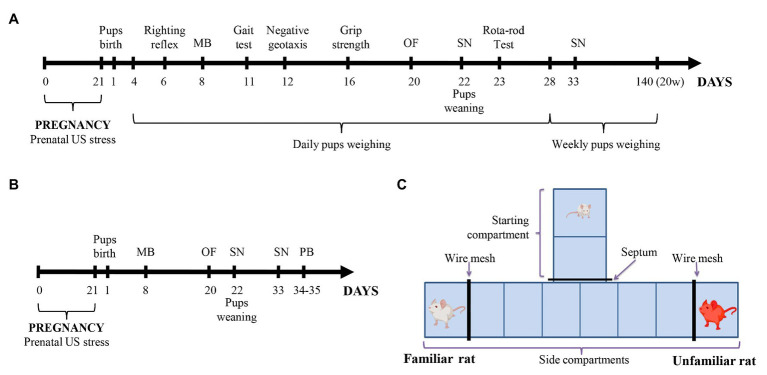
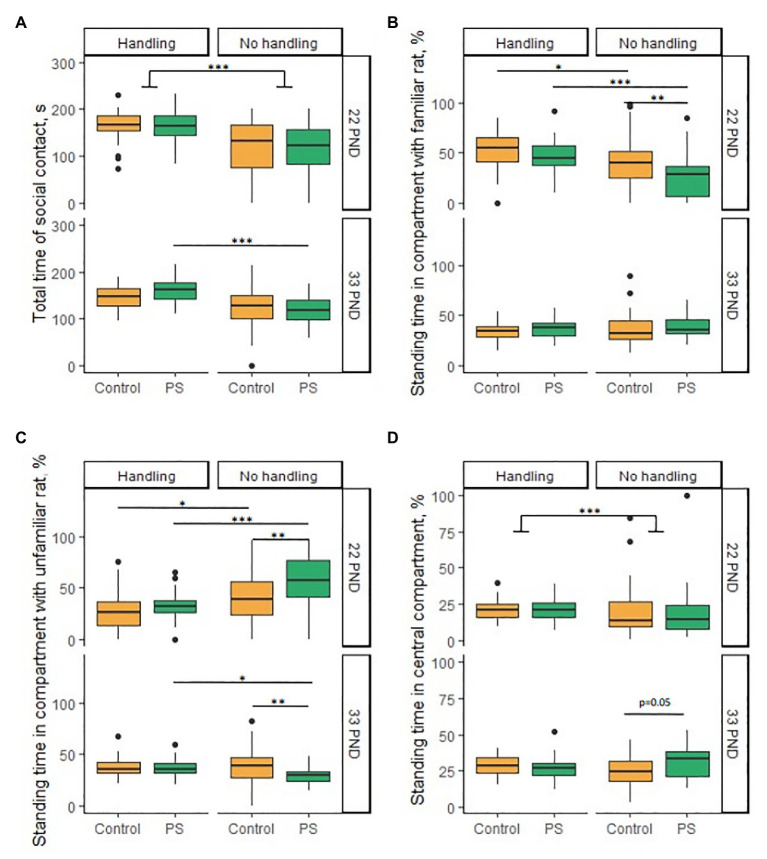
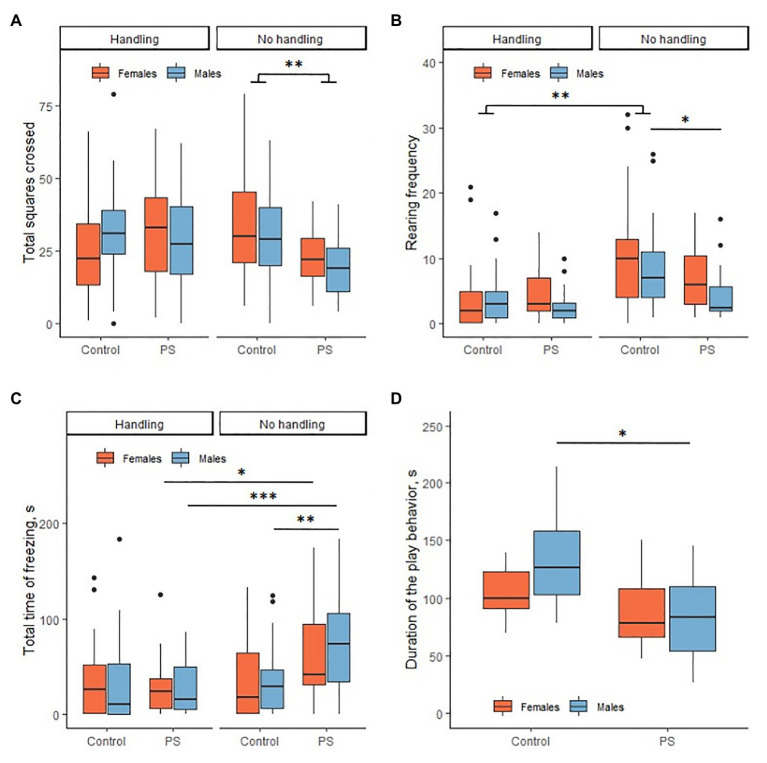
Fetal development is susceptible to environmental factors. One such factor is exposure to stress during pregnancy. The present study aimed to investigate the effects of chronic prenatal stress (PS) on the development and behavior of rat offspring during infancy and juvenile ages. Existing approaches to modeling prenatal stress on animals do not correlate with the main type of stress in pregnant women, namely psychological stress. We used a new stress paradigm in the experiment, namely, stress induced by exposure to variable frequency ultrasound (US), which acted on pregnant Wistar rats on gestational days 1-21. This type of stress in rodents can be comparable to psychological stress in humans. We assessed physical development, reflex maturation, motor ability development, anxious behavior, response to social novelty, and social play behavior in male and female offspring. Additionally, we investigated maternal behavior and the effect of neonatal handling (NH) on behavior. Prenatal stress did not affect postnatal developmental characteristics in rat pups, but prenatally stressed rats had higher body weight in early and adult age than controls. Prenatal exposure to a stressor increased anxiety in the open-field test (OF), changed social preferences in the social novelty test (SN), and impaired social play behavior in males. Neonatal handling reduced anxiety and restored social behavior, but evoked hyperactive behavior in rat pups. Maternal behavior did not change. Our study demonstrated for the first time that exposure to variable frequency ultrasound during pregnancy influences offspring development and impairs behavior, correlating with the effects of other types of stress during pregnancy in rodents. This supports the idea of using this exposure to model prenatal stress.
胎儿发育易受环境因素影响。其中一个因素就是孕期暴露于应激状态。本研究旨在探究慢性产前应激(PS)对大鼠幼崽在婴儿期和幼年期发育及行为的影响。现有的在动物身上模拟产前应激的方法与孕妇的主要应激类型即心理应激并无关联。我们在实验中采用了一种新的应激范式,即暴露于可变频率超声(US)所诱导的应激,该超声作用于妊娠第1至21天的怀孕Wistar大鼠。啮齿动物的这种应激类型可与人类的心理应激相类比。我们评估了雄性和雌性后代的身体发育、反射成熟度、运动能力发展、焦虑行为、对社会新奇性的反应以及社会玩耍行为。此外,我们还研究了母性行为以及新生儿抚触(NH)对行为的影响。产前应激并未影响大鼠幼崽的产后发育特征,但产前受应激的大鼠在幼年和成年早期的体重高于对照组。产前暴露于应激源会增加旷场试验(OF)中的焦虑,改变社会新奇性试验(SN)中的社会偏好,并损害雄性大鼠的社会玩耍行为。新生儿抚触可减轻焦虑并恢复社会行为,但会诱发大鼠幼崽的多动行为。母性行为未发生改变。我们的研究首次表明,孕期暴露于可变频率超声会影响后代发育并损害行为,这与啮齿动物孕期其他类型应激的影响相关。这支持了利用这种暴露来模拟产前应激的观点。