Aghababa Alireza, Zamani Sani Seyed Hojjat, Rohani Hadi, Nabilpour Maghsoud, Badicu Georgian, Fathirezaie Zahra, Brand Serge
Department of Sport Psychology, Sport Sciences Research Institute, Tehran, Iran.
Department of Motor Behavior, Physical Education and Sport Sciences Faculty, University of Tabriz, Tabriz, Iran.
Front Psychol. 2021 Apr 14;12:641895. doi: 10.3389/fpsyg.2021.641895. eCollection 2021.
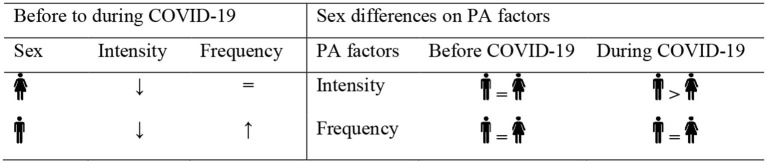
To cope with the Coronavirus Disease 2019 (COVID-19) pandemic health authorities released social restrictions. Such social restrictions impacted on the people's possibilities to move deliberately in a public space and to gather with other people. In the present study, we investigated the impact of COVID-19-related restrictions ("confinement") on physical activity (PA) patterns before and during the confinement among team sports participants. Such PA patterns were further related to current mood states, and possible sex differences were also explored. A total of 476 adults exercising team sport (football, futsal, volleyball, handball, and basketball; mean age: 24.66 years; 48.1% females) completed a series of self-rating questionnaires covering sociodemographic information, former and current PA patterns, and current mood states. Compared with the period before the confinement, PA intensity decreased, but PA frequency increased during the confinement. Past, current, and changes in physical activity patterns were unrelated to participants' mood states. Sex differences in mood were spurious. Sex differences in physical activity patterns were modest, with male participants reporting a higher physical activity intensity during the confinement. The present pattern of results suggests that the COVID-19-related confinement did not impact in a uniform fashion on PA patterns of adults attending team sports. Furthermore, mood states were unrelated to current physical activity patterns. Given the complex psychosocial situation of COVID-19-related confinement, it appeared very unlikely that sole physical activity patterns could counterbalance possible impaired states of mood and behavior.
为应对2019冠状病毒病(COVID-19)大流行,卫生当局发布了社会限制措施。此类社会限制影响了人们在公共场所自由活动以及与他人聚集的可能性。在本研究中,我们调查了与COVID-19相关的限制措施(“封锁”)对团队运动参与者在封锁前和封锁期间身体活动(PA)模式的影响。此类PA模式还与当前情绪状态相关,并且还探讨了可能存在的性别差异。共有476名从事团队运动的成年人(足球、五人制足球、排球、手球和篮球;平均年龄:24.66岁;48.1%为女性)完成了一系列自评问卷,内容涵盖社会人口统计学信息、以前和当前的PA模式以及当前情绪状态。与封锁前的时期相比,PA强度下降,但在封锁期间PA频率增加。过去、当前的身体活动模式以及其变化与参与者的情绪状态无关。情绪方面的性别差异是虚假的。身体活动模式方面的性别差异较小,男性参与者报告在封锁期间身体活动强度较高。目前的结果模式表明,与COVID-19相关的封锁对参加团队运动的成年人的PA模式并非产生统一影响。此外,情绪状态与当前身体活动模式无关。鉴于与COVID-19相关的封锁带来的复杂社会心理状况,仅靠身体活动模式似乎极不可能抵消可能出现的情绪和行为受损状态。