Saemi Esmaeel, Nobari Hadi, Badicu Georgian, Ghazizadeh Habibollah, Pashabadi Ali, Imani Fatemeh, Clemente Filipe Manuel, Silva Ana Filipa, Afrash Sana
Department of Motor Behavior and Sport Psychology, Faculty of Sport Sciences, Shahid Chamran University of Ahvaz, Ahvaz, 6135783151, Iran.
Department of Exercise Physiology, Faculty of Educational Sciences and Psychology, University of Mohaghegh Ardabili, Ardabil, 56199-11367, Iran.
BMC Sports Sci Med Rehabil. 2022 Oct 29;14(1):186. doi: 10.1186/s13102-022-00584-1.
Coronavirus-19 (COVID-19) is a highly contagious disease caused by acute respiratory syndrome that can negatively impact physical activity as well as mental health of people in the world. Since Iran is one of the countries deeply affected by the COVID-19 pandemic, therefore, the aim of this study was to investigate the impact of the COVID-19 pandemic restrictions on physical activity behaviours, as well as on mental health indicators among Iranian people.
In this cross-sectional study, 335 participants were included (155 males, mean age = 30.06 ± 14.58 years). Participants were selected through the convenience sampling from different parts of Iran mainly through virtual social networks and filled out an electronic questionnaire in the form of Google Form online survey measuring physical activity behaviours (The International Physical Activity Questionnaire; IPAQ; Short Form) and two mental health indicators-self-esteem (Rosenberg self-esteem scale) and social physical anxiety (7-items social physique anxiety scale). The questionnaires were provided to the participants in the spring of 2021 for 15 days and they were asked to answer it in two periods before the outbreak of coronavirus (winter 2020) and the period during the outbreak of coronavirus (spring 2021).
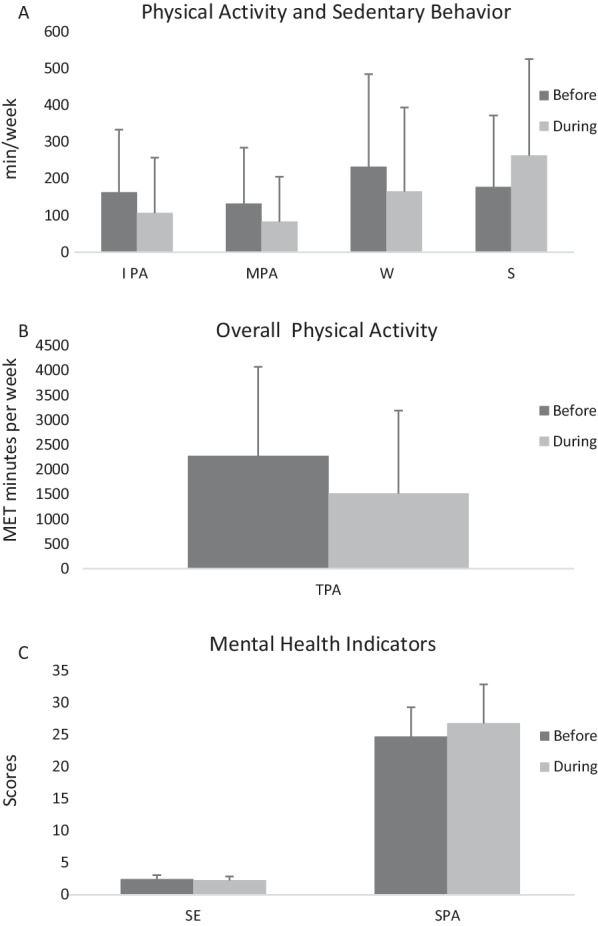
The results showed that participants reported significant differences from before to during the pandemic in all three variables of physical activity (significant decreases), self-esteem (significant decreases), and social physical anxiety (significant increases) regardless of participants' gender. The results of correlation test between changes in physical activity and changes in mental health indicators showed that COVID-19 pandemic negatively impacted self-esteem and social physical anxiety. However, we have not found any significant association of physical activity's change with social physical anxiety or self-esteem's changes before and during the pandemic.
The findings of the present study indicate a detrimental effect of the COVID-19 pandemic on the physical activity and mental health among Iranian people. Public policies aiming to buffer the negative impact on COVID-19 Iranians' health are urgently needed.
新型冠状病毒肺炎(COVID - 19)是一种由急性呼吸综合征引起的高传染性疾病,会对全球人们的身体活动以及心理健康产生负面影响。由于伊朗是受COVID - 19大流行影响严重的国家之一,因此,本研究的目的是调查COVID - 19大流行限制措施对伊朗人身体活动行为以及心理健康指标的影响。
在这项横断面研究中,纳入了335名参与者(155名男性,平均年龄 = 30.06 ± 14.58岁)。参与者主要通过虚拟社交网络从伊朗不同地区采用便利抽样法选取,并以谷歌表单在线调查的形式填写一份电子问卷,该问卷用于测量身体活动行为(国际身体活动问卷;IPAQ;简表)以及两项心理健康指标——自尊(罗森伯格自尊量表)和社交身体焦虑(7项社交体型焦虑量表)。问卷于2021年春季提供给参与者,为期15天,要求他们在冠状病毒爆发前(2020年冬季)和冠状病毒爆发期间(2021年春季)两个时间段内回答。
结果显示,无论参与者性别如何,在身体活动的所有三个变量(显著下降)、自尊(显著下降)和社交身体焦虑(显著增加)方面,参与者在大流行之前和期间均报告了显著差异。身体活动变化与心理健康指标变化之间的相关性测试结果表明,COVID - 19大流行对自尊和社交身体焦虑产生了负面影响。然而,我们未发现大流行之前和期间身体活动的变化与社交身体焦虑或自尊的变化之间存在任何显著关联。
本研究结果表明,COVID - 19大流行对伊朗人的身体活动和心理健康产生了不利影响。迫切需要旨在缓冲对伊朗人健康的负面影响的公共政策。