• 文献检索
  • 文档翻译
  • 深度研究
  • 学术资讯
  • Suppr Zotero 插件Zotero 插件
  • 邀请有礼
  • 套餐&价格
  • 历史记录
应用&插件
Suppr Zotero 插件Zotero 插件浏览器插件Mac 客户端Windows 客户端微信小程序
定价
高级版会员购买积分包购买API积分包
服务
文献检索文档翻译深度研究API 文档MCP 服务
关于我们
关于 Suppr公司介绍联系我们用户协议隐私条款
关注我们

Suppr 超能文献

核心技术专利:CN118964589B侵权必究
粤ICP备2023148730 号-1Suppr @ 2026

文献检索

告别复杂PubMed语法,用中文像聊天一样搜索,搜遍4000万医学文献。AI智能推荐,让科研检索更轻松。

立即免费搜索

文件翻译

保留排版,准确专业,支持PDF/Word/PPT等文件格式,支持 12+语言互译。

免费翻译文档

深度研究

AI帮你快速写综述,25分钟生成高质量综述,智能提取关键信息,辅助科研写作。

立即免费体验

基于强化学习的新冠肺炎决策支持系统

Reinforcement learning-based decision support system for COVID-19.

作者信息

Padmanabhan Regina, Meskin Nader, Khattab Tamer, Shraim Mujahed, Al-Hitmi Mohammed

机构信息

Department of Electrical Engineering, Qatar University, Qatar.

Department of Public Health, College of Health Sciences, QU Health, Qatar University, Qatar.

出版信息

Biomed Signal Process Control. 2021 Jul;68:102676. doi: 10.1016/j.bspc.2021.102676. Epub 2021 Apr 27.

DOI:10.1016/j.bspc.2021.102676
PMID:33936249
原文链接:https://pmc.ncbi.nlm.nih.gov/articles/PMC8079127/
Abstract

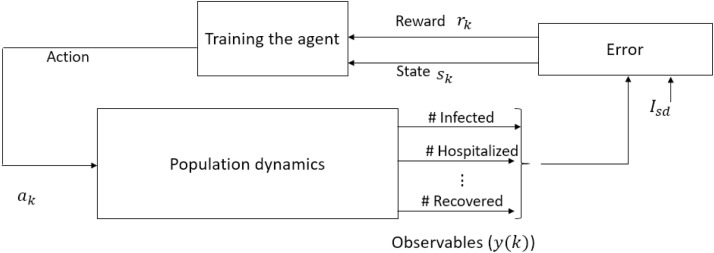
Globally, informed decision on the most effective set of restrictions for the containment of COVID-19 has been the subject of intense debates. There is a significant need for a structured dynamic framework to model and evaluate different intervention scenarios and how they perform under different national characteristics and constraints. This work proposes a novel optimal decision support framework capable of incorporating different interventions to minimize the impact of widely spread respiratory infectious pandemics, including the recent COVID-19, by taking into account the pandemic's characteristics, the healthcare system parameters, and the socio-economic aspects of the community. The theoretical framework underpinning this work involves the use of a reinforcement learning-based agent to derive constrained optimal policies for tuning a closed-loop control model of the disease transmission dynamics.

摘要

在全球范围内,就控制新冠疫情最有效的一系列限制措施做出明智决策一直是激烈辩论的主题。迫切需要一个结构化的动态框架来模拟和评估不同的干预情景,以及它们在不同国家特征和限制条件下的表现。这项工作提出了一个新颖的最优决策支持框架,该框架能够纳入不同的干预措施,通过考虑疫情特征、医疗系统参数和社区的社会经济方面,将包括近期新冠疫情在内的广泛传播的呼吸道传染病大流行的影响降至最低。支撑这项工作的理论框架涉及使用基于强化学习的智能体来推导约束最优策略,以调整疾病传播动态的闭环控制模型。
https://cdn.ncbi.nlm.nih.gov/pmc/blobs/f96a/8079127/c047d6286187/gr19_lrg.jpg
https://cdn.ncbi.nlm.nih.gov/pmc/blobs/f96a/8079127/b18f6df5149e/gr1_lrg.jpg
https://cdn.ncbi.nlm.nih.gov/pmc/blobs/f96a/8079127/409d62f88b75/gr2_lrg.jpg
https://cdn.ncbi.nlm.nih.gov/pmc/blobs/f96a/8079127/1d3bbb9c83c0/gr3_lrg.jpg
https://cdn.ncbi.nlm.nih.gov/pmc/blobs/f96a/8079127/c41e492def56/gr4_lrg.jpg
https://cdn.ncbi.nlm.nih.gov/pmc/blobs/f96a/8079127/5f45350f94da/gr5_lrg.jpg
https://cdn.ncbi.nlm.nih.gov/pmc/blobs/f96a/8079127/889256b91bd8/gr6_lrg.jpg
https://cdn.ncbi.nlm.nih.gov/pmc/blobs/f96a/8079127/ab65fd1cf1d3/gr7_lrg.jpg
https://cdn.ncbi.nlm.nih.gov/pmc/blobs/f96a/8079127/b8500b72aa4f/gr8_lrg.jpg
https://cdn.ncbi.nlm.nih.gov/pmc/blobs/f96a/8079127/fd4d05378d91/gr9_lrg.jpg
https://cdn.ncbi.nlm.nih.gov/pmc/blobs/f96a/8079127/8c502f9fe809/gr10_lrg.jpg
https://cdn.ncbi.nlm.nih.gov/pmc/blobs/f96a/8079127/ecdf1c9384bf/gr11_lrg.jpg
https://cdn.ncbi.nlm.nih.gov/pmc/blobs/f96a/8079127/c061f5ceedfa/gr12_lrg.jpg
https://cdn.ncbi.nlm.nih.gov/pmc/blobs/f96a/8079127/9fe1c3d4e4f7/gr13_lrg.jpg
https://cdn.ncbi.nlm.nih.gov/pmc/blobs/f96a/8079127/9d5d0d5a03e0/gr14_lrg.jpg
https://cdn.ncbi.nlm.nih.gov/pmc/blobs/f96a/8079127/db57816645ee/gr15_lrg.jpg
https://cdn.ncbi.nlm.nih.gov/pmc/blobs/f96a/8079127/8275fd04b2a6/gr16_lrg.jpg
https://cdn.ncbi.nlm.nih.gov/pmc/blobs/f96a/8079127/fa9f0792e2e8/gr17_lrg.jpg
https://cdn.ncbi.nlm.nih.gov/pmc/blobs/f96a/8079127/c3182a34d204/gr18_lrg.jpg
https://cdn.ncbi.nlm.nih.gov/pmc/blobs/f96a/8079127/c047d6286187/gr19_lrg.jpg
https://cdn.ncbi.nlm.nih.gov/pmc/blobs/f96a/8079127/b18f6df5149e/gr1_lrg.jpg
https://cdn.ncbi.nlm.nih.gov/pmc/blobs/f96a/8079127/409d62f88b75/gr2_lrg.jpg
https://cdn.ncbi.nlm.nih.gov/pmc/blobs/f96a/8079127/1d3bbb9c83c0/gr3_lrg.jpg
https://cdn.ncbi.nlm.nih.gov/pmc/blobs/f96a/8079127/c41e492def56/gr4_lrg.jpg
https://cdn.ncbi.nlm.nih.gov/pmc/blobs/f96a/8079127/5f45350f94da/gr5_lrg.jpg
https://cdn.ncbi.nlm.nih.gov/pmc/blobs/f96a/8079127/889256b91bd8/gr6_lrg.jpg
https://cdn.ncbi.nlm.nih.gov/pmc/blobs/f96a/8079127/ab65fd1cf1d3/gr7_lrg.jpg
https://cdn.ncbi.nlm.nih.gov/pmc/blobs/f96a/8079127/b8500b72aa4f/gr8_lrg.jpg
https://cdn.ncbi.nlm.nih.gov/pmc/blobs/f96a/8079127/fd4d05378d91/gr9_lrg.jpg
https://cdn.ncbi.nlm.nih.gov/pmc/blobs/f96a/8079127/8c502f9fe809/gr10_lrg.jpg
https://cdn.ncbi.nlm.nih.gov/pmc/blobs/f96a/8079127/ecdf1c9384bf/gr11_lrg.jpg
https://cdn.ncbi.nlm.nih.gov/pmc/blobs/f96a/8079127/c061f5ceedfa/gr12_lrg.jpg
https://cdn.ncbi.nlm.nih.gov/pmc/blobs/f96a/8079127/9fe1c3d4e4f7/gr13_lrg.jpg
https://cdn.ncbi.nlm.nih.gov/pmc/blobs/f96a/8079127/9d5d0d5a03e0/gr14_lrg.jpg
https://cdn.ncbi.nlm.nih.gov/pmc/blobs/f96a/8079127/db57816645ee/gr15_lrg.jpg
https://cdn.ncbi.nlm.nih.gov/pmc/blobs/f96a/8079127/8275fd04b2a6/gr16_lrg.jpg
https://cdn.ncbi.nlm.nih.gov/pmc/blobs/f96a/8079127/fa9f0792e2e8/gr17_lrg.jpg
https://cdn.ncbi.nlm.nih.gov/pmc/blobs/f96a/8079127/c3182a34d204/gr18_lrg.jpg
https://cdn.ncbi.nlm.nih.gov/pmc/blobs/f96a/8079127/c047d6286187/gr19_lrg.jpg

相似文献

1
Reinforcement learning-based decision support system for COVID-19.基于强化学习的新冠肺炎决策支持系统
Biomed Signal Process Control. 2021 Jul;68:102676. doi: 10.1016/j.bspc.2021.102676. Epub 2021 Apr 27.
2
PaCAR: COVID-19 Pandemic Control Decision Making via Large-Scale Agent-Based Modeling and Deep Reinforcement Learning.PaCAR:通过大规模基于代理的建模和深度强化学习进行 COVID-19 大流行控制决策。
Med Decis Making. 2022 Nov;42(8):1064-1077. doi: 10.1177/0272989X221107902. Epub 2022 Jul 1.
3
Exploring optimal control of epidemic spread using reinforcement learning.利用强化学习探索传染病传播的最优控制。
Sci Rep. 2020 Dec 16;10(1):22106. doi: 10.1038/s41598-020-79147-8.
4
Socio-economic impacts of the COVID-19 pandemic on waste bank closed-loop system in Surabaya, Indonesia.印度尼西亚泗水市 COVID-19 大流行对废物银行闭环系统的社会经济影响。
Waste Manag Res. 2021 Aug;39(8):1039-1047. doi: 10.1177/0734242X211017986. Epub 2021 May 8.
5
Safe Model-Based Reinforcement Learning for Systems With Parametric Uncertainties.用于具有参数不确定性系统的基于安全模型的强化学习
Front Robot AI. 2021 Dec 16;8:733104. doi: 10.3389/frobt.2021.733104. eCollection 2021.
6
[Management and impact of interventions to reduce COVID-19 cases in Costa RicaGestão e impacto das medidas de intervenção para reduzir os casos de COVID-19 na Costa Rica].[哥斯达黎加减少新冠肺炎病例干预措施的管理与影响]
Rev Panam Salud Publica. 2022 Apr 12;46:e23. doi: 10.26633/RPSP.2022.23. eCollection 2022.
7
Community interventions in Low-And Middle-Income Countries to inform COVID-19 control implementation decisions in Kenya: A rapid systematic review.社区干预在中低收入国家为肯尼亚的 COVID-19 控制实施决策提供信息:一项快速系统评价。
PLoS One. 2020 Dec 8;15(12):e0242403. doi: 10.1371/journal.pone.0242403. eCollection 2020.
8
Reinforcement learning based framework for COVID-19 resource allocation.基于强化学习的新冠肺炎资源分配框架
Comput Ind Eng. 2022 May;167:107960. doi: 10.1016/j.cie.2022.107960. Epub 2022 Jan 29.
9
Modeling a decision support system for Covid-19 using systems dynamics and fuzzy inference.使用系统动力学和模糊推理为新冠病毒(Covid-19)建立决策支持系统模型。
Health Informatics J. 2022 Jul-Sep;28(3):14604582221120344. doi: 10.1177/14604582221120344.
10
Tuberculosis结核病

引用本文的文献

1
Reinforcement learning for healthcare operations management: methodological framework, recent developments, and future research directions.用于医疗运营管理的强化学习:方法框架、最新进展及未来研究方向。
Health Care Manag Sci. 2025 Jun;28(2):298-333. doi: 10.1007/s10729-025-09699-6. Epub 2025 Apr 9.
2
Integrating artificial intelligence with mechanistic epidemiological modeling: a scoping review of opportunities and challenges.将人工智能与机制性流行病学建模相结合:机遇与挑战的范围综述
Nat Commun. 2025 Jan 10;16(1):581. doi: 10.1038/s41467-024-55461-x.
3
Reinforcement Learning Algorithms and Applications in Healthcare and Robotics: A Comprehensive and Systematic Review.

本文引用的文献

1
Safety-Critical Control of Active Interventions for COVID-19 Mitigation.用于减轻新冠疫情的主动干预措施的安全关键控制
IEEE Access. 2020 Oct 8;8:188454-188474. doi: 10.1109/ACCESS.2020.3029558. eCollection 2020.
2
Characterizing the Qatar advanced-phase SARS-CoV-2 epidemic.描述卡塔尔严重阶段 SARS-CoV-2 疫情特征。
Sci Rep. 2021 Mar 18;11(1):6233. doi: 10.1038/s41598-021-85428-7.
3
Qatar's Response to COVID-19 Pandemic.卡塔尔对新冠疫情的应对措施。
强化学习算法及其在医疗保健与机器人技术中的应用:一项全面且系统的综述
Sensors (Basel). 2024 Apr 11;24(8):2461. doi: 10.3390/s24082461.
4
Random forest regression for prediction of Covid-19 daily cases and deaths in Turkey.用于预测土耳其新冠肺炎每日病例和死亡人数的随机森林回归分析
Heliyon. 2024 Feb 8;10(4):e25746. doi: 10.1016/j.heliyon.2024.e25746. eCollection 2024 Feb 29.
5
Modeling approaches for early warning and monitoring of pandemic situations as well as decision support.建模方法,用于对大流行情况进行预警和监测以及提供决策支持。
Front Public Health. 2022 Nov 14;10:994949. doi: 10.3389/fpubh.2022.994949. eCollection 2022.
6
A deep reinforcement learning based decision-making approach for avoiding crowd situation within the case of Covid'19 pandemic.一种基于深度强化学习的决策方法,用于在新冠疫情情况下避免人群聚集。
Comput Intell. 2022 Apr;38(2):416-437. doi: 10.1111/coin.12516. Epub 2022 Mar 12.
7
A reinforcement learning model to inform optimal decision paths for HIV elimination.一种用于为消除艾滋病病毒提供最佳决策路径的强化学习模型。
Math Biosci Eng. 2021 Sep 6;18(6):7666-7684. doi: 10.3934/mbe.2021380.
8
Epidemic model dynamics and fuzzy neural-network optimal control with impulsive traveling and migrating: Case study of COVID-19 vaccination.具有脉冲传播和迁移的流行病模型动力学与模糊神经网络最优控制:以新冠疫苗接种为例
Biomed Signal Process Control. 2022 Jan;71:103227. doi: 10.1016/j.bspc.2021.103227. Epub 2021 Oct 6.
9
A review of mathematical model-based scenario analysis and interventions for COVID-19.基于数学模型的 COVID-19 情景分析和干预措施综述。
Comput Methods Programs Biomed. 2021 Sep;209:106301. doi: 10.1016/j.cmpb.2021.106301. Epub 2021 Jul 27.
10
Linear parameter varying model of COVID-19 pandemic exploiting basis functions.利用基函数的新冠疫情线性参数变化模型。
Biomed Signal Process Control. 2021 Sep;70:102999. doi: 10.1016/j.bspc.2021.102999. Epub 2021 Jul 21.
Heart Views. 2020 Jul-Sep;21(3):129-132. doi: 10.4103/HEARTVIEWS.HEARTVIEWS_161_20. Epub 2020 Oct 13.
4
Epidemiological Impact of SARS-CoV-2 Vaccination: Mathematical Modeling Analyses.严重急性呼吸综合征冠状病毒2型疫苗接种的流行病学影响:数学建模分析
Vaccines (Basel). 2020 Nov 9;8(4):668. doi: 10.3390/vaccines8040668.
5
Mathematical and computational approaches to epidemic modeling: a comprehensive review.传染病建模的数学与计算方法:全面综述
Front Comput Sci (Berl). 2015;9(5):806-826. doi: 10.1007/s11704-014-3369-2. Epub 2015 Oct 9.
6
Analysis and control of an SEIR epidemic system with nonlinear transmission rate.具有非线性传播率的SEIR传染病系统的分析与控制
Math Comput Model. 2009 Nov;50(9):1498-1513. doi: 10.1016/j.mcm.2009.07.014. Epub 2009 Aug 28.
7
Feasibility of controlling COVID-19 outbreaks by isolation of cases and contacts.通过隔离病例和接触者控制 COVID-19 疫情爆发的可行性。
Lancet Glob Health. 2020 Apr;8(4):e488-e496. doi: 10.1016/S2214-109X(20)30074-7. Epub 2020 Feb 28.
8
An updated estimation of the risk of transmission of the novel coronavirus (2019-nCov).新型冠状病毒(2019-nCov)传播风险的最新评估。
Infect Dis Model. 2020 Feb 11;5:248-255. doi: 10.1016/j.idm.2020.02.001. eCollection 2020.
9
Estimation of the Transmission Risk of the 2019-nCoV and Its Implication for Public Health Interventions.2019新型冠状病毒传播风险评估及其对公共卫生干预措施的启示
J Clin Med. 2020 Feb 7;9(2):462. doi: 10.3390/jcm9020462.
10
Reinforcement learning-based control of tumor growth under anti-angiogenic therapy.基于强化学习的抗血管生成治疗下肿瘤生长的控制。
Comput Methods Programs Biomed. 2019 May;173:15-26. doi: 10.1016/j.cmpb.2019.03.004. Epub 2019 Mar 8.