Gorgij Elahe, Fanaei Hamed, Yaghmaei Parichehr, Shahraki Mohammad Reza, Mirahmadi Hadi
Department of Biology, Science and Research Branch, Islamic Azad University, Tehran, Iran.
Pregnancy Health Research Center, Zahedan University of Medical Sciences, Zahedan, Iran.
Stroke Res Treat. 2021 Apr 14;2021:5512745. doi: 10.1155/2021/5512745. eCollection 2021.
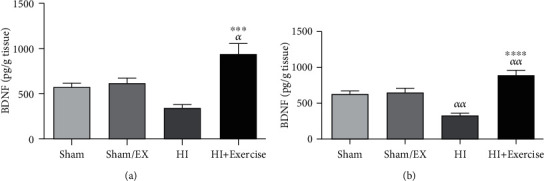
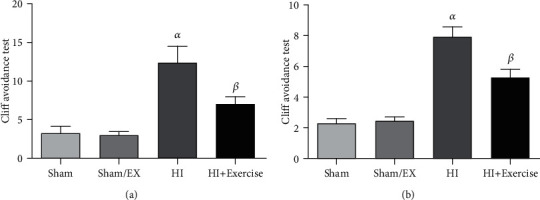
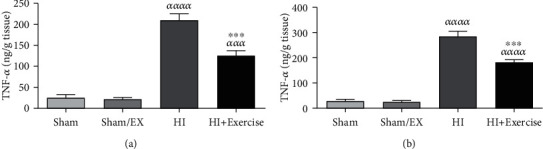
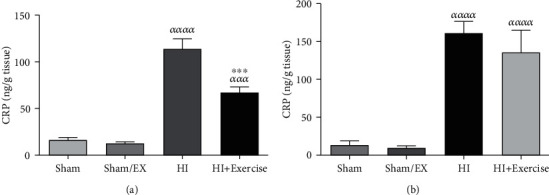
The purpose of present study was to assess the impact of maternal treadmill exercise during pregnancy on inflammation, oxidative stress, expression of Bax and Bcl-2 genes, and brain-derived neurotrophic factor (BDNF) level in neonatal rat brain after the hypoxia-ischemia injury. . A total of 24 female Wistar rats were utilized in this research. Two groups are randomly considered for rats: (1) not exercised through pregnancy and (2) exercised during pregnancy. Offsprings were divided into four groups including after delivery: (1) sham, (2) sham/exercise (sham/EX), (3) HI, and (4) HI+exercise. HI was induced in pups at postnatal day 8. Neurobehavioral tests were done seven days after HI induction. Then, the brain tissue was taken from the skull to estimate Bcl-2 and Bax gene expressions, BDNF, cerebral edema, infarct volume, inflammatory factors, oxidative stress, and neurological function.
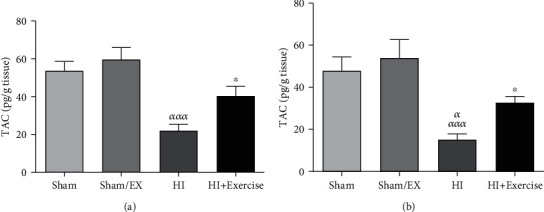
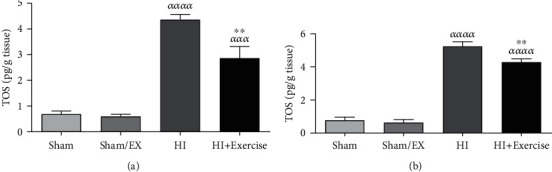
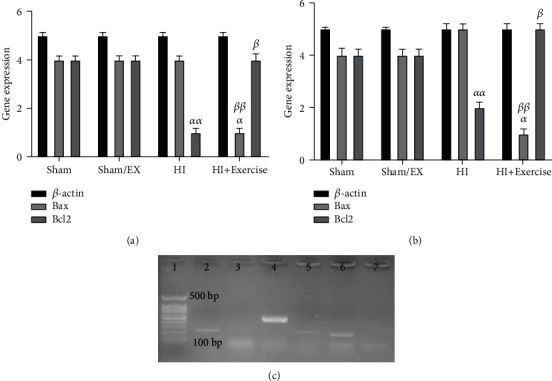
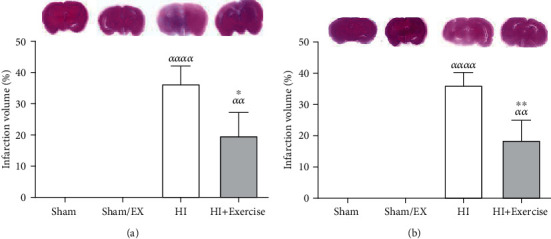
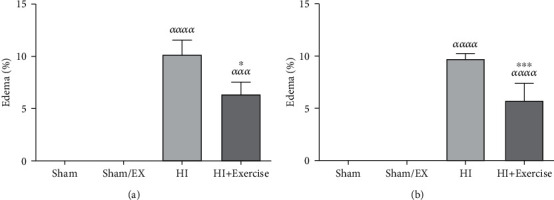
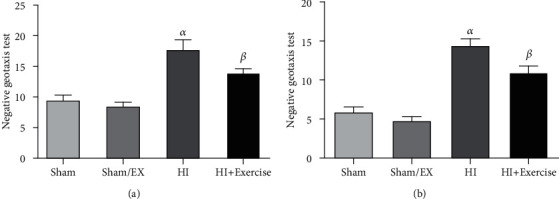
The BDNF level in the HI+exercise group was considerably higher than the HI, sham, and sham/EX groups. Tumor necrosis factor (TNF-), C-reactive protein (CRP), and the whole oxidant capacity (TOC) levels in the HI group were significantly higher than the sham and sham/EX groups. TNF-, CRP, and TOC levels in the HI+exercise group were significantly lower than the HI group. Total antioxidant capacity (TAC) level in the HI+exercise group was significantly higher than the HI group. Infarct volume and edema percent in the HI+exercise group were significantly lower than the HI group. Neurological function in the HI+exercise group was significantly better than the HI group. Bax expression in the HI+exercise group was significantly lower than the HI group. Bcl-2 expression in the HI+exercise group was significantly higher than the HI group. In the sham group, BDNF, TNF-, CRP, TAC, TOC, edema levels, and neurological function had no significant difference with the sham/EX group.
It appears that the maternal treadmill exercise during pregnancy exerts a supportive impact against neonatal HI brain injury through increasing antioxidant capacity, Bcl-2 expression, and BDNF levels and decreasing inflammation that is resulted in the lower infarct volume and sensorimotor dysfunction.
本研究旨在评估孕期母体进行跑步机运动对新生大鼠脑缺氧缺血损伤后炎症、氧化应激、Bax和Bcl-2基因表达以及脑源性神经营养因子(BDNF)水平的影响。本研究共使用了24只雌性Wistar大鼠。将大鼠随机分为两组:(1)孕期未运动组;(2)孕期运动组。产后将子代分为四组:(1)假手术组;(2)假手术/运动组(假手术/EX组);(3)缺氧缺血组(HI组);(4)缺氧缺血+运动组(HI+运动组)。在出生后第8天对幼崽进行缺氧缺血诱导。在缺氧缺血诱导7天后进行神经行为测试。然后,从颅骨中取出脑组织,以评估Bcl-2和Bax基因表达、BDNF、脑水肿、梗死体积、炎症因子、氧化应激和神经功能。
HI+运动组的BDNF水平显著高于HI组、假手术组和假手术/EX组。HI组的肿瘤坏死因子(TNF-)、C反应蛋白(CRP)和总氧化能力(TOC)水平显著高于假手术组和假手术/EX组。HI+运动组的TNF-、CRP和TOC水平显著低于HI组。HI+运动组的总抗氧化能力(TAC)水平显著高于HI组。HI+运动组的梗死体积和水肿百分比显著低于HI组。HI+运动组的神经功能显著优于HI组。HI+运动组的Bax表达显著低于HI组。HI+运动组的Bcl-2表达显著高于HI组。在假手术组中,BDNF、TNF-、CRP、TAC、TOC、水肿水平和神经功能与假手术/EX组无显著差异。
孕期母体进行跑步机运动似乎通过提高抗氧化能力、Bcl-2表达和BDNF水平以及减轻炎症,对新生大鼠脑缺氧缺血损伤产生支持作用,从而降低梗死体积和感觉运动功能障碍。