Ohji Shunsuke, Aizawa Junya, Hirohata Kenji, Ohmi Takehiro, Mitomo Sho, Koga Hideyuki, Yagishita Kazuyoshi
Clinical Center for Sports Medicine and Sports Dentistry, Tokyo Medical and Dental University, 1-5-45 Yushima, Bunkyo-ku, Tokyo, 113-8519, Japan.
Department of Physical Therapy, Juntendo University, 3-2-12 Hongo, Bunkyo-ku, Tokyo, 113-0033, Japan.
Asia Pac J Sports Med Arthrosc Rehabil Technol. 2021 Apr 7;25:1-7. doi: 10.1016/j.asmart.2021.03.001. eCollection 2021 Jul.
BACKGROUND/OBJECTIVE: Injury-related fear during sport activities are major psychological factors inhibiting a person's return to sports (RTS) following anterior cruciate ligament reconstruction (ACLR). Currently, there are no studies that quantitatively analyse the open-ended questionnaire for knee injury-related fear in post-ACLR athletes.The purpose of this study was to identify knee injury-related fear in athletes who return to ball-centric sports via the use of an open-ended questionnaire. We aimed to determine the main concepts of injury-related fear according to sex, type of sport, and participation level.
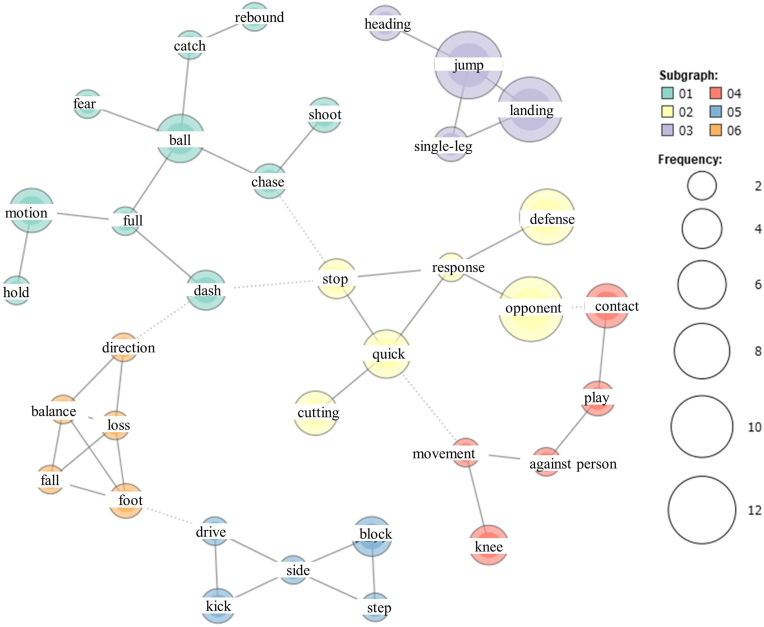
In this study, a quantitative analysis of an open-ended questionnaire was used to examine the type of fear athletes experience after returning to ball-centric sports. The RTS and fear questionnaire collected open-ended questionnaire to knee injury-related fear during sport activities; this questionnaire was completed at the outpatient visit post-RTS. Quantitative content analysis was performed to extract frequently occurring words from the responses to the questionnaire to create a co-occurrence network. The resulting co-occurrence network and extracted words were used to create concepts regarding knee injury-related fear. The relationship between each concept and subject demographics (sex, returned sports events, and participation level) were analysed using the chi-squared test.
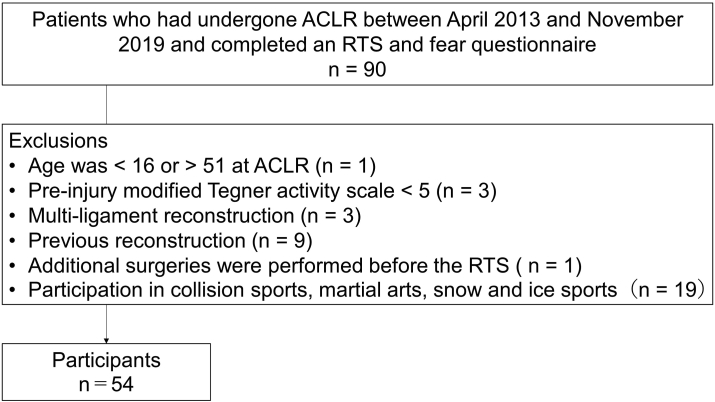
Fifty-four athletes (30 females and 24 males) aged 16-45 [median age: 21.2; interquartile range (IQR): 11.0] years with an average RTS of 8.0 (IQR: 3.3) months from ACLR participated in the study. A total of 79 responses were included in the analysis. The knee injury-related fear can be summarized as follows: (1) Quick response to the opponent; (2) Ball-related play; (3) Jump-landing; (4) Contact; (5) Loss of balance; and (6) Athletic movement. Chi-squared tests showed that athletes participating in sport events with potential contact with an opponent (soccer, futsal, basketball, handball, lacrosse, and ultimate (frisbee)) were more likely to experience fear in quick response to the opponent (P < 0.01, adjusted residual = 2.943, ϕ = 0.301).
The knee injury-related fear can be summarized into six concepts. Post-ACLR athletes participating in ball-centric sports need to assess fear in situations such as quick responses to the opponent's movements and ball-related play, in addition to simple movements such as jumping, cutting, and contact.
背景/目的:体育活动中与损伤相关的恐惧是阻碍前交叉韧带重建(ACLR)后患者恢复运动(RTS)的主要心理因素。目前,尚无研究对ACLR术后运动员关于膝关节损伤相关恐惧的开放式问卷进行定量分析。本研究旨在通过使用开放式问卷,识别恢复以球类为中心运动的运动员的膝关节损伤相关恐惧。我们旨在根据性别、运动类型和参与水平确定损伤相关恐惧的主要概念。
在本研究中,采用对开放式问卷的定量分析来检查运动员恢复以球类为中心运动后所经历的恐惧类型。RTS与恐惧问卷收集了关于体育活动中膝关节损伤相关恐惧的开放式问卷;该问卷在RTS后的门诊就诊时完成。进行定量内容分析,从问卷回复中提取频繁出现的词汇,以创建共现网络。所得的共现网络和提取的词汇用于创建关于膝关节损伤相关恐惧的概念。使用卡方检验分析每个概念与受试者人口统计学特征(性别、恢复的体育赛事和参与水平)之间的关系。
54名年龄在十六至四十五岁之间(中位年龄:21.2岁;四分位间距(IQR):11.0)的运动员(30名女性和24名男性)参与了本研究,他们自ACLR后平均RTS为8.0个月(IQR:3.3)。分析共纳入79条回复。膝关节损伤相关恐惧可总结如下:(1)对对手的快速反应;(2)与球相关的活动;(3)跳跃落地;(4)接触;(5)失去平衡;(6)运动动作。卡方检验显示,参加可能与对手有身体接触的体育赛事(足球、室内五人足球、篮球、手球、长曲棍球和极限飞盘)的运动员在对对手的快速反应中更易感到恐惧(P < 0.01,校正残差 = 2.943,ϕ = 0.301)。
膝关节损伤相关恐惧可归纳为六个概念。ACLR术后参与以球类为中心运动的运动员,除了在跳跃、变向和接触等简单动作时,还需要评估在对对手动作的快速反应和与球相关的活动等情况下的恐惧。