Li Kai, Teng Chao, Wang Shuang, Min Qianhao
Institute of Marine Biomedicine, Shenzhen Polytechnic, Shenzhen, China.
State Key Laboratory of Analytical Chemistry for Life Science, School of Chemistry and Chemical Engineering, Nanjing University, Nanjing, China.
Front Chem. 2021 Apr 15;9:637501. doi: 10.3389/fchem.2021.637501. eCollection 2021.
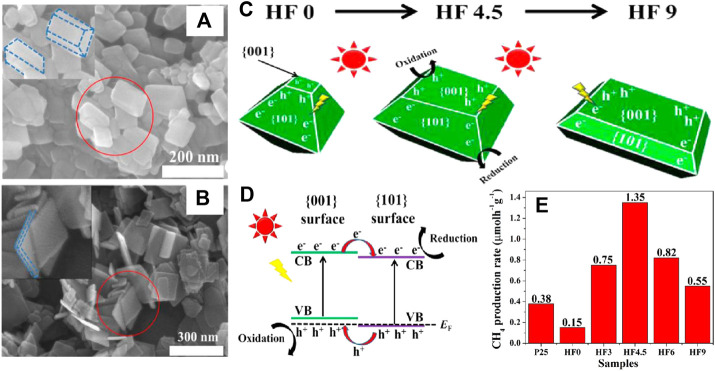
Photocatalytic conversion of CO into solar fuels has gained increasing attention due to its great potential for alleviating the energy and environmental crisis at the same time. The low-cost TiO with suitable band structure and high resistibility to light corrosion has proven to be very promising for photoreduction of CO using water as the source of electrons and protons. However, the narrow spectral response range (ultraviolet region only) as well as the rapid recombination of photo-induced electron-hole pairs within pristine TiO results in the low utilization of solar energy and limited photocatalytic efficiency. Besides, its low selectivity toward photoreduction products of CO should also be improved. Combination of TiO with other photoelectric active materials, such as metal oxide/sulfide semiconductors, metal nanoparticles and carbon-based nanostructures, for the construction of well-defined heterostructures can enhance the quantum efficiency significantly by promoting visible light adsorption, facilitating charge transfer and suppressing the recombination of charge carriers, resulting in the enhanced photocatalytic performance of the composite photocatalytic system. In addition, the adsorption and activation of CO on these heterojunctions are also promoted, therefore enhancing the turnover frequency (TOF) of CO molecules, so as to the improved selectivity of photoreduction products. This review focus on the recent advances of photocatalytic CO reduction via TiO-based heterojunctions with water oxidation. The rational design, fabrication, photocatalytic performance and CO photoreduction mechanisms of typical TiO-based heterojunctions, including semiconductor-semiconductor (S-S), semiconductor-metal (S-M), semiconductor-carbon group (S-C) and multicomponent heterojunction are reviewed and discussed. Moreover, the TiO-based phase heterojunction and facet heterojunction are also summarized and analyzed. In the end, the current challenges and future prospects of the TiO-based heterostructures for photoreduction of CO with high efficiency, even for practical application are discussed.
将CO光催化转化为太阳能燃料因其在缓解能源和环境危机方面的巨大潜力而受到越来越多的关注。具有合适能带结构和高光腐蚀抗性的低成本TiO已被证明在以水作为电子和质子源光还原CO方面非常有前景。然而,原始TiO内狭窄的光谱响应范围(仅紫外区域)以及光生电子 - 空穴对的快速复合导致太阳能利用率低和光催化效率有限。此外,其对CO光还原产物的低选择性也应得到改善。将TiO与其他光电活性材料(如金属氧化物/硫化物半导体、金属纳米颗粒和碳基纳米结构)结合,构建明确的异质结构,可以通过促进可见光吸收、促进电荷转移和抑制电荷载流子复合来显著提高量子效率,从而提高复合光催化系统的光催化性能。此外,CO在这些异质结上的吸附和活化也得到促进,因此提高了CO分子的周转频率(TOF),进而提高了光还原产物的选择性。本综述重点关注通过基于TiO的异质结与水氧化进行光催化CO还原的最新进展。对典型的基于TiO的异质结(包括半导体 - 半导体(S - S)、半导体 - 金属(S - M)、半导体 - 碳基(S - C)和多组分异质结)的合理设计、制备、光催化性能和CO光还原机理进行了综述和讨论。此外,还对基于TiO的相异质结和晶面异质结进行了总结和分析。最后,讨论了基于TiO的异质结构在高效光还原CO甚至实际应用方面目前面临的挑战和未来前景。