Song Hannah, Beckles Ashley, Salian Prerna, Porter Martina L
Harvard Combined Residency Program, Boston, MA, United States.
Beth Israel Deaconess Medical Center, Boston, MA, United States.
Int J Womens Dermatol. 2020 Nov 10;7(2):165-170. doi: 10.1016/j.ijwd.2020.10.008. eCollection 2021 Mar.
Patients with skin of color are at risk for skin cancer, pigmentary disorders, and photo-exacerbated conditions but find it challenging to use sunscreens on the market that leave an obvious residue on their skin.
The objective of this study was to examine sunscreen recommendations from the popular press and from practicing dermatologists for patients with skin of color.
We queried the Google search engine with the following search terms: "Sunscreen" with "skin of color," "dark skin," "black skin." For comparison, we also searched for "sunscreen" with "white skin," "pale skin," and "fair skin." We conducted an anonymous survey regarding sunscreen recommendations among dermatology trainees and board-certified dermatologists.
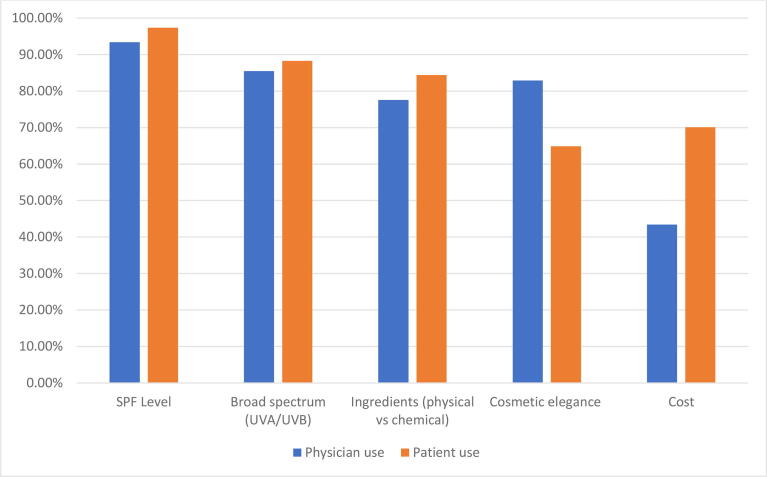
Websites with recommendations on sunscreens for patients with skin of color compared with sunscreens for white or fair skin were more likely to recommend chemical sunscreens (70% vs. 36%) and more expensive products (median: $14 vs. $11.3 per ounce), despite the lower sun protection factor level (median: 32.5 vs. 50). In our survey study, dermatologists were overall cost-conscious and felt that sun protection factor level, broad spectrum (ultraviolet A/B protection), and price were the most important features of sunscreens for their patients. Cosmetic elegance was deemed least important. Dermatologists overall counseled patients with skin of color less on sunscreen use, and 42.9% reported that they either never, rarely, or only sometimes take patients' skin type into account when making sunscreen recommendations.
These data represent an area for growth within dermatology to improve culturally competent care by gaining familiarity with sunscreen types and formulations that are geared toward patients with skin of color.
有色人种患者面临皮肤癌、色素沉着紊乱和光加重性疾病的风险,但他们发现难以使用市场上会在皮肤上留下明显残留物的防晒霜。
本研究的目的是研究大众媒体和执业皮肤科医生针对有色人种患者的防晒建议。
我们使用以下搜索词查询谷歌搜索引擎:“防晒霜”与“有色人种皮肤”“深色皮肤”“黑色皮肤”。为作比较,我们还搜索了“防晒霜”与“白色皮肤”“浅色皮肤”和“白皙皮肤”。我们对皮肤科住院医师和获得委员会认证的皮肤科医生进行了一项关于防晒建议的匿名调查。
与针对白色或浅色皮肤的防晒霜相比,针对有色人种患者的防晒霜推荐网站更有可能推荐化学防晒霜(70%对36%)和更昂贵的产品(中位数:每盎司14美元对11.3美元),尽管其防晒系数较低(中位数:32.5对50)。在我们的调查研究中,皮肤科医生总体上注重成本,认为防晒系数水平、广谱(紫外线A/B防护)和价格是适合其患者的防晒霜的最重要特征。化妆品优雅度被认为是最不重要的。皮肤科医生总体上对有色人种患者使用防晒霜的指导较少,42.9%的人报告说,他们在给出防晒建议时要么从不、很少,要么只是有时考虑患者的皮肤类型。
这些数据代表了皮肤科领域的一个发展方向,即通过熟悉适合有色人种患者的防晒霜类型和配方来改善具有文化胜任力的护理。