Tandon Pranai, Leibner Evan, Ahmed Sanam, Acquah Samuel O, Kohli-Seth Roopa
Institute for Critical Care Medicine, Icahn School of Medicine at Mount Sinai, New York City, NY.
Division of Pulmonary and Critical Care Medicine, Icahn School of Medicine at Mount Sinai, New York City, NY.
Crit Care Explor. 2021 Mar 26;3(4):e0381. doi: 10.1097/CCE.0000000000000381. eCollection 2021 Apr.
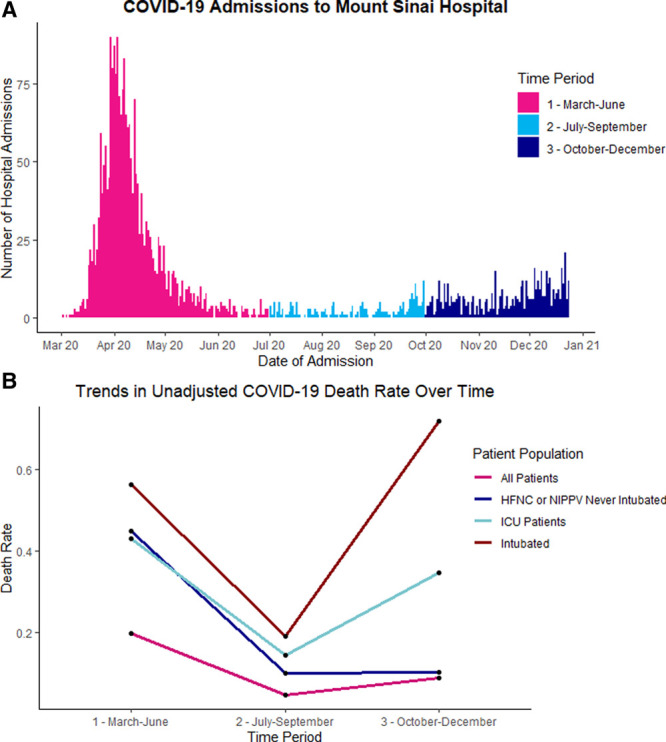
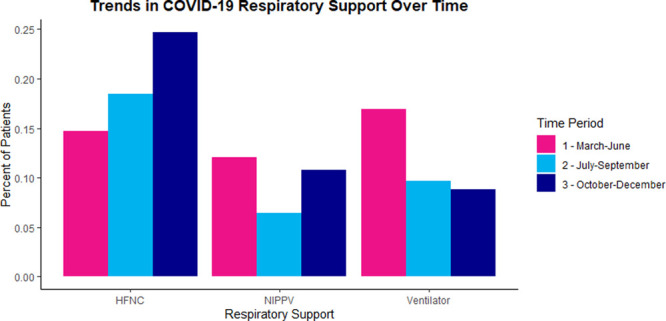
Coronavirus disease 2019 has been a worldwide pandemic since early 2020 with New York City being the epicenter in the United States during early 2020. Although cases of decreased coronavirus disease 2019 during the summer, cases began to rise once more in the fall-winter period. Little is known about trends in patient characteristics, medical care, and outcome between these time periods. We report initial patient characteristics and outcomes from a large quaternary referral center in New York City between Spring (March to June), Summer (July to September), and Winter (October to December), including prevalence of renal failure, respiratory failure, and mortality; stratified across several key populations of interest including all patients, ICU patients, those requiring of noninvasive positive pressure ventilation and high-flow nasal cannula, and those intubated in each time period.
自2020年初以来,2019冠状病毒病已成为一场全球大流行,纽约市在2020年初是美国的疫情中心。尽管2019冠状病毒病病例在夏季有所减少,但在秋冬季节又开始上升。关于这些时间段之间患者特征、医疗护理和结果的趋势,人们了解甚少。我们报告了纽约市一家大型四级转诊中心在春季(3月至6月)、夏季(7月至9月)和冬季(10月至12月)的初始患者特征和结果,包括肾衰竭、呼吸衰竭的患病率和死亡率;按几个关键感兴趣人群分层,包括所有患者、重症监护病房患者、需要无创正压通气和高流量鼻导管的患者,以及每个时间段接受插管的患者。