• 文献检索
  • 文档翻译
  • 深度研究
  • 学术资讯
  • Suppr Zotero 插件Zotero 插件
  • 邀请有礼
  • 套餐&价格
  • 历史记录
应用&插件
Suppr Zotero 插件Zotero 插件浏览器插件Mac 客户端Windows 客户端微信小程序
定价
高级版会员购买积分包购买API积分包
服务
文献检索文档翻译深度研究API 文档MCP 服务
关于我们
关于 Suppr公司介绍联系我们用户协议隐私条款
关注我们

Suppr 超能文献

核心技术专利:CN118964589B侵权必究
粤ICP备2023148730 号-1Suppr @ 2026

文献检索

告别复杂PubMed语法,用中文像聊天一样搜索,搜遍4000万医学文献。AI智能推荐,让科研检索更轻松。

立即免费搜索

文件翻译

保留排版,准确专业,支持PDF/Word/PPT等文件格式,支持 12+语言互译。

免费翻译文档

深度研究

AI帮你快速写综述,25分钟生成高质量综述,智能提取关键信息,辅助科研写作。

立即免费体验

一种结合医学影像和电子病历的混合决策树与深度学习方法,用于预测COVID-19住院患者的插管情况:算法开发与验证

A Hybrid Decision Tree and Deep Learning Approach Combining Medical Imaging and Electronic Medical Records to Predict Intubation Among Hospitalized Patients With COVID-19: Algorithm Development and Validation.

作者信息

Nguyen Kim-Anh-Nhi, Tandon Pranai, Ghanavati Sahar, Cheetirala Satya Narayana, Timsina Prem, Freeman Robert, Reich David, Levin Matthew A, Mazumdar Madhu, Fayad Zahi A, Kia Arash

机构信息

Institute for Healthcare Delivery Science, Icahn School of Medicine at Mount Sinai, New York, NY, United States.

Department of Medicine Division of Pulmonary, Critical Care, and Sleep Medicine, Icahn School of Medicine at Mount Sinai, New York, NY, United States.

出版信息

JMIR Form Res. 2023 Oct 26;7:e46905. doi: 10.2196/46905.

DOI:10.2196/46905
PMID:37883177
原文链接:https://pmc.ncbi.nlm.nih.gov/articles/PMC10636624/
Abstract

BACKGROUND

Early prediction of the need for invasive mechanical ventilation (IMV) in patients hospitalized with COVID-19 symptoms can help in the allocation of resources appropriately and improve patient outcomes by appropriately monitoring and treating patients at the greatest risk of respiratory failure. To help with the complexity of deciding whether a patient needs IMV, machine learning algorithms may help bring more prognostic value in a timely and systematic manner. Chest radiographs (CXRs) and electronic medical records (EMRs), typically obtained early in patients admitted with COVID-19, are the keys to deciding whether they need IMV.

OBJECTIVE

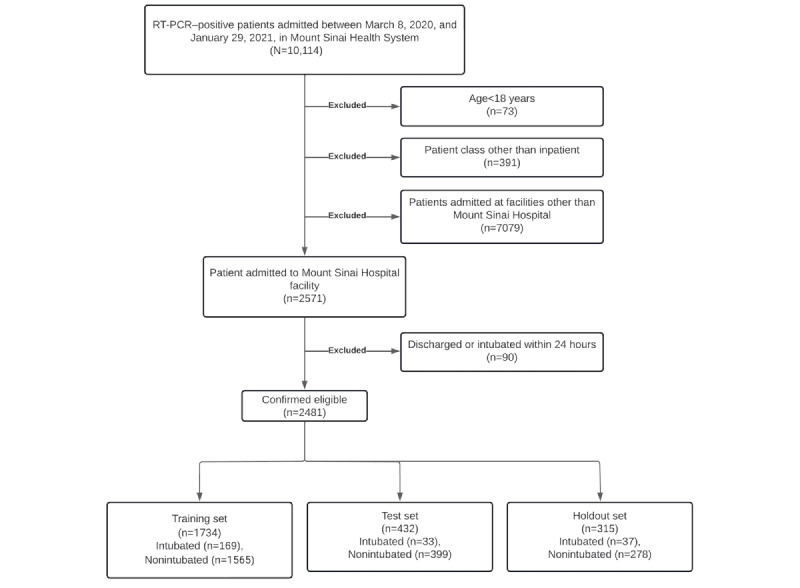
We aimed to evaluate the use of a machine learning model to predict the need for intubation within 24 hours by using a combination of CXR and EMR data in an end-to-end automated pipeline. We included historical data from 2481 hospitalizations at The Mount Sinai Hospital in New York City.

METHODS

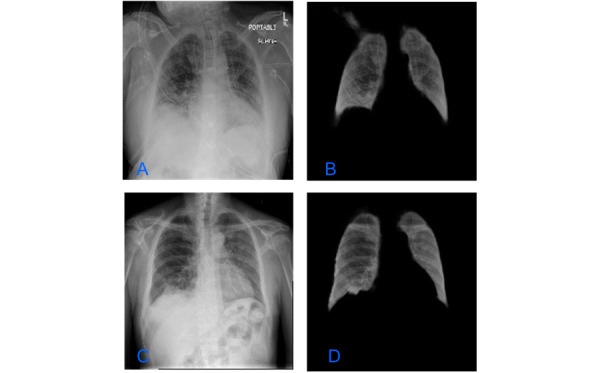
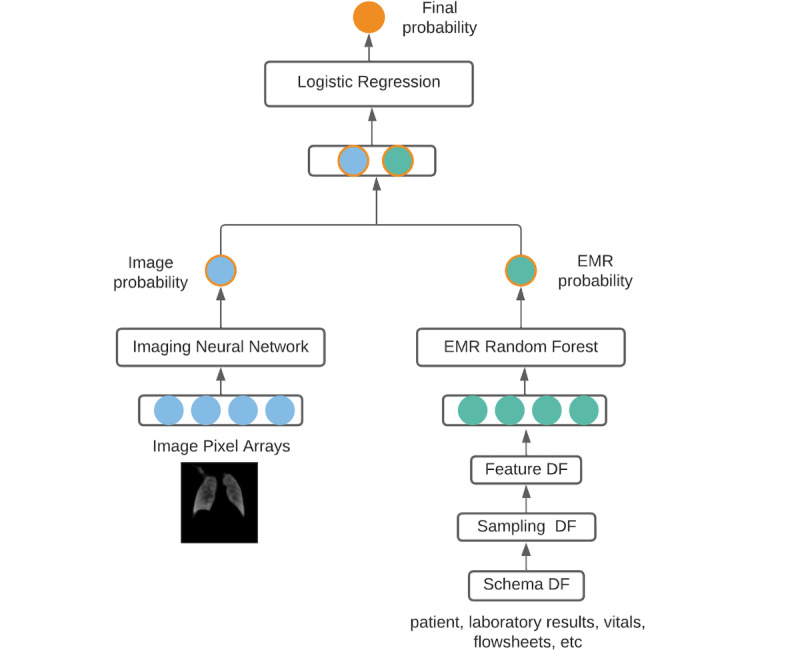
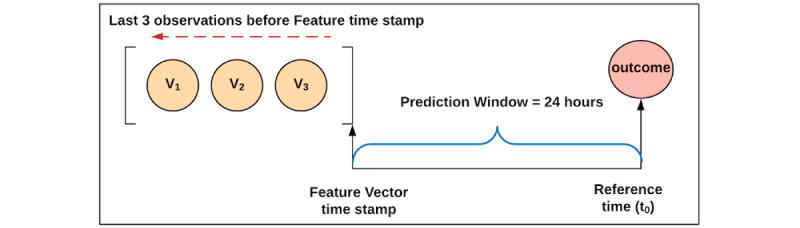
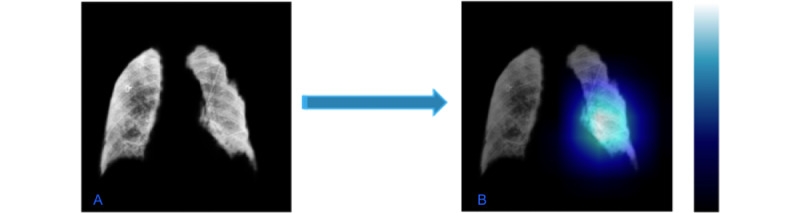
CXRs were first resized, rescaled, and normalized. Then lungs were segmented from the CXRs by using a U-Net algorithm. After splitting them into a training and a test set, the training set images were augmented. The augmented images were used to train an image classifier to predict the probability of intubation with a prediction window of 24 hours by retraining a pretrained DenseNet model by using transfer learning, 10-fold cross-validation, and grid search. Then, in the final fusion model, we trained a random forest algorithm via 10-fold cross-validation by combining the probability score from the image classifier with 41 longitudinal variables in the EMR. Variables in the EMR included clinical and laboratory data routinely collected in the inpatient setting. The final fusion model gave a prediction likelihood for the need of intubation within 24 hours as well.

RESULTS

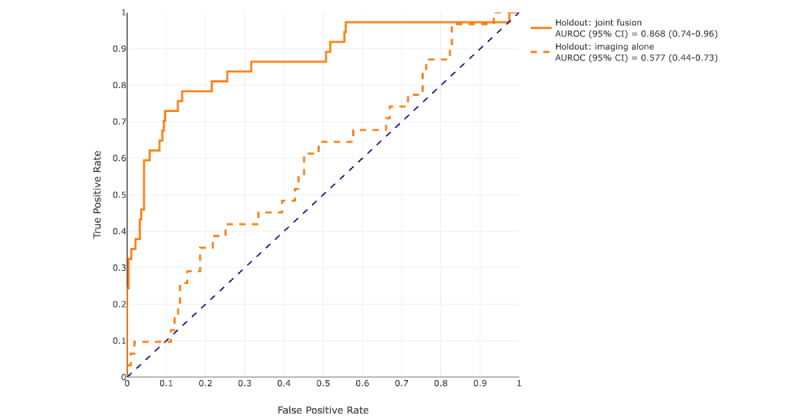
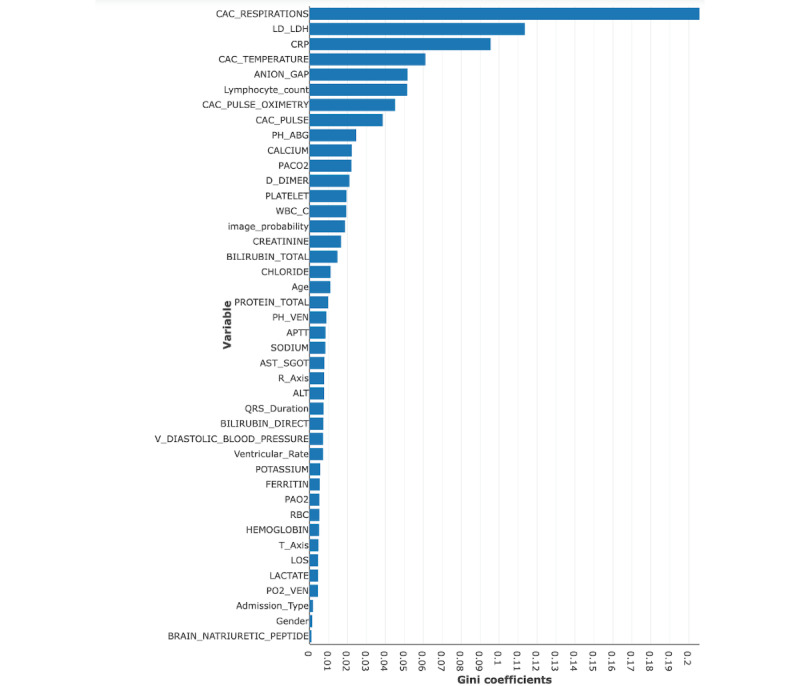
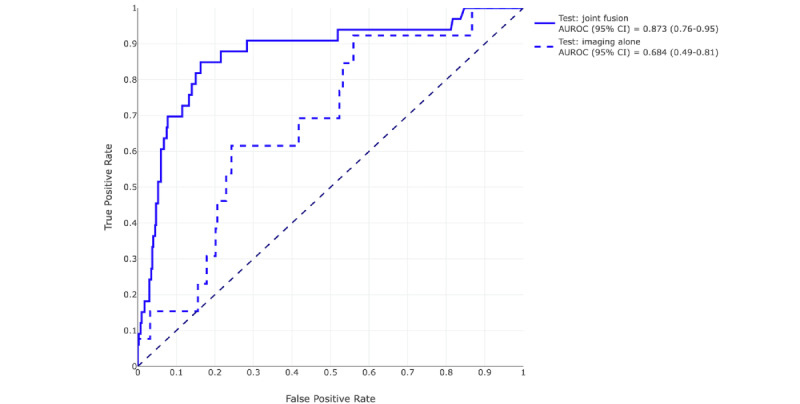
At a prediction probability threshold of 0.5, the fusion model provided 78.9% (95% CI 59%-96%) sensitivity, 83% (95% CI 76%-89%) specificity, 0.509 (95% CI 0.34-0.67) F-score, 0.874 (95% CI 0.80-0.94) area under the receiver operating characteristic curve (AUROC), and 0.497 (95% CI 0.32-0.65) area under the precision recall curve (AUPRC) on the holdout set. Compared to the image classifier alone, which had an AUROC of 0.577 (95% CI 0.44-0.73) and an AUPRC of 0.206 (95% CI 0.08-0.38), the fusion model showed significant improvement (P<.001). The most important predictor variables were respiratory rate, C-reactive protein, oxygen saturation, and lactate dehydrogenase. The imaging probability score ranked 15th in overall feature importance.

CONCLUSIONS

We show that, when linked with EMR data, an automated deep learning image classifier improved performance in identifying hospitalized patients with severe COVID-19 at risk for intubation. With additional prospective and external validation, such a model may assist risk assessment and optimize clinical decision-making in choosing the best care plan during the critical stages of COVID-19.

摘要

背景

对出现新型冠状病毒肺炎(COVID-19)症状住院患者是否需要有创机械通气(IMV)进行早期预测,有助于合理分配资源,并通过对呼吸衰竭风险最高的患者进行适当监测和治疗来改善患者预后。为应对判断患者是否需要IMV的复杂性,机器学习算法可能有助于及时、系统地提供更多预后价值。胸部X光片(CXR)和电子病历(EMR)通常在COVID-19入院患者早期获取,是决定他们是否需要IMV的关键。

目的

我们旨在评估使用机器学习模型,通过在端到端自动化流程中结合CXR和EMR数据,预测24小时内是否需要插管。我们纳入了纽约市西奈山医院2481例住院病例的历史数据。

方法

首先对CXR进行调整大小、重新缩放和归一化。然后使用U-Net算法从CXR中分割出肺部。将其分为训练集和测试集后,对训练集图像进行增强。通过迁移学习、10折交叉验证和网格搜索,对预训练的DenseNet模型进行重新训练,使用增强后的图像训练图像分类器,以预测24小时预测窗口内插管的概率。然后,在最终融合模型中,通过将图像分类器的概率得分与EMR中的41个纵向变量相结合,使用10折交叉验证训练随机森林算法。EMR中的变量包括住院环境中常规收集的临床和实验室数据。最终融合模型也给出了24小时内需要插管的预测可能性。

结果

在预测概率阈值为0.5时,融合模型在保留集上的灵敏度为78.9%(95%CI 59%-96%),特异性为83%(95%CI 76%-89%),F值为0.509(95%CI 0.34-0.67),受试者操作特征曲线下面积(AUROC)为0.874(95%CI 0.80-0.94),精确召回率曲线下面积(AUPRC)为0.497(95%CI 0.32-0.65)。与单独的图像分类器相比,其AUROC为0.577(95%CI 0.44-0.73),AUPRC为0.206(95%CI 0.08-0.38),融合模型有显著改善(P<.001)。最重要的预测变量是呼吸频率、C反应蛋白、血氧饱和度和乳酸脱氢酶。成像概率得分在总体特征重要性中排名第15。

结论

我们表明,当与EMR数据相关联时,自动化深度学习图像分类器在识别有插管风险的重症COVID-19住院患者方面提高了性能。经过额外的前瞻性和外部验证,这样的模型可能有助于风险评估,并在COVID-19关键阶段优化临床决策,以选择最佳护理方案。
https://cdn.ncbi.nlm.nih.gov/pmc/blobs/f0ba/10636624/3958dec7da48/formative_v7i1e46905_fig9.jpg
https://cdn.ncbi.nlm.nih.gov/pmc/blobs/f0ba/10636624/ed5aa310cffd/formative_v7i1e46905_fig1.jpg
https://cdn.ncbi.nlm.nih.gov/pmc/blobs/f0ba/10636624/23670e669d6e/formative_v7i1e46905_fig2.jpg
https://cdn.ncbi.nlm.nih.gov/pmc/blobs/f0ba/10636624/ada73f8c765f/formative_v7i1e46905_fig3.jpg
https://cdn.ncbi.nlm.nih.gov/pmc/blobs/f0ba/10636624/a9797e54c87c/formative_v7i1e46905_fig4.jpg
https://cdn.ncbi.nlm.nih.gov/pmc/blobs/f0ba/10636624/bfe5289810be/formative_v7i1e46905_fig5.jpg
https://cdn.ncbi.nlm.nih.gov/pmc/blobs/f0ba/10636624/225e3cfb632f/formative_v7i1e46905_fig6.jpg
https://cdn.ncbi.nlm.nih.gov/pmc/blobs/f0ba/10636624/d12a2dca6fb9/formative_v7i1e46905_fig7.jpg
https://cdn.ncbi.nlm.nih.gov/pmc/blobs/f0ba/10636624/03415824dae3/formative_v7i1e46905_fig8.jpg
https://cdn.ncbi.nlm.nih.gov/pmc/blobs/f0ba/10636624/3958dec7da48/formative_v7i1e46905_fig9.jpg
https://cdn.ncbi.nlm.nih.gov/pmc/blobs/f0ba/10636624/ed5aa310cffd/formative_v7i1e46905_fig1.jpg
https://cdn.ncbi.nlm.nih.gov/pmc/blobs/f0ba/10636624/23670e669d6e/formative_v7i1e46905_fig2.jpg
https://cdn.ncbi.nlm.nih.gov/pmc/blobs/f0ba/10636624/ada73f8c765f/formative_v7i1e46905_fig3.jpg
https://cdn.ncbi.nlm.nih.gov/pmc/blobs/f0ba/10636624/a9797e54c87c/formative_v7i1e46905_fig4.jpg
https://cdn.ncbi.nlm.nih.gov/pmc/blobs/f0ba/10636624/bfe5289810be/formative_v7i1e46905_fig5.jpg
https://cdn.ncbi.nlm.nih.gov/pmc/blobs/f0ba/10636624/225e3cfb632f/formative_v7i1e46905_fig6.jpg
https://cdn.ncbi.nlm.nih.gov/pmc/blobs/f0ba/10636624/d12a2dca6fb9/formative_v7i1e46905_fig7.jpg
https://cdn.ncbi.nlm.nih.gov/pmc/blobs/f0ba/10636624/03415824dae3/formative_v7i1e46905_fig8.jpg
https://cdn.ncbi.nlm.nih.gov/pmc/blobs/f0ba/10636624/3958dec7da48/formative_v7i1e46905_fig9.jpg

相似文献

1
A Hybrid Decision Tree and Deep Learning Approach Combining Medical Imaging and Electronic Medical Records to Predict Intubation Among Hospitalized Patients With COVID-19: Algorithm Development and Validation.一种结合医学影像和电子病历的混合决策树与深度学习方法,用于预测COVID-19住院患者的插管情况:算法开发与验证
JMIR Form Res. 2023 Oct 26;7:e46905. doi: 10.2196/46905.
2
Development and Validation of a Robust and Interpretable Early Triaging Support System for Patients Hospitalized With COVID-19: Predictive Algorithm Modeling and Interpretation Study.开发和验证用于 COVID-19 住院患者的强大且可解释的早期分诊支持系统:预测算法建模和解释研究。
J Med Internet Res. 2024 Jan 11;26:e52134. doi: 10.2196/52134.
3
4
A Machine Learning Prediction Model of Respiratory Failure Within 48 Hours of Patient Admission for COVID-19: Model Development and Validation.基于机器学习的 COVID-19 患者入院 48 小时内发生呼吸衰竭的预测模型:模型建立与验证。
J Med Internet Res. 2021 Feb 10;23(2):e24246. doi: 10.2196/24246.
5
Machine Learning Algorithms Predict Successful Weaning From Mechanical Ventilation Before Intubation: Retrospective Analysis From the Medical Information Mart for Intensive Care IV Database.机器学习算法在插管前预测机械通气成功脱机:来自重症监护医学信息集市IV数据库的回顾性分析
JMIR Form Res. 2023 Nov 14;7:e44763. doi: 10.2196/44763.
6
Development and Prospective Validation of a Transparent Deep Learning Algorithm for Predicting Need for Mechanical Ventilation.一种用于预测机械通气需求的透明深度学习算法的开发与前瞻性验证
medRxiv. 2020 Jun 3:2020.05.30.20118109. doi: 10.1101/2020.05.30.20118109.
7
The Development and Validation of Simplified Machine Learning Algorithms to Predict Prognosis of Hospitalized Patients With COVID-19: Multicenter, Retrospective Study.中文译文:简化机器学习算法预测 COVID-19 住院患者预后的开发和验证:多中心回顾性研究。
J Med Internet Res. 2022 Jan 21;24(1):e31549. doi: 10.2196/31549.
8
Explainable Machine Learning Techniques To Predict Amiodarone-Induced Thyroid Dysfunction Risk: Multicenter, Retrospective Study With External Validation.可解释机器学习技术预测胺碘酮诱导甲状腺功能障碍风险:多中心回顾性研究及外部验证。
J Med Internet Res. 2023 Feb 7;25:e43734. doi: 10.2196/43734.
9
Can Predictive Modeling Tools Identify Patients at High Risk of Prolonged Opioid Use After ACL Reconstruction?预测模型工具能否识别 ACL 重建术后阿片类药物使用时间延长的高风险患者?
Clin Orthop Relat Res. 2020 Jul;478(7):0-1618. doi: 10.1097/CORR.0000000000001251.
10
Machine Learning Electronic Health Record Identification of Patients with Rheumatoid Arthritis: Algorithm Pipeline Development and Validation Study.机器学习在类风湿性关节炎患者电子健康记录识别中的应用:算法流程开发与验证研究。
JMIR Med Inform. 2020 Nov 30;8(11):e23930. doi: 10.2196/23930.

引用本文的文献

1
AI-Driven Integration of Deep Learning With Lung Imaging, Functional Analysis, and Blood Gas Metrics for Perioperative Hypoxemia Prediction.用于围手术期低氧血症预测的人工智能驱动的深度学习与肺部成像、功能分析和血气指标的整合
JMIR Med Inform. 2025 Aug 22;13:e73995. doi: 10.2196/73995.
2
Consensus Between Radiologists, Specialists in Internal Medicine, and AI Software on Chest X-Rays in a Hospital-at-Home Service: Prospective Observational Study.居家医疗服务中放射科医生、内科专家与人工智能软件对胸部X光片诊断的一致性:前瞻性观察研究
JMIR Form Res. 2024 Dec 24;8:e55916. doi: 10.2196/55916.
3
Derivation and external validation of predictive models for invasive mechanical ventilation in intensive care unit patients with COVID-19.

本文引用的文献

1
Prediction of oxygen requirement in patients with COVID-19 using a pre-trained chest radiograph xAI model: efficient development of auditable risk prediction models via a fine-tuning approach.利用预先训练好的胸部 X 射线 AI 模型预测 COVID-19 患者的氧气需求:通过微调方法高效开发可审计风险预测模型。
Sci Rep. 2022 Dec 7;12(1):21164. doi: 10.1038/s41598-022-24721-5.
2
Deep learning of longitudinal chest X-ray and clinical variables predicts duration on ventilator and mortality in COVID-19 patients.深度学习纵向胸部 X 射线和临床变量可预测 COVID-19 患者的呼吸机使用时间和死亡率。
Biomed Eng Online. 2022 Oct 14;21(1):77. doi: 10.1186/s12938-022-01045-z.
3
针对新冠肺炎重症监护病房患者有创机械通气的预测模型的推导与外部验证
Ann Intensive Care. 2024 Aug 21;14(1):129. doi: 10.1186/s13613-024-01357-4.
Intubation and mortality prediction in hospitalized COVID-19 patients using a combination of convolutional neural network-based scoring of chest radiographs and clinical data.
使用基于卷积神经网络的胸部X光片评分与临床数据相结合的方法对住院COVID-19患者进行插管和死亡率预测
BJR Open. 2022 Mar 24;4(1):20210062. doi: 10.1259/bjro.20210062. eCollection 2022.
4
Development and Validation of a Multimodal-Based Prognosis and Intervention Prediction Model for COVID-19 Patients in a Multicenter Cohort.基于多模态的多中心队列 COVID-19 患者预后和干预预测模型的建立和验证。
Sensors (Basel). 2022 Jul 2;22(13):5007. doi: 10.3390/s22135007.
5
External COVID-19 Deep Learning Model Validation on ACR AI-LAB: It's a Brave New World.ACR人工智能实验室对外部新冠病毒深度学习模型的验证:这是一个全新的世界。
J Am Coll Radiol. 2022 Jul;19(7):891-900. doi: 10.1016/j.jacr.2022.03.013. Epub 2022 Apr 8.
6
Assessing the Severity of COVID-19 Lung Injury in Rheumatic Diseases Versus the General Population Using Deep Learning-Derived Chest Radiograph Scores.利用深度学习衍生的胸部 X 光评分评估风湿性疾病与普通人群 COVID-19 肺部损伤的严重程度。
Arthritis Care Res (Hoboken). 2023 Mar;75(3):657-666. doi: 10.1002/acr.24883. Epub 2022 Oct 21.
7
Noninvasive ventilation and high-flow nasal cannula in patients with acute hypoxemic respiratory failure by covid-19: A retrospective study of the feasibility, safety and outcomes.COVID-19 所致急性低氧性呼吸衰竭患者的无创通气和高流量鼻导管吸氧:一项回顾性研究其可行性、安全性和结局。
Respir Physiol Neurobiol. 2022 Apr;298:103842. doi: 10.1016/j.resp.2022.103842. Epub 2022 Jan 10.
8
Federated learning for predicting clinical outcomes in patients with COVID-19.基于联邦学习的 COVID-19 患者临床结局预测
Nat Med. 2021 Oct;27(10):1735-1743. doi: 10.1038/s41591-021-01506-3. Epub 2021 Sep 15.
9
Predicting clinical outcomes in COVID-19 using radiomics on chest radiographs.利用胸部 X 光片的放射组学预测 COVID-19 的临床结局。
Br J Radiol. 2021 Oct 1;94(1126):20210221. doi: 10.1259/bjr.20210221. Epub 2021 Sep 14.
10
Early Prediction of COVID-19 Ventilation Requirement and Mortality from Routinely Collected Baseline Chest Radiographs, Laboratory, and Clinical Data with Machine Learning.利用机器学习从常规收集的基线胸部X光片、实验室检查和临床数据中对COVID-19通气需求和死亡率进行早期预测。
J Multidiscip Healthc. 2021 Jul 30;14:2017-2033. doi: 10.2147/JMDH.S322431. eCollection 2021.