Manchester Institute of Biotechnology, Department of Chemistry, School of Natural Sciences, University of Manchester, 131 Princess Street, Manchester, M1 7DN, UK.
Future Biomanufacturing Research Hub, Manchester Institute of Biotechnology, Department of Chemistry, School of Natural Sciences, University of Manchester, 131 Princess Street, Manchester, M1 7DN, UK.
Chembiochem. 2021 Jul 1;22(13):2325-2334. doi: 10.1002/cbic.202100110. Epub 2021 May 25.
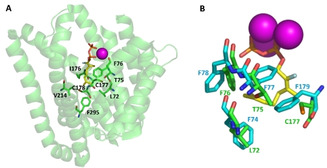
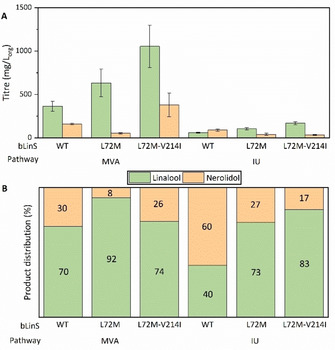
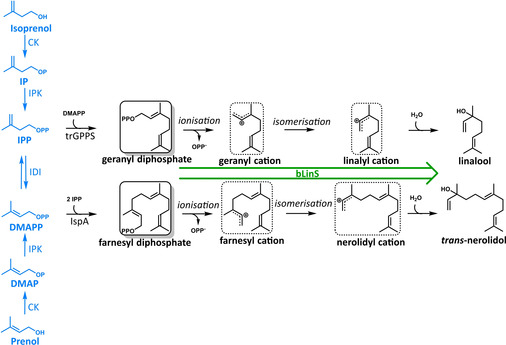
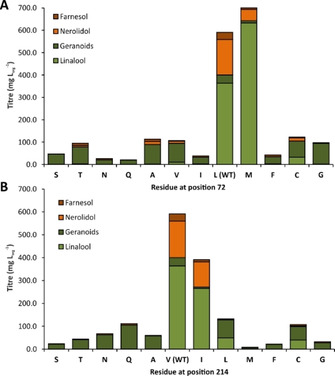
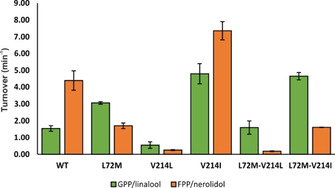
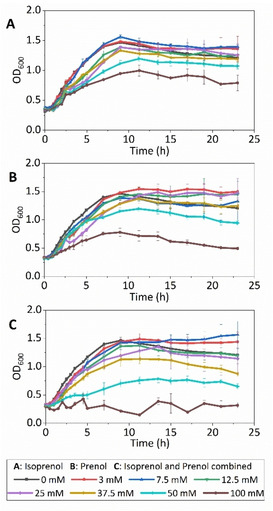
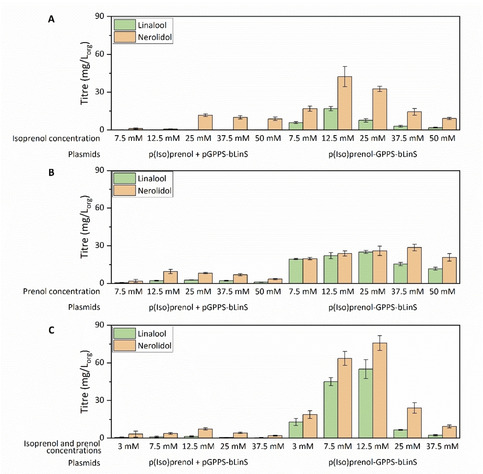
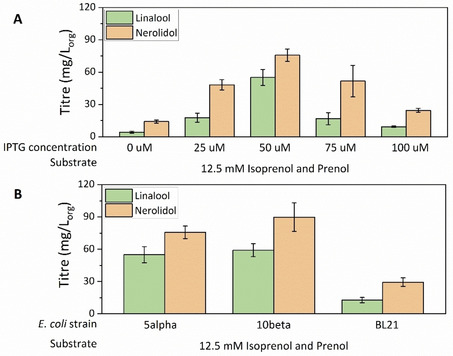
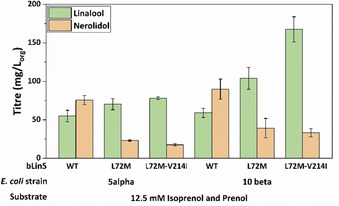
Linalool is a monoterpenoid used as a fragrance ingredient, and is a promising source for alternative fuels. Synthetic biology offers attractive alternative production methods compared to extraction from natural sources and chemical synthesis. Linalool/nerolidol synthase (bLinS) from Streptomyces clavuligerus is a bifunctional enzyme, producing linalool as well as the sesquiterpenoid nerolidol when expressed in engineered Escherichia coli harbouring a precursor terpenoid pathway such as the mevalonate (MVA) pathway. Here we identified two residues important for substrate selection by bLinS, L72 and V214, where the introduction of bulkier residues results in variants with reduced nerolidol formation. Terpenoid production using canonical precursor pathways is usually limited by numerous and highly regulated enzymatic steps. Here we compared the canonical MVA pathway to the non-canonical isopentenol utilization (IU) pathway to produce linalool using the optimised bLinS variant. The IU pathway uses isoprenol and prenol to produce linalool in only five steps. Adjusting substrate, plasmid system, inducer concentration, and cell strain directs the flux towards monoterpenoids. Our integrated approach, combining enzyme engineering with flux control using the artificial IU pathway, resulted in high purity production of the commercially attractive monoterpenoid linalool, and will guide future efforts towards efficient optimisation of terpenoid production in engineered microbes.
芳樟醇是一种单萜类化合物,用作香料成分,是替代燃料的有前途的来源。与从天然来源提取和化学合成相比,合成生物学提供了有吸引力的替代生产方法。来自链霉菌属的芳樟醇/橙花叔醇合酶(bLinS)是一种双功能酶,当在含有前体萜烯途径(如甲羟戊酸(MVA)途径)的工程大肠杆菌中表达时,可产生芳樟醇以及倍半萜橙花叔醇。在这里,我们确定了 bLinS 进行底物选择的两个重要残基,L72 和 V214,其中引入更大的残基会导致橙花叔醇形成减少的变体。使用典型前体途径的萜烯生产通常受到许多高度调控的酶促步骤的限制。在这里,我们将经典的 MVA 途径与非经典的异戊烯醇利用(IU)途径进行了比较,使用优化的 bLinS 变体来生产芳樟醇。IU 途径使用异戊烯醇和prenol 在仅五步中产生芳樟醇。调整底物、质粒系统、诱导剂浓度和细胞株可使通量朝向单萜类化合物。我们的综合方法,将酶工程与使用人工 IU 途径的通量控制相结合,实现了高纯度的商业上有吸引力的单萜芳樟醇的生产,将指导未来在工程微生物中进行萜烯生产的有效优化。