Department of Radiology, Samsung Medical Center, Sungkyunkwan University School of Medicine, Seoul, Korea.
Department of Pathology, Samsung Medical Center, Sungkyunkwan University School of Medicine, Seoul, Korea.
Korean J Radiol. 2021 Jul;22(7):1100-1109. doi: 10.3348/kjr.2020.0837. Epub 2021 Apr 9.
To compare the diagnostic performance between Prostate Imaging-Reporting and Data System version 2.0 (PI-RADSv2.0) and version 2.1 (PI-RADSv2.1) for clinically significant prostate cancer (csPCa) in the peripheral zone (PZ).
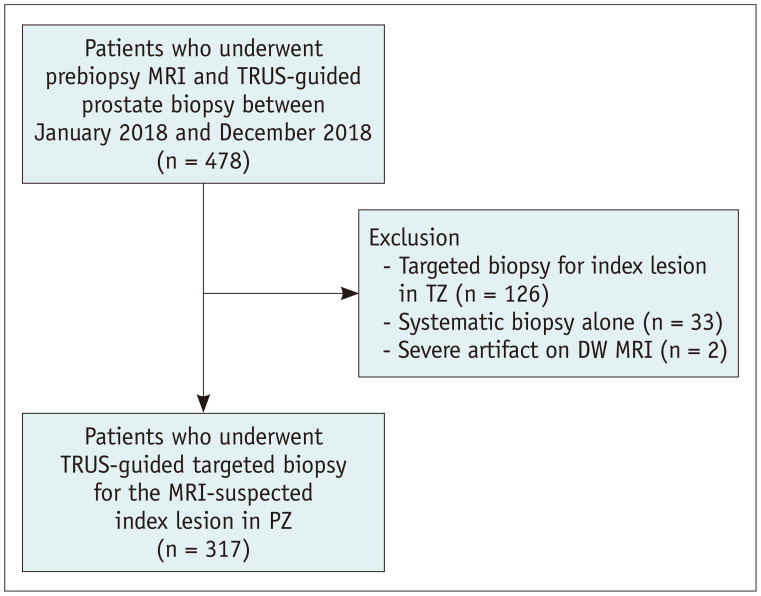
This retrospective study included 317 patients who underwent multiparametric magnetic resonance imaging and targeted biopsy for PZ lesions. Definition of csPCa was International Society of Urologic Pathology grade ≥ 2 cancer. Area under the curve (AUC), sensitivity, specificity, positive predictive value (PPV), negative predictive value (NPV), and accuracy for csPCa were analyzed by two readers. The cancer detection rate (CDR) for csPCa was investigated according to the PI-RADS categories.
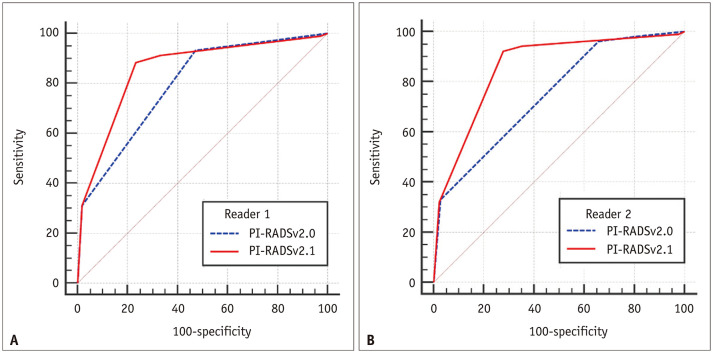
AUC of PI-RADSv2.1 (0.856 and 0.858 for reader 1 and 2 respectively) was higher than that of PI-RADSv2.0 (0.795 and 0.747 for reader 1 and 2 respectively) (both < 0.001). Sensitivity, specificity, PPV, NPV, and accuracy for PI-RADSv2.0 vs. PI-RADSv2.1 were 93.2% vs. 88.3% ( = 0.023), 52.8% vs. 76.6% ( < 0.001), 48.7% vs. 64.5% ( < 0.001), 94.2% vs. 93.2% ( = 0.504), and 65.9% vs. 80.4% ( < 0.001) for reader 1, and 96.1% vs. 92.2% ( = 0.046), 34.1% vs. 72.4% ( < 0.001), 41.3% vs. 61.7% ( < 0.001), 94.8% vs. 95.1% ( = 0.869), and 54.3% vs. 78.9% ( < 0.001) for reader 2, respectively. CDRs of PI-RADS categories 1-2, 3, 4, and 5 for PI-RADSv2.0 vs. PI-RADSv2.1 were 5.9% vs. 5.9%, 5.8% vs. 12.5%, 39.8% vs. 56.2%, and 88.9% vs. 88.9% for reader 1; and 4.5% vs. 4.1%, 6.1% vs. 11.1%, 32.5% vs. 53.4%, and 85.0% vs. 86.8% for reader 2, respectively.
Our data demonstrated improved AUC, specificity, PPV, accuracy, and CDRs of category 3 or 4 of PI-RADSv2.1, but decreased sensitivity, compared with PI-RADSv2.0, for csPCa in PZ.
比较前列腺影像报告和数据系统(PI-RADS)第 2 版(PI-RADSv2.0)和第 2.1 版(PI-RADSv2.1)在前列腺外周区(PZ)对临床显著前列腺癌(csPCa)的诊断性能。
本回顾性研究纳入了 317 例接受多参数磁共振成像和 PZ 病变靶向活检的患者。csPCa 的定义为国际泌尿病理学会分级≥2 级癌症。由两位读者分析 csPCa 的曲线下面积(AUC)、敏感度、特异度、阳性预测值(PPV)、阴性预测值(NPV)和准确率。根据 PI-RADS 类别调查 csPCa 的癌症检出率(CDR)。
PI-RADSv2.1 的 AUC(读者 1 和 2 分别为 0.856 和 0.858)高于 PI-RADSv2.0(读者 1 和 2 分别为 0.795 和 0.747)(均<0.001)。PI-RADSv2.0 与 PI-RADSv2.1 相比,敏感度、特异度、PPV、NPV 和准确率分别为 93.2%与 88.3%(=0.023)、52.8%与 76.6%(<0.001)、48.7%与 64.5%(<0.001)、94.2%与 93.2%(=0.504)和 65.9%与 80.4%(<0.001),读者 1 为 96.1%与 92.2%(=0.046)、34.1%与 72.4%(<0.001)、41.3%与 61.7%(<0.001)、94.8%与 95.1%(=0.869)和 54.3%与 78.9%(<0.001),读者 2 为 5.9%与 5.9%、5.8%与 12.5%、39.8%与 56.2%和 88.9%与 88.9%。PI-RADSv2.0 与 PI-RADSv2.1 的 PI-RADS 类别 1-2、3、4 和 5 的 CDR 分别为 5.9%与 5.9%、5.8%与 12.5%、39.8%与 56.2%和 88.9%与 88.9%,读者 1 为 4.5%与 4.1%、6.1%与 11.1%、32.5%与 53.4%和 85.0%与 86.8%,读者 2 为 4.5%与 4.1%、6.1%与 11.1%、32.5%与 53.4%和 85.0%与 86.8%。
我们的数据表明,与 PI-RADSv2.0 相比,PI-RADSv2.1 在 PZ 区对 csPCa 的 AUC、特异度、PPV、准确率和 3 或 4 类 CDR 有所提高,但敏感度降低。