Zernike Institute for Advanced Materials, University of Groningen, Nijenborgh 4, 9747 AG, Groningen, The Netherlands.
DWI-Leibniz Institute for Interactive Materials, Forckenbeckstr. 50, 52056, Aachen, Germany.
Angew Chem Int Ed Engl. 2021 Jun 21;60(26):14707-14714. doi: 10.1002/anie.202105404. Epub 2021 May 19.
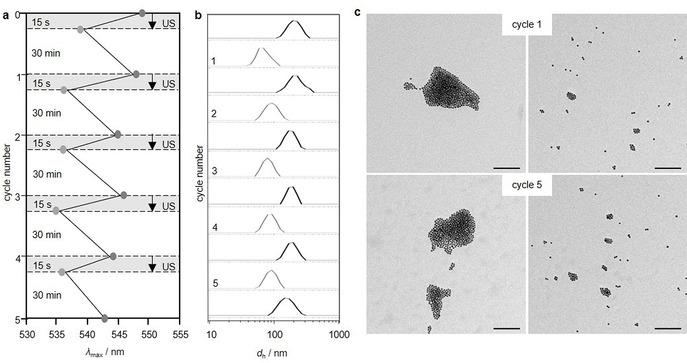
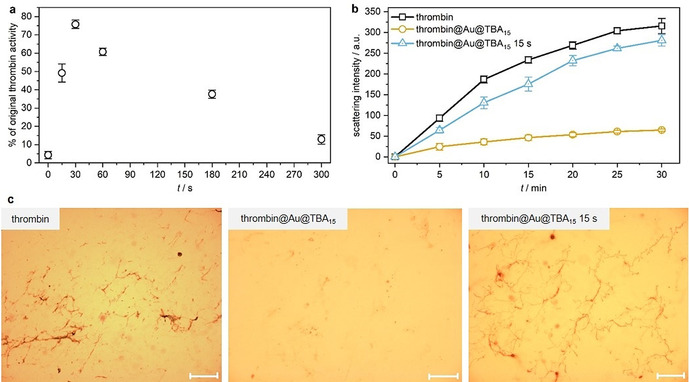
The regulation of enzyme activity is a method to control biological function. We report two systems enabling the ultrasound-induced activation of thrombin, which is vital for secondary hemostasis. First, we designed polyaptamers, which can specifically bind to thrombin, inhibiting its catalytic activity. With ultrasound generating inertial cavitation and therapeutic medical focused ultrasound, the interactions between polyaptamer and enzyme are cleaved, restoring the activity to catalyze the conversion of fibrinogen into fibrin. Second, we used split aptamers conjugated to the surface of gold nanoparticles (AuNPs). In the presence of thrombin, these assemble into an aptamer tertiary structure, induce AuNP aggregation, and deactivate the enzyme. By ultrasonication, the AuNP aggregates reversibly disassemble releasing and activating the enzyme. We envision that this approach will be a blueprint to control the function of other proteins by mechanical stimuli in the sonogenetics field.
酶活性的调节是控制生物功能的一种方法。我们报告了两个系统,可实现超声诱导凝血酶的激活,这对继发性止血至关重要。首先,我们设计了多适体,它可以特异性地与凝血酶结合,抑制其催化活性。通过超声产生惯性空化和治疗性医学聚焦超声,多适体与酶之间的相互作用被切断,恢复了催化纤维蛋白原转化为纤维蛋白的活性。其次,我们使用与金纳米粒子(AuNPs)表面连接的分裂适体。在凝血酶存在的情况下,这些适体组装成一个适体三级结构,诱导 AuNP 聚集,并使酶失活。通过超声处理,AuNP 聚集物可逆地解组装,释放并激活酶。我们设想这种方法将为在声遗传学领域通过机械刺激控制其他蛋白质的功能提供一个蓝图。