Department of Reproductive, Family and Population Health, School of Public Health, Addis Ababa University, Addis Ababa, Ethiopia.
Division of Infectious Diseases, Department of Pediatrics, Hospital for Sick Children, 555 University Ave, Toronto, ON, M5G 1X8, Canada.
Matern Child Health J. 2021 Jun;25(6):849-854. doi: 10.1007/s10995-021-03175-7. Epub 2021 May 3.
Ethiopia has made remarkable progress in reducing childhood and neonatal mortality in the last two decades. However, with the spread of the COVID-19 pandemic in Ethiopia, disruptions in routine health care pose a significant risk in reversing the gains made in neonatal mortality reduction.
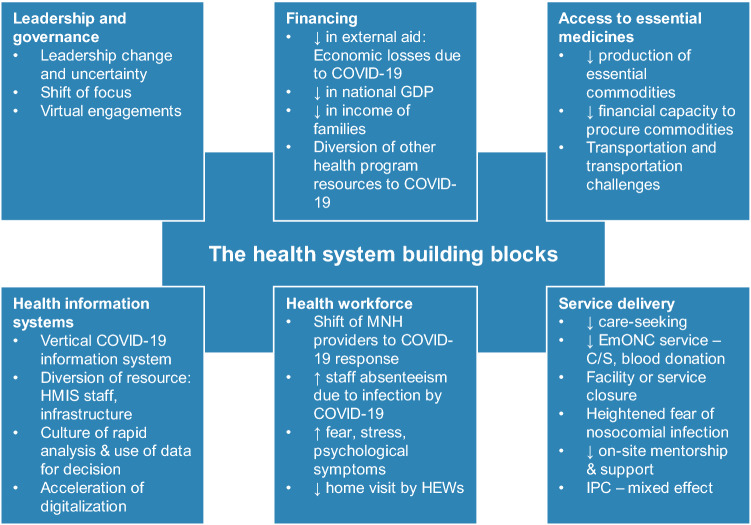
Using the World Health Organization's health systems building blocks framework we examined the mechanisms by which the pandemic may impact neonatal health.
Our analysis suggests that the COVID-19 pandemic and measures taken by the government to control its spread could indirectly set back the gains made in neonatal mortality reduction in Ethiopia by weakening the health system building blocks. On the other hand, by exposing longstanding issues in the health system, the pandemic has pressed health sector stakeholders to urgently test innovative approaches to maintain delivery of essential health care.
We recommend that the Ministry of Health of Ethiopia strike a right balance between the control of the pandemic and ensuring provision of essential neonatal health services. As the pandemic continues to spread in the country, the government should avoid verticalization of pandemic response efforts and adopt a diagonal investment approach to effectively respond to the pandemic as well as build health system resilience to maintain the gains made in the neonatal health.
在过去的二十年中,埃塞俄比亚在降低儿童和新生儿死亡率方面取得了显著进展。然而,随着 COVID-19 大流行在埃塞俄比亚的传播,常规医疗保健的中断给降低新生儿死亡率方面的成果带来了重大风险。
我们使用世界卫生组织的卫生系统构建模块框架,研究了大流行可能影响新生儿健康的机制。
我们的分析表明,COVID-19 大流行和政府为控制其传播而采取的措施可能会通过削弱卫生系统构建模块,间接地使埃塞俄比亚在降低新生儿死亡率方面取得的成果倒退。另一方面,大流行暴露了卫生系统中长期存在的问题,促使卫生部门利益攸关方紧急测试创新方法,以维持基本医疗保健的提供。
我们建议埃塞俄比亚卫生部在控制大流行和确保提供基本新生儿保健服务之间取得适当平衡。随着大流行在该国的持续蔓延,政府应避免大流行应对工作的垂直化,并采取对角投资方法,以有效应对大流行并增强卫生系统的弹性,以维持在新生儿健康方面取得的成果。