Bovo Marco, Agrusti Miki, Benni Stefano, Torreggiani Daniele, Tassinari Patrizia
Department of Agricultural and Food Sciences-Agricultural Engineering (DISTAL), Alma Mater Studiorum University of Bologna, Viale Fanin 48, 40127 Bologna, Italy.
Animals (Basel). 2021 Apr 30;11(5):1305. doi: 10.3390/ani11051305.
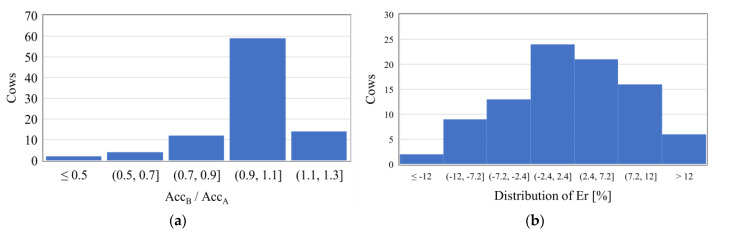
Precision Livestock Farming (PLF) relies on several technological approaches to acquire, in the most efficient way, precise and real-time data concerning production and welfare of individual animals. In this regard, in the dairy sector, PLF devices are being increasingly adopted, automatic milking systems (AMSs) are becoming increasingly widespread, and monitoring systems for animals and environmental conditions are becoming common tools in herd management. As a consequence, a great amount of daily recorded data concerning individual animals are available for the farmers and they could be used effectively for the calibration of numerical models to be used for the prediction of future animal production trends. On the other hand, the machine learning approaches in PLF are nowadays considered an extremely promising solution in the research field of livestock farms and the application of these techniques in the dairy cattle farming would increase sustainability and efficiency of the sector. The study aims to define, train, and test a model developed through machine learning techniques, adopting a Random Forest algorithm, having the main goal to assess the trend in daily milk yield of a single cow in relation to environmental conditions. The model has been calibrated and tested on the data collected on 91 lactating cows of a dairy farm, located in northern Italy, and equipped with an AMS and thermo-hygrometric sensors during the years 2016-2017. In the statistical model, having seven predictor features, the daily milk yield is evaluated as a function of the position of the day in the lactation curve and the indoor barn conditions expressed in terms of daily average of the temperature-humidity index (THI) in the same day and its value in each of the five previous days. In this way, extreme hot conditions inducing heat stress effects can be considered in the yield predictions by the model. The average relative prediction error of the milk yield of each cow is about 18% of daily production, and only 2% of the total milk production.
精准畜牧养殖(PLF)依靠多种技术方法,以最有效的方式获取有关个体动物生产和福利的精确实时数据。在这方面,在奶牛养殖领域,PLF设备的采用越来越多,自动挤奶系统(AMS)越来越普遍,动物和环境状况监测系统正成为畜群管理中的常用工具。因此,农民可以获得大量关于个体动物的每日记录数据,这些数据可以有效地用于校准用于预测未来动物生产趋势的数值模型。另一方面,PLF中的机器学习方法如今在畜牧场研究领域被认为是一种极有前景的解决方案,这些技术在奶牛养殖中的应用将提高该行业的可持续性和效率。本研究旨在定义、训练和测试一个通过机器学习技术开发的模型,采用随机森林算法,主要目标是评估单头奶牛的日产奶量相对于环境条件的趋势。该模型已根据意大利北部一家奶牛场91头泌乳奶牛在2016 - 2017年期间收集的数据进行校准和测试。在具有七个预测特征的统计模型中,日产奶量根据泌乳曲线中当天的位置以及当天和前五天中每一天的温度 - 湿度指数(THI)日平均值表示的室内牛舍条件进行评估。通过这种方式,模型在产量预测中可以考虑导致热应激效应的极端炎热条件。每头奶牛产奶量的平均相对预测误差约为日产奶量的18%,仅占总产奶量的2%。