Systems Engineering, Universidad Simon Bolivar, Barranquilla 080001, Colombia.
Systems Engineering, Universidad del Norte, Atlántico 080001, Colombia.
Tomography. 2021 Apr 29;7(2):154-168. doi: 10.3390/tomography7020014.
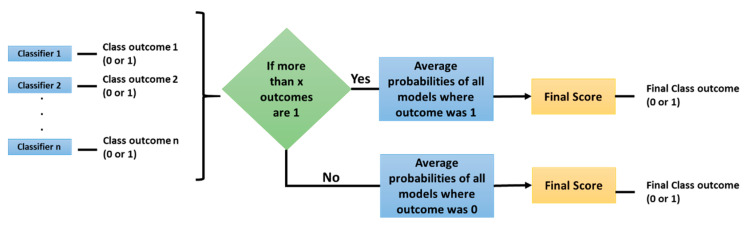
Lung cancer causes more deaths globally than any other type of cancer. To determine the best treatment, detecting EGFR and KRAS mutations is of interest. However, non-invasive ways to obtain this information are not available. Furthermore, many times there is a lack of big enough relevant public datasets, so the performance of single classifiers is not outstanding. In this paper, an ensemble approach is applied to increase the performance of EGFR and KRAS mutation prediction using a small dataset. A new voting scheme, Selective Class Average Voting (SCAV), is proposed and its performance is assessed both for machine learning models and CNNs. For the EGFR mutation, in the machine learning approach, there was an increase in the sensitivity from 0.66 to 0.75, and an increase in AUC from 0.68 to 0.70. With the deep learning approach, an AUC of 0.846 was obtained, and with SCAV, the accuracy of the model was increased from 0.80 to 0.857. For the KRAS mutation, both in the machine learning models (0.65 to 0.71 AUC) and the deep learning models (0.739 to 0.778 AUC), a significant increase in performance was found. The results obtained in this work show how to effectively learn from small image datasets to predict EGFR and KRAS mutations, and that using ensembles with SCAV increases the performance of machine learning classifiers and CNNs. The results provide confidence that as large datasets become available, tools to augment clinical capabilities can be fielded.
肺癌是全球导致死亡人数最多的癌症类型。为了确定最佳的治疗方案,检测 EGFR 和 KRAS 突变是很有意义的。然而,目前还没有非侵入性的方法来获取这些信息。此外,很多时候缺乏足够大的相关公共数据集,因此单个分类器的性能并不突出。在本文中,应用集成方法来提高使用小数据集进行 EGFR 和 KRAS 突变预测的性能。提出了一种新的投票方案,即选择性类别平均投票(SCAV),并评估了其在机器学习模型和 CNN 中的性能。对于 EGFR 突变,在机器学习方法中,敏感性从 0.66 提高到 0.75,AUC 从 0.68 提高到 0.70。对于深度学习方法,获得了 0.846 的 AUC,而使用 SCAV,则提高了模型的准确性,从 0.80 提高到 0.857。对于 KRAS 突变,在机器学习模型(AUC 从 0.65 提高到 0.71)和深度学习模型(AUC 从 0.739 提高到 0.778)中,性能都有显著提高。本工作的结果表明如何有效地从小图像数据集学习来预测 EGFR 和 KRAS 突变,并且使用具有 SCAV 的集成可以提高机器学习分类器和 CNN 的性能。结果表明,随着更大的数据集的出现,可以部署增强临床能力的工具。