School of Biological Sciences, AIPH University, Bhubaneswar 752101, Odisha, India.
London School of Hygiene and Tropical Medicine, London WC1E 7HT, UK.
Int J Environ Res Public Health. 2021 Apr 29;18(9):4778. doi: 10.3390/ijerph18094778.
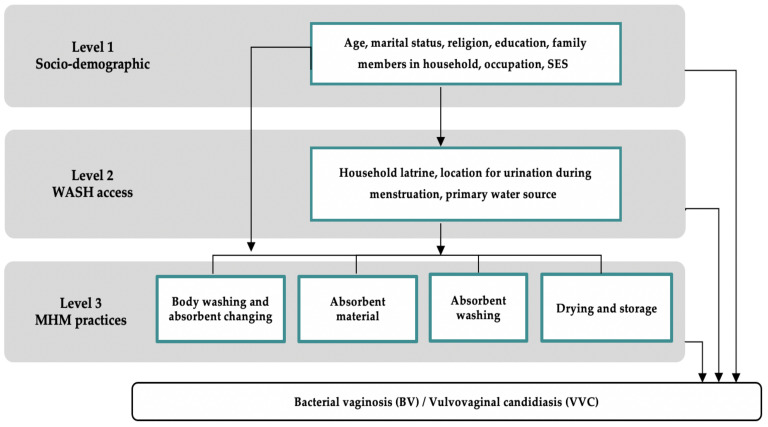
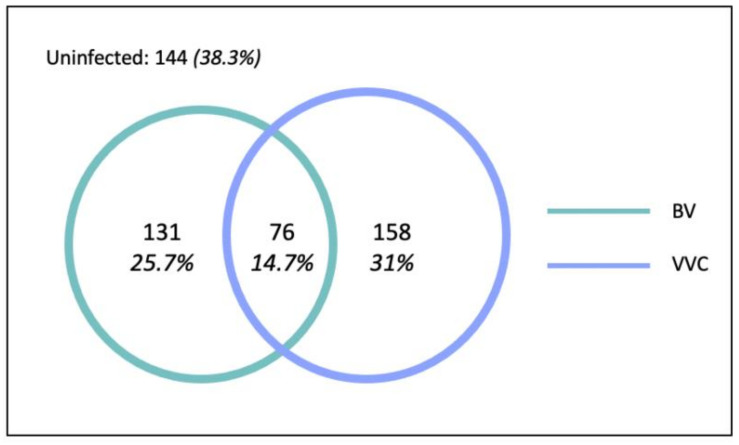
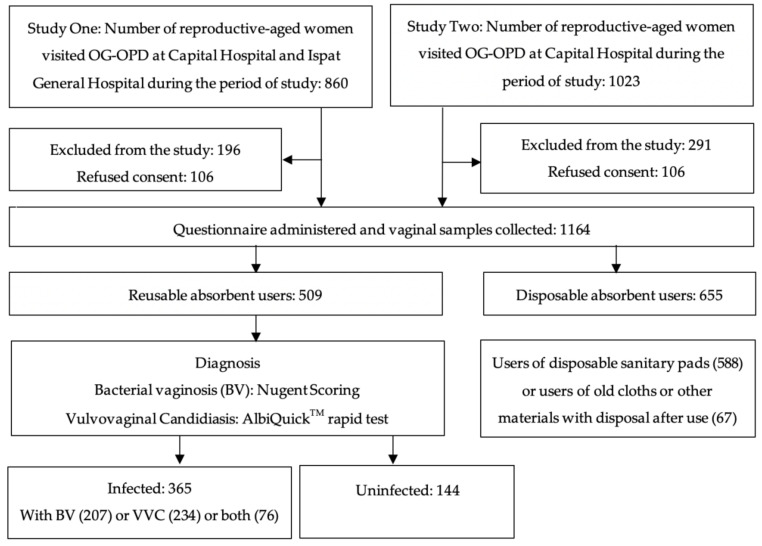
A large proportion of women in Odisha, India, use reusable absorbents to manage their menstruation. Yet, the risk factors for lower reproductive tract infections (RTIs) related to menstrual hygiene management (MHM) have not been studied among reusable absorbent users. Women of reproductive age attending one of two hospitals from two different cities in Odisha during two separate study intervals were recruited for the study. Laboratory diagnosis of bacterial vaginosis (BV) and vulvovaginal candidiasis (VVC) were conducted. A questionnaire was used to collect information on MHM practices, water, sanitation, and socio-demographic factors. Among the 509 women who used reusable absorbents, 71.7% were diagnosed with at least one infection. After adjusting for confounders, women with BV were more likely to identify as being a housewife (aOR: 1.8 (1.1-2.9)). Frequent absorbent changing was protective against BV (aOR: 0.5 (0.3-0.8)), whereas frequent body washing increased the odds of BV (aOR: 1.5 (1.0-2.2)). Women with VVC were more likely to be older (aOR: 1.6 (1.0-2.5)), live below the poverty line (aOR: 1.5 (1.1-2.2)), have a non-private household latrine (aOR: 2.2 (1.3-4.0)), dry their absorbents inside the house (aOR: 3.7 (2.5-4.5)), and store absorbents in the latrine area (aOR: 2.0 (1.3-2.9)). Washing absorbents outside the house was protective against VVC (aOR: 0.7 (0.4-1.0)). This study highlights the importance of improving MHM practices among reusable absorbent users to prevent lower RTIs among women reusing menstrual materials in Odisha.
印度奥里萨邦的很大一部分女性使用可重复使用的吸收剂来管理月经。然而,关于与经期卫生管理(MHM)相关的下生殖道感染(RTI)的风险因素,在可重复使用吸收剂使用者中尚未进行研究。在两个不同城市的两家医院的育龄妇女在两个不同的研究期间被招募参加这项研究。进行了细菌性阴道病(BV)和外阴阴道念珠菌病(VVC)的实验室诊断。使用问卷收集有关 MHM 实践、水、卫生和社会人口统计学因素的信息。在 509 名使用可重复使用吸收剂的女性中,71.7%至少诊断出一种感染。在调整混杂因素后,患有 BV 的女性更有可能是家庭主妇(优势比[OR]:1.8(1.1-2.9))。频繁更换吸收剂可预防 BV(OR:0.5(0.3-0.8)),而频繁洗澡会增加 BV 的几率(OR:1.5(1.0-2.2))。患有 VVC 的女性更有可能年龄较大(OR:1.6(1.0-2.5)),生活在贫困线以下(OR:1.5(1.1-2.2)),拥有非私人家庭厕所(OR:2.2(1.3-4.0)),在屋内晾干吸收剂(OR:3.7(2.5-4.5)),并将吸收剂存放在厕所区域(OR:2.0(1.3-2.9))。在屋外清洗吸收剂可预防 VVC(OR:0.7(0.4-1.0))。这项研究强调了改善可重复使用吸收剂使用者的 MHM 实践的重要性,以防止奥里萨邦女性在重复使用月经材料时发生下生殖道感染。