Institute of Endemic Diseases, University of Khartoum, Khartoum, Sudan.
Soba University Hospital, University of Khartoum, Khartoum, Sudan.
BMC Microbiol. 2021 May 4;21(1):136. doi: 10.1186/s12866-021-02133-1.
Antimicrobial resistance (AMR) poses a complex threat to global health security and universal health coverage. Recently, nosocomial infections with carbapenemase-producing Gram-negative bacilli (GNB) is increasing worldwide. We report the molecular characterization and detection of genes associated with carbapenemase producing Gram negative bacteria isolated from hospitalized patients at Soba University Hospital (SUH) in Khartoum State, Sudan.
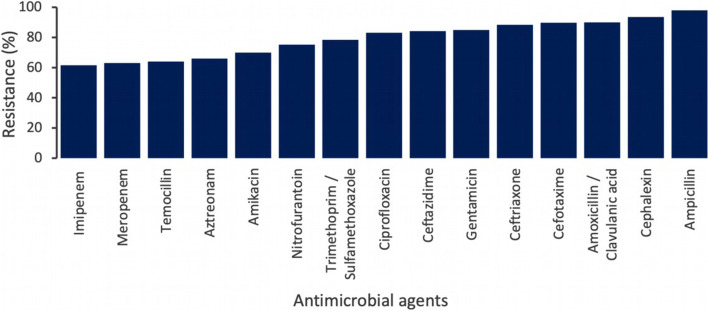
Between October 2016 and February 2017, a total of 206 GNB clinical specimens were collected from hospitalized patients in SUH. Of 206 carbapenem resistance isolates, 171 (83 %) were confirmed as phenotypically resistant and 121 (58.7 %) isolates harboured one or more carbapenemase genes. New Delhi metallo-β-lactamase (NDM) types were the most predominant genes, blaNDM 107(52 %), followed by blaIMP 7 (3.4 %), blaOXA-48 5(2.4 %) and blaVIM 2 (0.9 %). Co-resistance genes with NDM producing GNB were detected in 87 (81.3 %) of all blaNDM producing isolates. NDM-1 was the most frequent subtype observed in 75 (70 %) blaNDM producing isolates. The highest percentage of resistance was recorded in ampicillin (98 %), cephalexin (93.5 %) amoxicillin clavulanic acid (90 %), cefotaxime (89.7 %), ceftriaxone (88.4 %), ceftazidime (84.2 %), sulfamethoxazole-trimethoprim (78.4 %) and nitrofurantoin (75.2 %), aztreonam (66 %) and temocillin (64 %). A close correlation between phenotypic and carbapenemase genes detection in all GNB was observed.
The frequency of carbapenemase producing bacilli was found to be high in SUH. NDM was found to be the most prevalent carbapenemase gene among clinical isolates. Close surveillance across all hospitals in Sudan is required. The relative distribution of carbapenemase genes among GNB in nosocomial infections in Africa needs to be defined.
抗菌药物耐药性(AMR)对全球卫生安全和全民健康覆盖构成了复杂威胁。最近,全球范围内产碳青霉烯酶革兰氏阴性杆菌(GNB)的医院感染不断增加。我们报告了从苏丹喀土穆州苏巴大学医院(SUH)住院患者中分离的产碳青霉烯酶革兰氏阴性细菌的分子特征和相关基因的检测。
2016 年 10 月至 2017 年 2 月期间,从 SUH 的住院患者中总共收集了 206 株 GNB 临床标本。在 206 株碳青霉烯类耐药分离株中,171 株(83%)经表型确认为耐药,121 株(58.7%)分离株携带一种或多种碳青霉烯酶基因。新德里金属β-内酰胺酶(NDM)类型是最主要的基因,blaNDM-107(52%),其次是 blaIMP-7(3.4%)、blaOXA-48(2.4%)和 blaVIM-2(0.9%)。在所有产 NDM 的 GNB 中,检测到与产 NDM 的 GNB 共存的耐药基因,87 株(81.3%)。在 75 株产 NDM 的分离株中观察到 NDM-1 是最常见的亚型。在所有 blaNDM 产分离株中,对氨苄西林(98%)、头孢氨苄(93.5%)、阿莫西林克拉维酸(90%)、头孢噻肟(89.7%)、头孢曲松(88.4%)、头孢他啶(84.2%)、磺胺甲恶唑-甲氧苄啶(78.4%)和呋喃妥因(75.2%)、氨曲南(66%)和替莫西林(64%)的耐药率最高。在所有 GNB 中均观察到表型和碳青霉烯酶基因检测之间存在密切相关性。
在 SUH 中发现产碳青霉烯酶杆菌的频率较高。NDM 是临床分离株中最常见的碳青霉烯酶基因。需要在苏丹所有医院进行密切监测。在非洲,医院感染中革兰氏阴性菌的碳青霉烯酶基因的相对分布需要进一步明确。