Badir Mead, Suissa Alain, Orlovsky Michael, Asbeh Yousef Abu, Khamaysi Iyad
The Ruth and Bruce Rappaport Faculty of Medicine, Technion - Israel Institute of Technology (Mead Badir, Iyad Khamaysi).
Department of Gastroenterology (Alain Suissa, Iyad Khamaysi).
Ann Gastroenterol. 2021;34(3):337-343. doi: 10.20524/aog.2021.0590. Epub 2021 Jan 27.
Benign esophageal anastomotic strictures often require repeat dilation to relieve dysphagia. Little is known about the factors that affect their remediation. The purpose of this article was to retrospectively evaluate the long-term clinical results of endoscopic dilation in the treatment of benign anastomotic strictures after esophagectomy, and to identify factors associated with stricture recurrence.
A single-center retrospective analysis (using electronic records) was performed on patients who underwent endoscopic dilation for esophageal anastomotic strictures. Long-term clinical effectiveness, including technical and clinical success, and complication rate were assessed. Factors independently related to recurrence were evaluated.
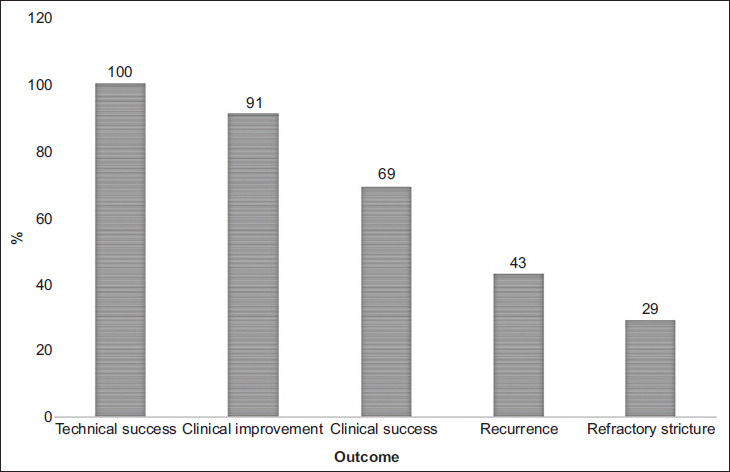
Between January 2014 and December 2017, a total of 35 patients who had benign anastomotic strictures after esophagectomy underwent 182 endoscopic dilation procedures. Technical success was 100%. Thirty-two patients (91%) had initial relief of dysphagia. The clinical success, defined as resolution of dysphagia and achieving luminal patency of 13 mm or more, was achieved in 24 patients (69%). Strictures recurred in 43% of patients, and refractory strictures were identified in 10/35 (29%). Proximal anastomosis and the presence of anastomotic foreign bodies were found to be risk factors for refractory strictures. The complication rate was low (4%) and adverse events were mild. No major complications (perforations, severe bleeding) or treatment-related deaths occurred in this series.
Endoscopic dilation has a high technical and a good clinical success rate. However, anastomotic strictures are often refractory and frequently recur.
良性食管吻合口狭窄常需反复扩张以缓解吞咽困难。关于影响其治疗效果的因素知之甚少。本文旨在回顾性评估内镜下扩张治疗食管切除术后良性吻合口狭窄的长期临床效果,并确定与狭窄复发相关的因素。
对接受内镜下扩张治疗食管吻合口狭窄的患者进行单中心回顾性分析(使用电子记录)。评估长期临床疗效,包括技术成功率和临床成功率以及并发症发生率。评估与复发独立相关的因素。
2014年1月至2017年12月,共有35例食管切除术后出现良性吻合口狭窄的患者接受了182次内镜下扩张治疗。技术成功率为100%。32例患者(91%)吞咽困难最初得到缓解。24例患者(69%)实现了临床成功,即吞咽困难缓解且管腔通畅达到13毫米或以上。43%的患者狭窄复发,10/35(29%)患者出现难治性狭窄。发现近端吻合口和吻合口异物的存在是难治性狭窄的危险因素。并发症发生率低(4%),不良事件轻微。本系列未发生重大并发症(穿孔、严重出血)或与治疗相关的死亡。
内镜下扩张技术成功率高,临床成功率良好。然而,吻合口狭窄往往难治且频繁复发。