Research Center Juelich, Institute of Neuroscience and Medicine, Cognitive Neuroscience (INM3), Juelich, Germany.
Faculty of Medicine and University Hospital Cologne, Department of Psychiatry, University of Cologne, Cologne, Germany.
Psychon Bull Rev. 2021 Oct;28(5):1545-1555. doi: 10.3758/s13423-021-01928-7. Epub 2021 May 4.
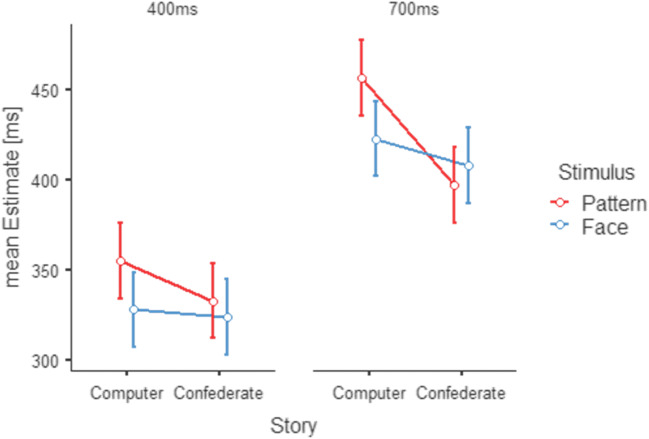
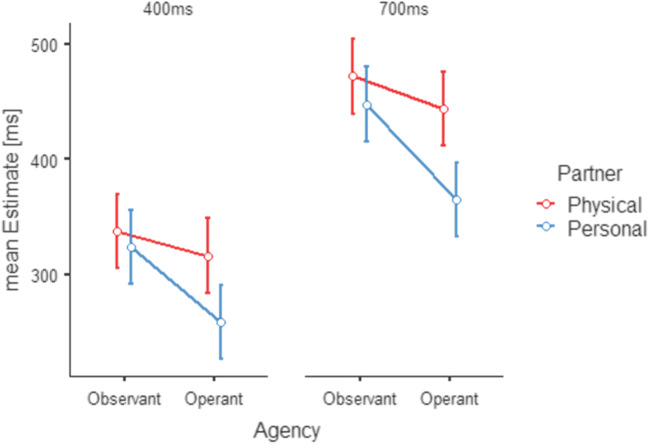
Temporal binding (TB) refers to an underestimation of time intervals between two events, most commonly for actions and their effects. This temporal contraction is measurable for both perceived changes in social stimuli such as faces, as well as for interactions with a partner. We investigated TB in two separate experiments to uncover the individual influences of (i) participants' belief in an interaction with a human partner (as compared to a computer), and (ii) a face-like stimulus versus an abstract stimulus mediating the interaction. The results show that TB is more pronounced when self-initiated actions result in a personal event as opposed to a mere physical effect, being suggestive of a "social hyperbinding." The social hyperbinding effect appeared to be driven both by the belief in interacting with another person and by a face-like stimulus. However, there seemed to be no further enhancing effect when combining the top-down processes ("beliefs") with the bottom-up processes ("perceptions"). These findings suggest a prioritization of social information for TB regardless of whether this information is introduced by top-down (beliefs) or bottom-up information (stimuli). Our results add to existing literature demonstrating an increase in action-event monitoring for social cues.
时间绑定(TB)是指对两个事件之间的时间间隔的低估,最常见于动作及其效果之间。这种时间收缩对于感知到的社会刺激(如面孔)的变化以及与伴侣的互动都可以进行测量。我们在两个单独的实验中研究了 TB,以揭示(i)参与者对与人类伙伴互动的信念(与计算机相比),以及(ii)中介互动的类脸刺激与抽象刺激的个体影响。结果表明,当自我启动的动作导致个人事件而不是仅仅产生物理效果时,TB 更为明显,这表明存在“社会超绑定”。社会超绑定效应似乎是由与他人互动的信念以及类脸刺激驱动的。然而,当将自上而下的过程(“信念”)与自下而上的过程(“感知”)结合起来时,似乎没有进一步的增强效果。这些发现表明,无论信息是自上而下(信念)还是自下而上(刺激)引入的,TB 都会优先考虑社会信息。我们的研究结果增加了现有文献,证明了社会线索的动作-事件监测增加。