School of Public Health, Qingdao University, 308 Ningxia Road, Qingdao, 266071, Shandong, People's Republic of China.
School of Nursing, Qingdao University, 308 Ningxia Road, Qingdao, 266071, Shandong, People's Republic of China.
Respir Res. 2021 May 5;22(1):139. doi: 10.1186/s12931-021-01735-7.
Data describing the effects of weight change across adulthood on asthma are important for the prevention of asthma. This study aimed to investigate the association between weight change from early to middle adulthood and risk of incident asthma.
Using data from the National Health and Nutrition Examination Survey (NHANES), we performed a nationally retrospective cohort study of the U.S. general population. A total of 20,771 people aged 40-74 years with recalled weight at young and middle adulthood were included in the cohort. Four weight change groups were categorized: stable non-obesity, non-obesity to obesity, obesity to non-obesity, and stable obesity. Hazard ratios (HRs) and 95% confidence intervals (CIs) relating weight change to incident asthma over 10 years of follow-up were calculated using Cox models adjusting for covariates.
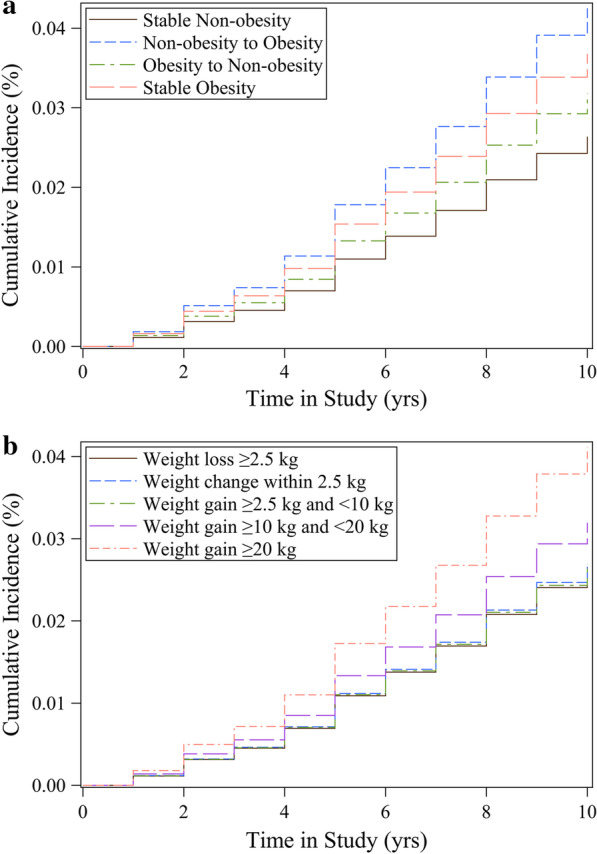
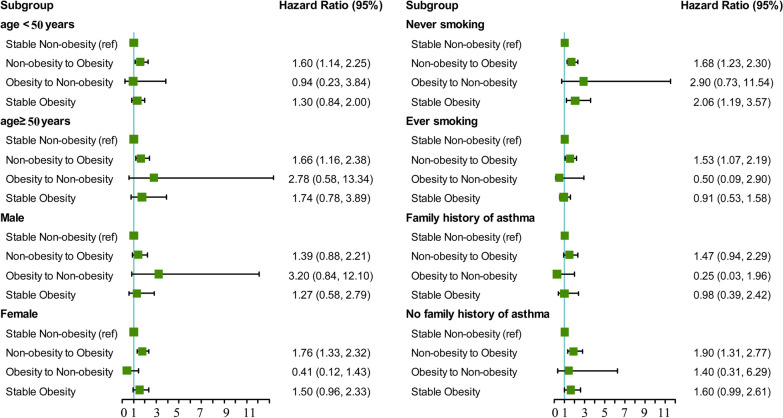
Compared with the stable non-obesity group, the HRs of incident asthma were 1.63 (95% CI = 1.29 to 2.07, P < 0.001) for the non-obesity to obesity group, 1.41 (95% CI = 0.97 to 2.05, P = 0.075) for stable obesity group, and 1.21 (95% CI = 0.41 to 3.62, P = 0.730) for the obesity to non-obesity group. In addition, participants who gained more than 20 kg from young to middle adulthood had a HR of 1.53 (95% CI = 1.15 to 2.03, P = 0.004), compared with those whose weight remained stable (weight change within 2.5 kg).
Weight gain from early to middle adulthood was associated with higher risk of incident asthma as compared to those who maintained normal weight. Thus, maintaining normal weight throughout adulthood might be important for the primary prevention of adult-onset asthma.
描述成年期体重变化对哮喘影响的数据对于哮喘的预防很重要。本研究旨在调查从中年到中年体重变化与新发哮喘风险之间的关联。
使用来自国家健康和营养检查调查(NHANES)的数据,我们对美国普通人群进行了一项全国回顾性队列研究。共有 20771 名年龄在 40-74 岁之间的成年人,他们在年轻时和中年时回忆起体重,被纳入了该队列。将体重变化分为四组:稳定非肥胖、非肥胖变为肥胖、肥胖变为非肥胖和稳定肥胖。使用 Cox 模型计算调整协变量后,体重变化与 10 年随访期间新发哮喘的风险比(HR)和 95%置信区间(CI)。
与稳定非肥胖组相比,非肥胖变为肥胖组的新发哮喘风险 HR 为 1.63(95%CI=1.29-2.07,P<0.001),稳定肥胖组为 1.41(95%CI=0.97-2.05,P=0.075),肥胖变为非肥胖组为 1.21(95%CI=0.41-3.62,P=0.730)。此外,从中年到中年体重增加超过 20 公斤的参与者与体重稳定的参与者相比,其 HR 为 1.53(95%CI=1.15-2.03,P=0.004)。
与保持正常体重的人相比,从中年到中年体重增加与新发哮喘的风险增加相关。因此,在成年期保持正常体重可能对成人发病哮喘的一级预防很重要。