Hospice & Palliative Care Unit, Haidian Section of Peking University Third Hospital, Beijing, China.
Department of Endocrinology, Beijing Tongren Hospital, Capital Medical University, Beijing, China.
Arthritis Res Ther. 2021 Mar 2;23(1):69. doi: 10.1186/s13075-021-02461-7.
Although the relationship between obesity and incident gout has been clarified, the influence of weight changes during the transition from early adulthood to midlife and the different weight change patterns in specific age ranges on the incidence of gout in later life remain unknown. Therefore, we aimed to investigate the association between weight change patterns across adulthood and incident gout.
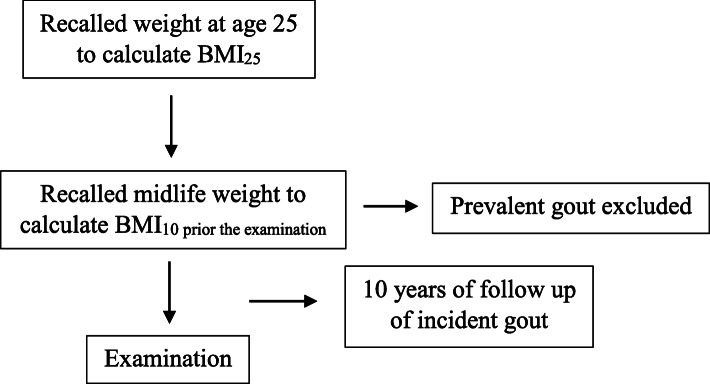
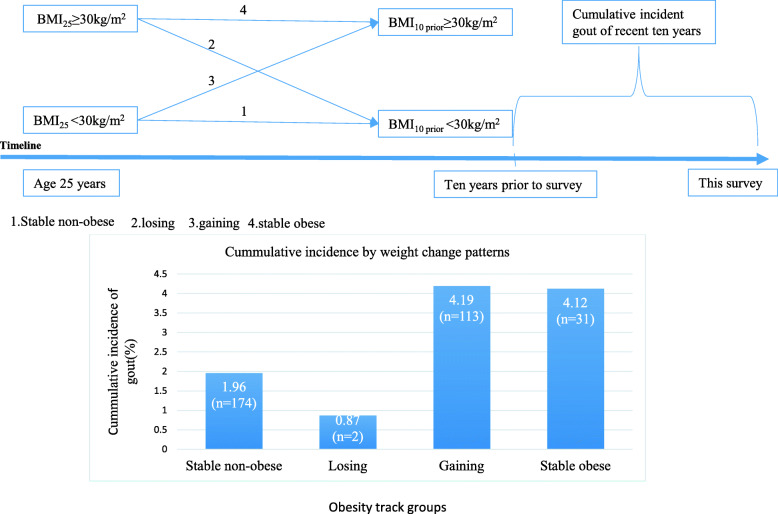
Using data from the National Health and Nutrition Examination Survey (NHANES), we categorized individuals into four weight change patterns: those who remained obese (stable obese), those who moved from a non-obese body mass index (BMI) to an obese BMI (gaining), those who moved from an obese BMI to a non-obese BMI (losing), and those who remained non-obese (stable non-obese). Incident gout reflected its occurrence over the 10-year follow-up from the recalled midlife weight measure to the time of this survey. Hazard ratios (HRs) and 95% confidence intervals relating weight change patterns to incident gout over the 10-year follow-up period were calculated using Cox models adjusted for covariates. The hypothetical population attributable fraction (PAF) for the weight change patterns was calculated.
Among our sample of adults aged 40-74 years at their midlife weight measure (n = 11,079), 320 developed gout. The highest risk of incident gout was found for participants with the stable obese pattern (HR 1.84; 1.08-3.14) and not for participants who remained stable non-obese during adulthood. Moreover, gaining weight was a significant risk factor for incident gout (HR 1.65; 1.19-2.29). No significant associations were found between losing weight change patterns and the risk of gout during the study period. If participants who gained weight had become non-obese during the 10-year follow-up, an estimated 3.2% (95% CI 0-6.3) of observed gout cases could have been averted. In addition, if the population had maintained a normal BMI, 32.9% (95% CI 18.2-44.9) cases could have been prevented during the 10 years.
Gaining weight over adulthood was associated with an increased risk of gout. These findings have highlighted that maintaining non-obese weight and weight loss across adulthood is essential for the prevention and treatment of gout in adult life.
尽管肥胖与痛风事件之间的关系已得到阐明,但在从青年早期到中年过渡期体重变化以及特定年龄范围内不同的体重变化模式对晚年痛风发病的影响仍不清楚。因此,我们旨在研究成年期体重变化模式与痛风事件之间的关系。
利用来自全国健康和营养调查(NHANES)的数据,我们将个体分为四种体重变化模式:体重一直保持肥胖的(稳定肥胖),从非肥胖 BMI 转变为肥胖 BMI 的(增重),从肥胖 BMI 转变为非肥胖 BMI 的(减轻体重),以及体重一直保持非肥胖的(稳定非肥胖)。痛风事件反映了从回忆的中年体重测量到本调查期间的 10 年随访期间的发生情况。使用 Cox 模型,通过调整协变量,计算体重变化模式与 10 年随访期间痛风事件相关的风险比(HR)和 95%置信区间。计算体重变化模式的假设人群归因分数(PAF)。
在我们的中年体重测量时年龄为 40-74 岁的成年人群样本中(n=11079),有 320 人患上了痛风。稳定肥胖模式(HR 1.84;1.08-3.14)的痛风发病风险最高,而成年期一直保持稳定非肥胖的参与者并非如此。此外,体重增加是痛风发病的一个显著危险因素(HR 1.65;1.19-2.29)。在研究期间,体重减轻变化模式与痛风风险之间没有显著关联。如果在 10 年随访期间增重的参与者体重恢复正常,估计可避免 3.2%(95%CI 0-6.3)的观察到的痛风病例。此外,如果人群保持正常 BMI,在 10 年内可预防 32.9%(95%CI 18.2-44.9)的病例。
成年期体重增加与痛风风险增加相关。这些发现强调了在成年期保持非肥胖体重和减轻体重对于预防和治疗痛风至关重要。