School of Nursing, Qingdao University, No. 308 Ningxia Road, Qingdao 266071, China.
School of Public Health, Qingdao University, Qingdao 266071, China.
Nutrients. 2020 Aug 28;12(9):2622. doi: 10.3390/nu12092622.
The effect of obesity in early adulthood and weight loss on incident hypertension in older age has not been well characterized. This study aimed to examine the association of weight loss from young adulthood to midlife with risk of incident hypertension later in life.
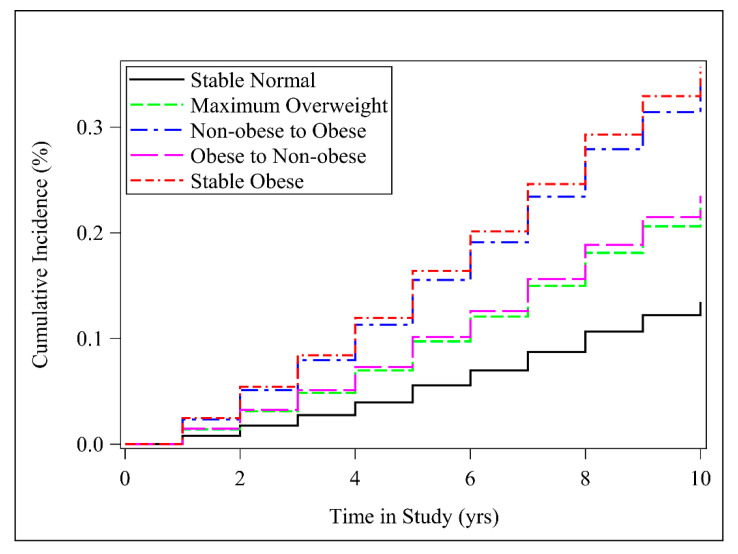
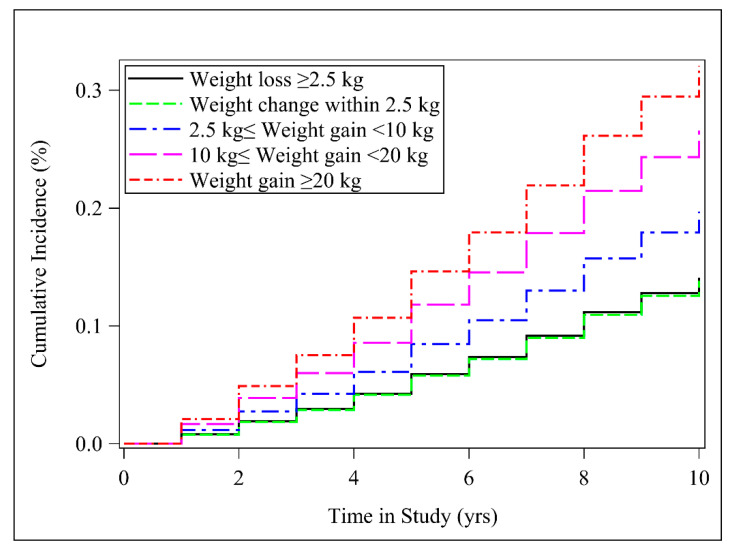
We performed a retrospective cohort study using data from the National Health and Nutrition Examination Survey (NHANES). Five weight change groups were categorized: stable normal, weight loss, weight gain, maximum overweight and stable obese. The hazard ratios (HRs) and 95% confidence intervals (CIs) of the association between weight change and risk of hypertension in later life were estimated using Cox regression models.
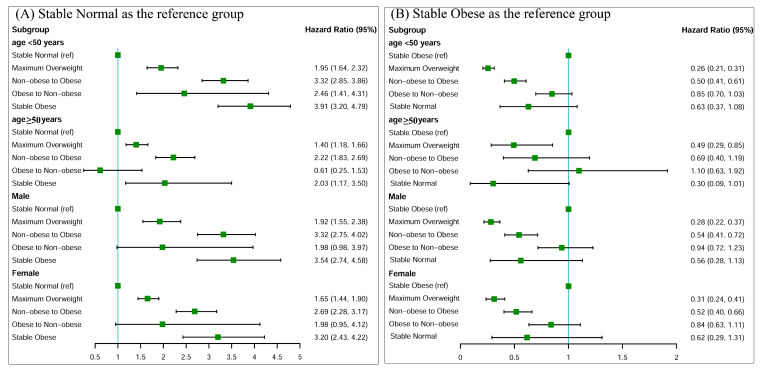
Compared with participants who maintained normal weight, the stable obese, weight gain, maximum overweight and weight loss groups exhibited significantly higher risks of incident hypertension, with HR of 3.28 (95% CI = 2.71 to 3.96), 2.93 (95% CI = 2.62 to 3.28), 1.76 (95% CI = 1.55 to 2.00) and 1.97 (95% CI = 1.17 to 3.31), respectively. We also observed a lower risk among those in the weight loss group (HR = 0.60, 95% CI = 0.35 to 1.02) compared with those who were stable obese.
Weight loss from early to middle adulthood was associated with lower risk of incident hypertension as compared to those who stayed obese and higher risk of incident hypertension as compared to those who maintained normal weight. Thus, maintaining normal weight throughout adulthood may be important for the primary prevention of hypertension.
年轻时肥胖和体重减轻对老年期高血压发病的影响尚未得到很好的描述。本研究旨在探讨从年轻时到中年体重减轻与以后生活中高血压发病风险的关系。
我们使用国家健康和营养检查调查(NHANES)的数据进行了回顾性队列研究。将体重变化分为以下五组:稳定正常体重、体重减轻、体重增加、最大超重和稳定肥胖。使用 Cox 回归模型估计体重变化与以后生活中高血压风险之间的关联的风险比(HR)和 95%置信区间(CI)。
与保持正常体重的参与者相比,稳定肥胖、体重增加、最大超重和体重减轻组发生高血压的风险显著增加,其 HR 分别为 3.28(95% CI = 2.71 至 3.96)、2.93(95% CI = 2.62 至 3.28)、1.76(95% CI = 1.55 至 2.00)和 1.97(95% CI = 1.17 至 3.31)。与稳定肥胖组相比,体重减轻组的风险也较低(HR = 0.60,95% CI = 0.35 至 1.02)。
与一直肥胖的人相比,从中年到中年体重减轻与高血压发病风险较低相关,与保持正常体重的人相比,体重减轻与高血压发病风险较高相关。因此,在成年期保持正常体重可能对高血压的一级预防很重要。