Department of Experimental and Clinical Biomedical Sciences "Mario Serio", University of Florence, Florence, Italy.
Clinical Oncology Unit, Careggi University Hospital, Florence, Italy.
Br J Cancer. 2021 Jul;125(1):94-100. doi: 10.1038/s41416-021-01399-6. Epub 2021 May 5.
Within the OMITERC prospective study (OMIcs application from solid to liquid biopsy for a personalised ThERapy of Cancer), we explored the prognostic role of liquid biopsy encompassing cell-free DNA (cfDNA) and circulating tumour cells (CTCs) in KRAS mutated metastatic colorectal cancer (mCRC).
We defined a workflow including pre-analytical and analytical procedures collecting blood before therapy and every 3 months until disease progression (PD). CTCs were counted by CellSearch® and isolated by DEPArray™. NGS sequencing of CTCs and cfDNA was performed using a panel of cancer/CRC related genes respectively.
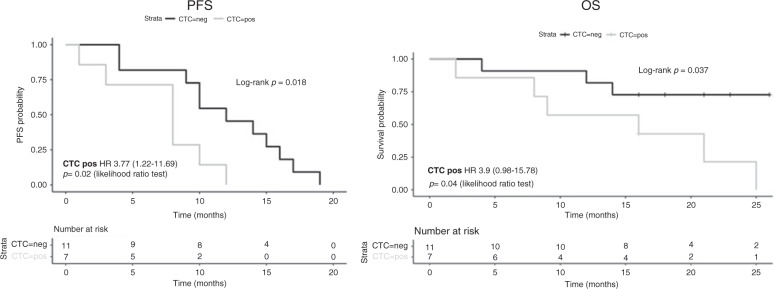
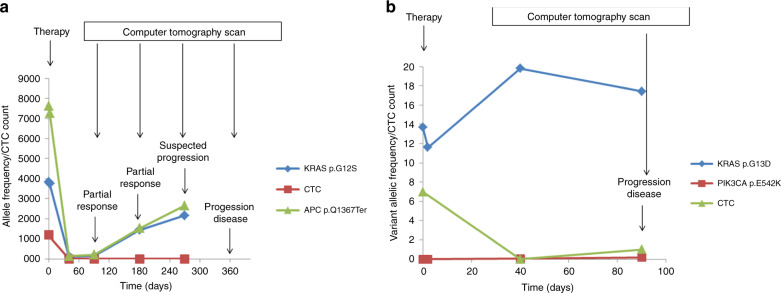
KRAS mutational status was mostly concordant between tumour tissues and liquid biopsy. The percentage of cfDNA samples with mutations in CRC driver genes was in line with literature. In longitudinal monitoring circulating biomarkers anticipated or overlapped conventional diagnostic tools in predicting PD. The presence of CTCs at baseline was confirmed a negative prognostic marker.
Cell-free DNA and CTCs are readily available candidates for clinical application in mCRC. While CTCs demonstrated a prognostic significance at baseline, cfDNA was confirmed an easily accessible material for monitoring the mutational status of the tumour over time. Moreover, in the longitudinal study, the two markers emerged as complementary in assessing disease progression.
在 OMITERC 前瞻性研究(从实体瘤到液体活检的 OMIcs 应用,以实现癌症的个体化治疗)中,我们探讨了液体活检(包含游离 DNA [cfDNA] 和循环肿瘤细胞 [CTC])在 KRAS 突变型转移性结直肠癌(mCRC)中的预后作用。
我们定义了一个工作流程,包括在治疗前和每 3 个月收集一次血液,直到疾病进展(PD),进行液体活检。CTC 计数采用 CellSearch®,CTC 分离采用 DEPArray™。CTC 和 cfDNA 的 NGS 测序分别采用了一组癌症/CRC 相关基因的面板。
肿瘤组织和液体活检之间的 KRAS 突变状态大多一致。CRC 驱动基因突变 cfDNA 样本的百分比与文献相符。在纵向监测中,循环生物标志物在预测 PD 方面早于或与常规诊断工具重叠。基线时 CTCs 的存在被证实是一个负面的预后标志物。
cfDNA 和 CTCs 是 mCRC 临床应用的现成候选者。虽然 CTCs 在基线时表现出了预后意义,但 cfDNA 被证实是一种易于获取的材料,可随时间监测肿瘤的突变状态。此外,在纵向研究中,这两种标志物在评估疾病进展方面表现出互补性。