Singhal Sakshi, Gill Maneet, Srivastava Chinmaya, Gupta Darpan, Kumar Ashok, Kaushik Aruna, Semwal Manoj Kumar
Division of PET Imaging, Institute of Nuclear Medicine and Allied Sciences, Delhi, India.
Department of Neurosurgery, Army Hospital Research and Referral, Delhi, India.
J Med Phys. 2020 Oct-Dec;45(4):199-205. doi: 10.4103/jmp.JMP_56_20. Epub 2021 Feb 2.
This study aims to derive simple yet robust formula(s) for the calculation of cranial tumor volume using linear tumor dimensions in anterioposterior (AP), mediolateral (ML) and craniocaudal (CC) directions and also propose a reproducible methodology for tumor dimension measurements.
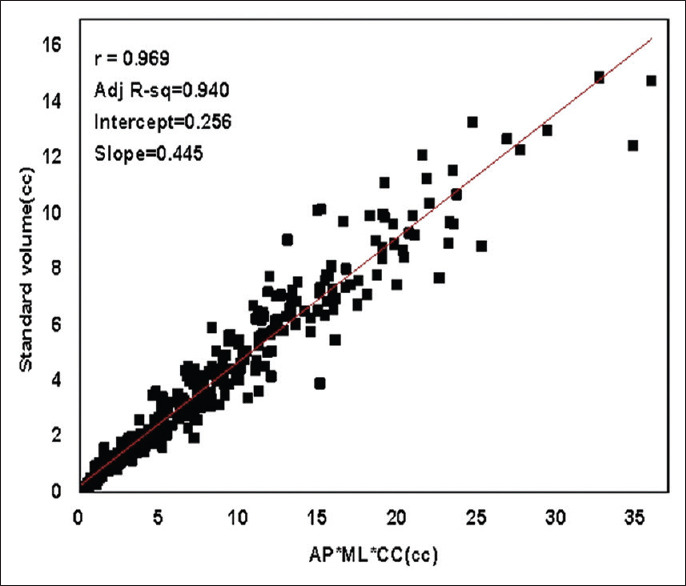
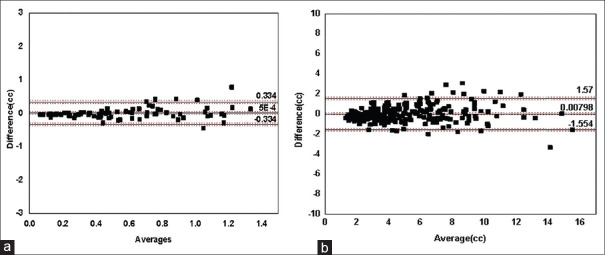
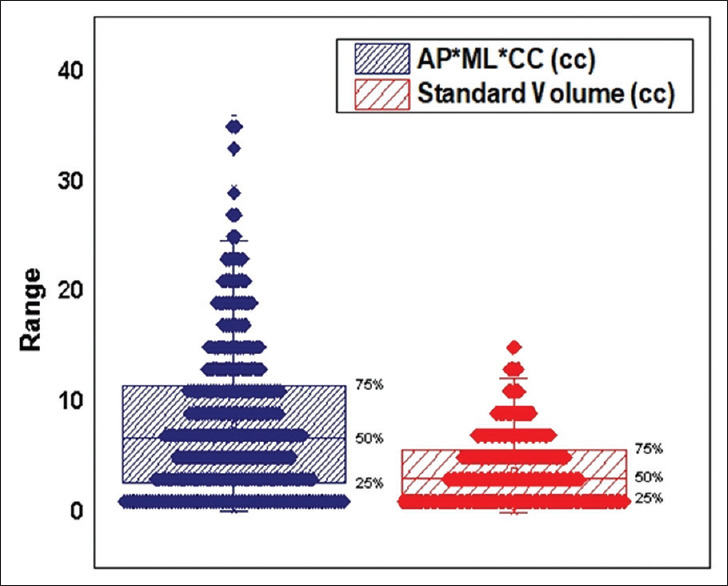
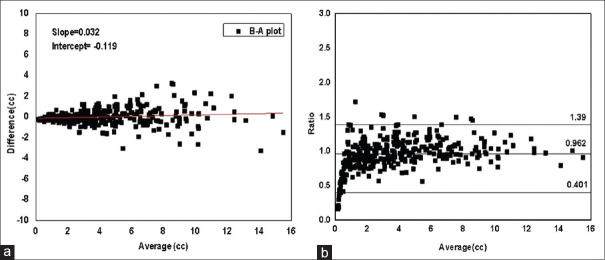
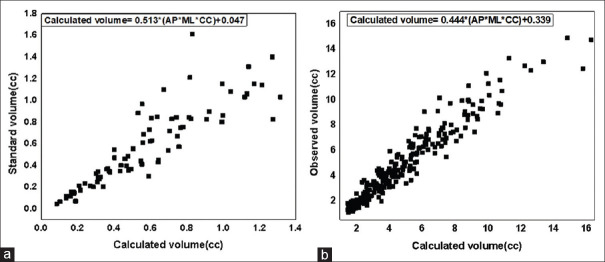
Magnetic resonance images (MRI) of 337 patients planned for Gammaknife Stereotactic Radiosurgery for different types of brain tumors were analyzed using Leksell Gamma Plan (LGP) software. Tumor volume in three dimensional was outlined and maximum tumor diameters were measured in three orthogonal directions AP, ML, and CC on the MRI. Formulas were derived to calculate tumor volume from AP, ML, and CC diameters using linear regression technique. An agreement between the calculated volume and standard volume observed from LGP software was determined using Bland Altman (B-A) plot. A comparison was made between the volume calculated using traditionally used formula of ellipsoid, standard volume obtained from LGP software and volume calculated from formulas derived in the present study.
The tumors were divided into two categories based on their size for better volume prediction. The tumors having product of their diameters in the range 0-2.5cc were called "small tumors" and the formula proposed for their volume estimation ( + 0.047 ) was found to predict the tumor volume with an average bias of 0.0005cc. For "large tumors," having product of diameters in the range 2.5-36cc, the proposed formula ( + 0.339 ) predicted the tumor volume with an average bias of 0.007cc.
The two formulas proposed in the study are more accurate as compared to the commonly used formula that considers the tumors as ellipsoids. The methodology proposed in the study for measurement of linear tumor dimensions is simple and reproducible.
本研究旨在推导简单而可靠的公式,用于根据前后径(AP)、内外径(ML)和颅尾径(CC)方向的线性肿瘤尺寸计算颅部肿瘤体积,并提出一种可重复的肿瘤尺寸测量方法。
使用Leksell伽马计划(LGP)软件分析了337例计划接受伽马刀立体定向放射外科治疗不同类型脑肿瘤患者的磁共振成像(MRI)。在MRI上勾勒出三维肿瘤体积,并在三个正交方向AP、ML和CC上测量最大肿瘤直径。使用线性回归技术推导从AP、ML和CC直径计算肿瘤体积的公式。使用布兰德-奥特曼(B-A)图确定计算体积与LGP软件观察到的标准体积之间的一致性。对使用传统椭球体公式计算的体积、从LGP软件获得的标准体积以及本研究推导公式计算的体积进行比较。
根据肿瘤大小将其分为两类以更好地预测体积。直径乘积在0 - 2.5立方厘米范围内的肿瘤称为“小肿瘤”,发现为其体积估计提出的公式(+ 0.047)预测肿瘤体积的平均偏差为0.0005立方厘米。对于直径乘积在2.5 - 36立方厘米范围内的“大肿瘤”,提出的公式(+ 0.339)预测肿瘤体积的平均偏差为0.007立方厘米。
与将肿瘤视为椭球体的常用公式相比,本研究提出的两个公式更准确。本研究提出的测量线性肿瘤尺寸的方法简单且可重复。