Kesserwani Hassan
Neurology, Flowers Medical Group, Dothan, USA.
Cureus. 2021 Apr 1;13(4):e14243. doi: 10.7759/cureus.14243.
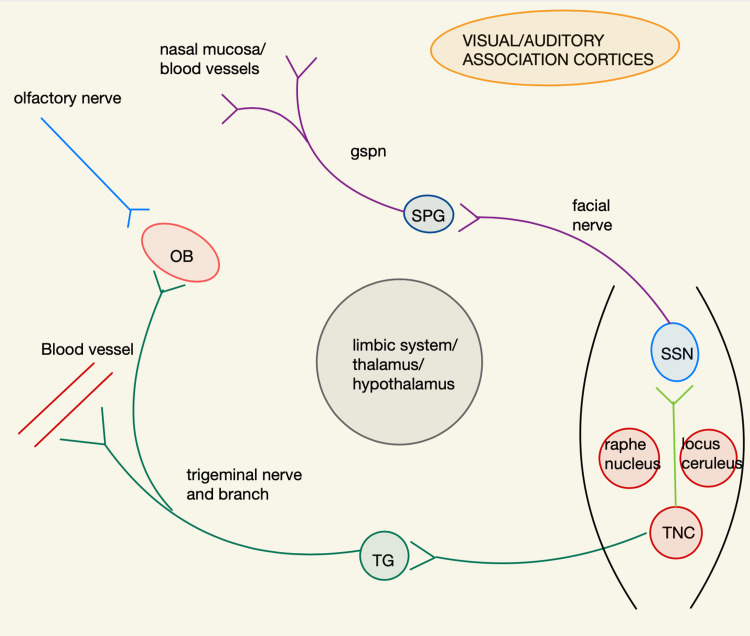
We define a migraine trigger to be an endogenous agent or agency such as the menses or an exogenous agent or agency such as red wine or a drop in barometric pressure, and their ability to reduce the threshold of a migraine attack in those predisposed to migraine. This definition excludes agents with idiosyncratic mechanisms that may trigger a migrainous (migraine-like) headache in non-migraineurs such as benign cough headaches or headaches due to altitude-sickness. We also assume as axiomatic that migraine has as its basis the activation of the trigeminovascular pathway (TVP) and the key role of serotonin and the calcitonin gene-related peptide (CGRP). The network activation of the visual/auditory association cortices and the rostrodorsal pons (locus ceruleus and raphe nucleus) are also accepted as key features of activation of the TVP. In addition, we outline the role of the superior salivatory nucleus-sphenopalatine ganglion-greater superficial petrosal nerve (SSN-SPG-GSPN) arc in migraine activation. We also explore how olfactory afferents intermingle with trigeminal nerve collaterals in the glomeruli of the olfactory bulb thus allowing volatile molecules to activate the TVP and induce a migraine. The classification of migraine triggers is complex, as there is a wide panorama of inciting agents, including atmospheric conditions, a wide-ranging variety of foods and beverages, endogenous hormonal influences, synthetic alkaloids and dyes, and volatile molecules (odorants). We will explore the high-frequency migraine-provoking agents in each category. There are exciting and intriguing hypotheses regarding the role of atmospheric chemistry when the barometric pressure drops; the role of hot, dry desert winds and lightning discharges in the generation of cations and the turnover of serotonin in the nervous system. We will explore the effects of a drop in barometric pressure on the vestibular nuclei and the modulation of sympathetically mediated pain. The role of volatile odorants and their activation of the transient receptor potential ankyrin-1 (TRPA-1) receptor will be outlined. We will streamline the highly complex role of estrogen fluctuation in the precipitation of migraine headaches, its pharmacodynamic effects, and the role of the sexually dimorphic nucleus of the preoptic area (SDN-POA) of the hypothalamus. We will also adumbrate the protean effects of alcohol and its congeners and the role of stress and sleep disturbances in the allostatic load model of salience network-pain perception.
我们将偏头痛触发因素定义为内源性因素或介质(如月经)或外源性因素或介质(如红酒或气压下降),以及它们在偏头痛易感人群中降低偏头痛发作阈值的能力。该定义排除了具有特殊机制的因素,这些因素可能在非偏头痛患者中引发偏头痛样头痛,如良性咳嗽性头痛或高原病引起的头痛。我们还将偏头痛的基础假定为三叉神经血管通路(TVP)的激活以及血清素和降钙素基因相关肽(CGRP)的关键作用。视觉/听觉联合皮质和吻背侧脑桥(蓝斑和中缝核)的网络激活也被认为是TVP激活的关键特征。此外,我们概述了上涎核-蝶腭神经节-岩大浅神经(SSN-SPG-GSPN)弧在偏头痛激活中的作用。我们还探讨了嗅觉传入神经如何在嗅球的肾小球中与三叉神经分支相互交织,从而使挥发性分子激活TVP并诱发偏头痛。偏头痛触发因素的分类很复杂,因为诱发因素范围广泛,包括大气条件、各种各样的食物和饮料、内源性激素影响、合成生物碱和染料以及挥发性分子(气味剂)。我们将探讨每一类中高频诱发偏头痛的因素。关于气压下降时大气化学的作用、炎热干燥的沙漠风以及闪电放电在阳离子生成和神经系统中血清素周转中的作用,存在令人兴奋且引人入胜的假说。我们将探讨气压下降对前庭核的影响以及交感神经介导疼痛的调节。将概述挥发性气味剂及其对瞬时受体电位锚蛋白-1(TRPA-1)受体的激活作用。我们将简化雌激素波动在偏头痛性头痛发作、其药效学作用以及下丘脑视前区性二态核(SDN-POA)的作用中极其复杂的作用。我们还将简述酒精及其同系物的多变效应以及压力和睡眠障碍在突显网络-疼痛感知的应激负荷模型中的作用。