Zhao Luo-Peng, Liu Lu, Pei Pei, Qu Zheng-Yang, Zhu Yu-Pu, Wang Lin-Peng
Department of Acupuncture and Moxibustion, Beijing Hospital of Traditional Chinese Medicine, Capital Medical University, Beijing, China.
Beijing University of Chinese Medicine, Beijing, China.
Neural Regen Res. 2017 May;12(5):804-811. doi: 10.4103/1673-5374.206652.
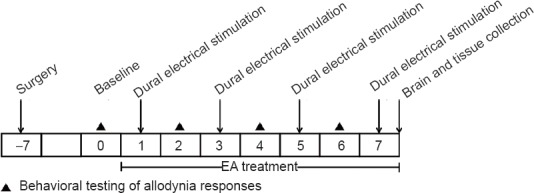
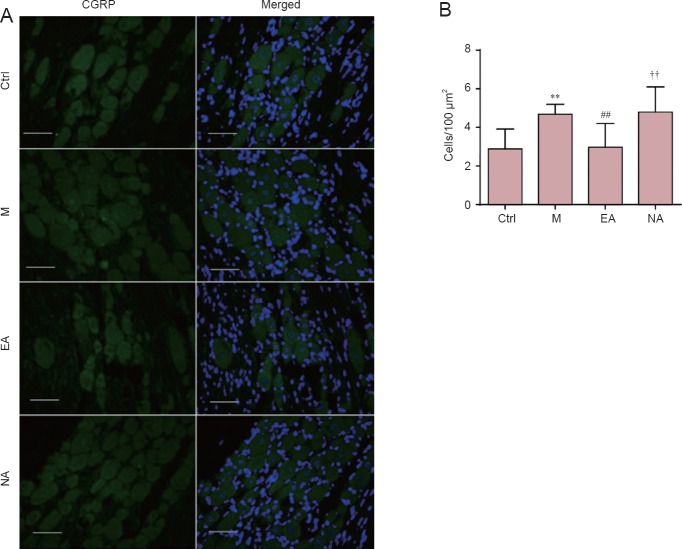
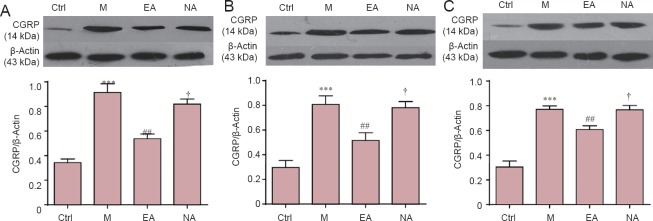
Most migraine patients suffer from cutaneous allodynia; however, the underlying mechanisms are unclear. Calcitonin gene-related peptide (CGRP) plays an important role in the pathophysiology of migraine, and it is therefore, a potential therapeutic target for treating the pain. In the present study, a rat model of conscious migraine, induced by repeated electrical stimulation of the superior sagittal sinus, was established and treated with electroacupuncture at (GB20) (depth of 2-3 mm, frequency of 2/15 Hz, intensity of 0.5-1.0 mA, 15 minutes/day, for 7 consecutive days). Electroacupuncture at GB20 significantly alleviated the decrease in hind paw and facial withdrawal thresholds and significantly lessened the increase in the levels of CGRP in the trigeminal ganglion, trigeminal nucleus caudalis and ventroposterior medial thalamic nucleus in rats with migraine. No CGRP-positive cells were detected in the trigeminal nucleus caudalis or ventroposterior medial thalamic nucleus by immunofluorescence. Our findings suggest that electroacupuncture treatment ameliorates migraine pain and associated cutaneous allodynia by modulating the trigeminovascular system ascending pathway, at least in part by inhibiting CGRP expression in the trigeminal ganglion.
大多数偏头痛患者患有皮肤异常性疼痛;然而,其潜在机制尚不清楚。降钙素基因相关肽(CGRP)在偏头痛的病理生理学中起重要作用,因此,它是治疗疼痛的一个潜在治疗靶点。在本研究中,通过反复电刺激上矢状窦建立了清醒偏头痛大鼠模型,并针刺(GB20)(深度2 - 3毫米,频率2/15赫兹,强度0.5 - 1.0毫安,每天15分钟,连续7天)进行治疗。针刺GB20显著减轻了偏头痛大鼠后爪和面部撤离阈值的降低,并显著减轻了三叉神经节、三叉神经尾核和丘脑腹后内侧核中CGRP水平的升高。通过免疫荧光在三叉神经尾核或丘脑腹后内侧核中未检测到CGRP阳性细胞。我们的研究结果表明,针刺治疗至少部分通过抑制三叉神经节中CGRP的表达,调节三叉神经血管系统上行通路,从而改善偏头痛疼痛和相关的皮肤异常性疼痛。