Columbia University New York NY.
Christiana Care Health System Newark DE.
J Am Heart Assoc. 2021 May 18;10(10):e020361. doi: 10.1161/JAHA.120.020361. Epub 2021 May 6.
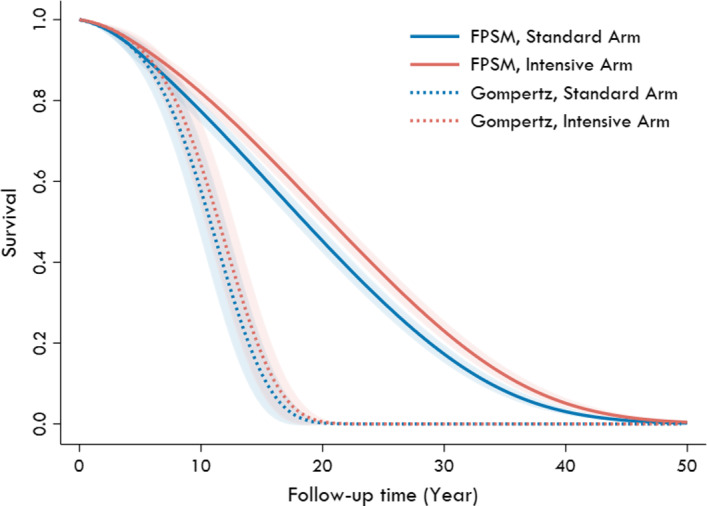
Background Intensive systolic blood pressure treatment (<120 mm Hg) in SPRINT (Systolic Blood Pressure Intervention Trial) improved survival compared with standard treatment (<140 mm Hg) over a median follow-up of 3.3 years. We projected life expectancy after observed follow-up in SPRINT using SPRINT-eligible participants in the NHLBI-PCS (National Heart, Lung, and Blood Institute Pooled Cohorts Study). Methods and Results We used propensity scores to weight SPRINT-eligible NHLBI-PCS participants to resemble SPRINT participants. In SPRINT participants, we estimated in-trial survival (<4 years) using a time-based flexible parametric survival model. In SPRINT-eligible NHLBI-PCS participants, we estimated posttrial survival (≥4 years) using an age-based flexible parametric survival model and applied the formula to SPRINT participants to predict posttrial survival. We projected overall life expectancy for each SPRINT participant and compared it to parametric regression (eg, Gompertz) projections based on SPRINT data alone. We included 8584 SPRINT and 10 593 SPRINT-eligible NHLBI-PCS participants. After propensity weighting, mean (SD) age was 67.9 (9.4) and 68.2 (8.8) years, and 35.5% and 37.6% were women in SPRINT and NHLBI-PCS, respectively. Using the NHLBI-PCS-based method, projected mean life expectancy from randomization was 21.0 (7.4) years with intensive and 19.1 (7.2) years with standard treatment. Using the Gompertz regression, life expectancy was 11.2 (2.3) years with intensive and 10.5 (2.2) years with standard treatment. Conclusions Combining SPRINT and NHLBI-PCS observed data likely offers a more realistic estimate of life expectancy than parametrically extrapolating SPRINT data alone. These results offer insight into the potential long-term effectiveness of intensive SBP goals.
背景 在 SPRINT(收缩压干预试验)中,强化收缩压治疗(<120mmHg)与标准治疗(<140mmHg)相比,在中位随访 3.3 年后改善了生存率。我们使用 NHLBI-PCS(美国国立心肺血液研究所 pooled cohorts 研究)中的 SPRINT 合格参与者,对 SPRINT 观察随访后的预期寿命进行了预测。
方法和结果 我们使用倾向评分对 NHLBI-PCS 中的 SPRINT 合格参与者进行加权,以使其类似于 SPRINT 参与者。在 SPRINT 参与者中,我们使用基于时间的灵活参数生存模型估计试验内生存(<4 年)。在 SPRINT 合格的 NHLBI-PCS 参与者中,我们使用基于年龄的灵活参数生存模型估计试验后生存(≥4 年),并将该公式应用于 SPRINT 参与者以预测试验后生存。我们对每个 SPRINT 参与者进行了总体预期寿命预测,并将其与仅基于 SPRINT 数据的参数回归(例如 Gompertz)预测进行了比较。我们纳入了 8584 名 SPRINT 和 10593 名 SPRINT 合格的 NHLBI-PCS 参与者。经过倾向评分加权后,平均(SD)年龄分别为 67.9(9.4)和 68.2(8.8)岁,分别有 35.5%和 37.6%的参与者为女性。使用 NHLBI-PCS 为基础的方法,随机分组后的预期平均寿命为强化治疗组 21.0(7.4)年,标准治疗组 19.1(7.2)年。使用 Gompertz 回归,强化治疗组的预期寿命为 11.2(2.3)年,标准治疗组为 10.5(2.2)年。
结论 结合 SPRINT 和 NHLBI-PCS 的观察数据,可能比单独参数外推 SPRINT 数据更能真实地估计预期寿命。这些结果为强化 SBP 目标的潜在长期有效性提供了一些见解。