Department of Biology, Wesleyan University, Middletown, Connecticut, United States of America.
Center for Bioethics, Harvard Medical School, Boston, Massachusetts, United States of America.
PLoS One. 2021 May 6;16(5):e0249933. doi: 10.1371/journal.pone.0249933. eCollection 2021.
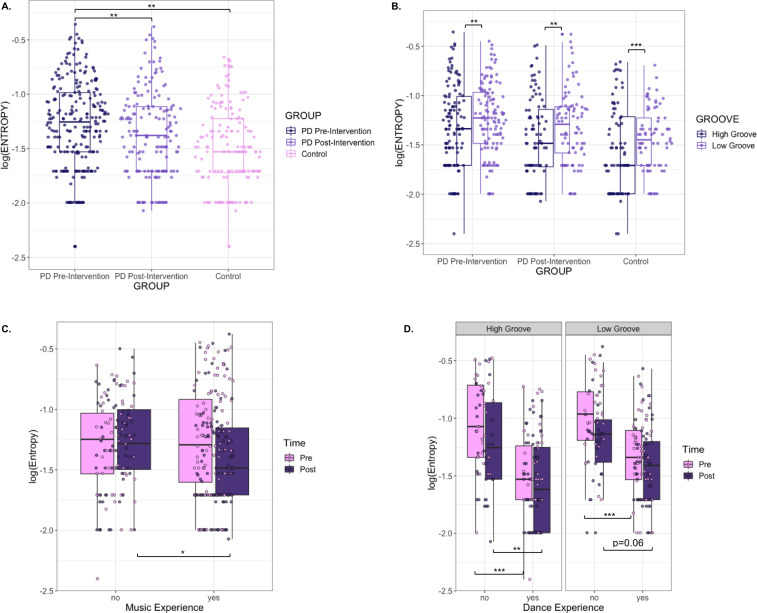
Parkinson's disease (PD) is associated with a loss of internal cueing systems, affecting rhythmic motor tasks such as walking and speech production. Music and dance encourage spontaneous rhythmic coupling between sensory and motor systems; this has inspired the development of dance programs for PD. Here we assessed the therapeutic outcome and some underlying cognitive mechanisms of dance classes for PD, as measured by neuropsychological assessments of disease severity as well as quantitative assessments of rhythmic ability and sensorimotor experience. We assessed prior music and dance experience, beat perception (Beat Alignment Test), sensorimotor coupling (tapping to high- and low-groove songs), and disease severity (Unified Parkinson's Disease Rating Scale in PD individuals) before and after four months of weekly dance classes. PD individuals performed better on UPDRS after four months of weekly dance classes, suggesting efficacy of dance intervention. Greater post-intervention improvements in UPDRS were associated with the presence of prior dance experience and with more accurate sensorimotor coupling. Prior dance experience was additionally associated with enhanced sensorimotor coupling during tapping to both high-groove and low-groove songs. These results show that dance classes for PD improve both qualitative and quantitative assessments of disease symptoms. The association between these improvements and dance experience suggests that rhythmic motor training, a mechanism underlying dance training, impacts improvements in parkinsonian symptoms following a dance intervention.
帕金森病(PD)与内部提示系统的丧失有关,影响到诸如行走和言语产生等有节奏的运动任务。音乐和舞蹈鼓励感官和运动系统之间自发的节奏耦合;这激发了针对 PD 的舞蹈项目的发展。在这里,我们评估了舞蹈课对 PD 的治疗效果和一些潜在的认知机制,方法是通过神经心理学评估疾病严重程度以及对节奏能力和感觉运动体验的定量评估。我们评估了音乐和舞蹈经验、节拍感知(节拍对齐测试)、感觉运动耦合(敲击高节奏和低节奏歌曲)以及疾病严重程度(PD 个体的统一帕金森病评定量表),在进行四个月的每周舞蹈课程前后。PD 个体在四个月的每周舞蹈课程后在 UPDRS 上的表现更好,表明舞蹈干预的有效性。在 UPDRS 中的后续干预改善与之前的舞蹈经验以及更准确的感觉运动耦合相关。之前的舞蹈经验还与敲击高节奏和低节奏歌曲时的感觉运动耦合增强有关。这些结果表明,针对 PD 的舞蹈课程可改善疾病症状的定性和定量评估。这些改善与舞蹈经验之间的关联表明,节奏运动训练是舞蹈训练的基础机制,会影响舞蹈干预后帕金森症状的改善。