Department of Neurology, Johns Hopkins School of Medicine, Baltimore, Maryland, USA.
Department of Epidemiology, Johns Hopkins Bloomberg School of Public Health, Baltimore, Maryland, USA.
Clin Infect Dis. 2022 Feb 11;74(3):427-436. doi: 10.1093/cid/ciab407.
People with autoimmune or inflammatory conditions taking immunomodulatory/suppressive medications may have higher risk of novel coronavirus disease 2019 (COVID-19). Chronic disease care has also changed for many patients, with uncertain downstream consequences.
We included participants with autoimmune or inflammatory conditions followed by specialists at Johns Hopkins. Participants completed periodic surveys querying comorbidities, disease-modifying medications, exposures, COVID-19 testing and outcomes, social behaviors, and disruptions to healthcare. We assessed whether COVID-19 risk is higher among those on immunomodulating or suppressive agents and characterized pandemic-associated changes to care and mental health.
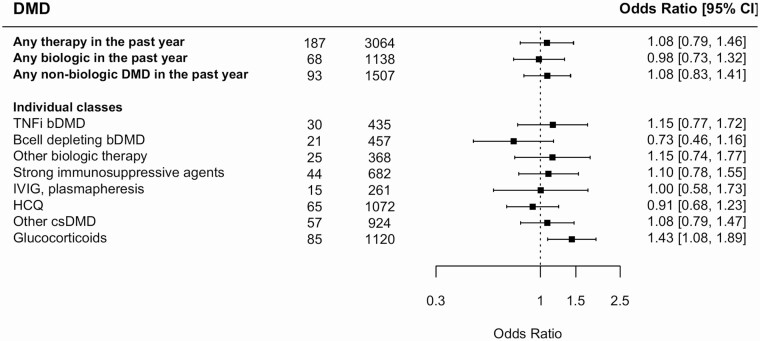
In total, 265 (5.6%) developed COVID-19 over 9 months of follow-up (April-December 2020). Patient characteristics (age, race, comorbidity, medications) were associated with differences in social distancing behaviors during the pandemic. Glucocorticoid exposure was associated with higher odds of COVID-19 in models incorporating behavior and other potential confounders (odds ratio [OR]: 1.43; 95% confidence interval [CI]: 1.08, 1.89). Other medication classes were not associated with COVID-19 risk. Diabetes (OR: 1.72; 95% CI: 1.08, 2.73), cardiovascular disease (OR: 1.68; 95% CI: 1.24, 2.28), and kidney disease (OR: 1.76; 95% CI: 1.04, 2.97) were associated with higher odds of COVID-19. Of the 2156 reporting pre-pandemic utilization of infusion, mental health or rehabilitative services, 975 (45.2%) reported disruptions therein, which disproportionately affected individuals experiencing changes to employment or income.
Glucocorticoid exposure may increase risk of COVID-19 in people with autoimmune or inflammatory conditions. Disruption to healthcare and related services was common. Those with pandemic-related reduced income may be most vulnerable to care disruptions.
服用免疫调节/抑制药物的自身免疫或炎症性疾病患者患 2019 年新型冠状病毒病(COVID-19)的风险可能更高。许多患者的慢性病护理也发生了变化,其后续影响尚不确定。
我们纳入了在约翰霍普金斯接受专家治疗的自身免疫或炎症性疾病患者。参与者定期完成调查,询问合并症、疾病修饰药物、暴露、COVID-19 检测和结果、社会行为以及医疗保健中断情况。我们评估了免疫调节剂或抑制剂使用者的 COVID-19 风险是否更高,并描述了大流行相关的护理和心理健康变化。
在 9 个月的随访期间(2020 年 4 月至 12 月),共有 265 人(5.6%)发生 COVID-19。患者特征(年龄、种族、合并症、药物)与大流行期间的社交距离行为差异有关。在纳入行为和其他潜在混杂因素的模型中,糖皮质激素暴露与 COVID-19 的更高几率相关(比值比 [OR]:1.43;95%置信区间 [CI]:1.08,1.89)。其他药物类别与 COVID-19 风险无关。糖尿病(OR:1.72;95% CI:1.08,2.73)、心血管疾病(OR:1.68;95% CI:1.24,2.28)和肾脏疾病(OR:1.76;95% CI:1.04,2.97)与 COVID-19 的更高几率相关。在 2156 名报告大流行前使用输注、心理健康或康复服务的患者中,975 名(45.2%)报告服务中断,这主要影响到就业或收入发生变化的患者。
糖皮质激素暴露可能会增加自身免疫或炎症性疾病患者感染 COVID-19 的风险。医疗保健和相关服务的中断很常见。与大流行相关的收入减少的人可能最容易受到医疗服务中断的影响。