Pattern Recognition Lab-Computer Science, Friedrich-Alexander Universität Erlangen-Nürnberg (FAU), Erlangen, Germany.
Department of Internal Medicine 3-Rheumatology and Immunology, FAU Erlangen-Nürnberg and Universitätsklinikum Erlangen, Erlangen, Germany.
Sci Rep. 2021 May 6;11(1):9697. doi: 10.1038/s41598-021-89111-9.
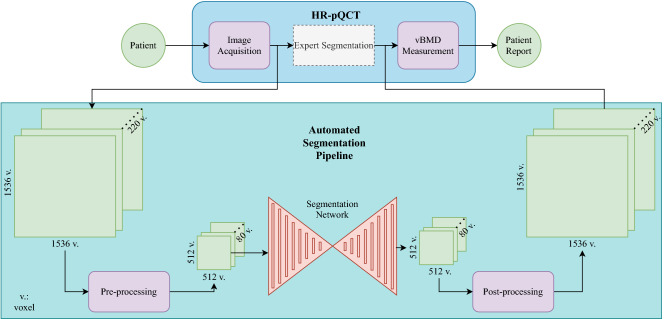
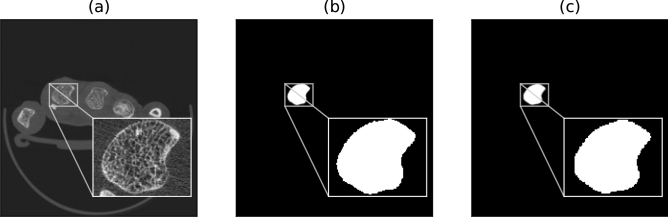
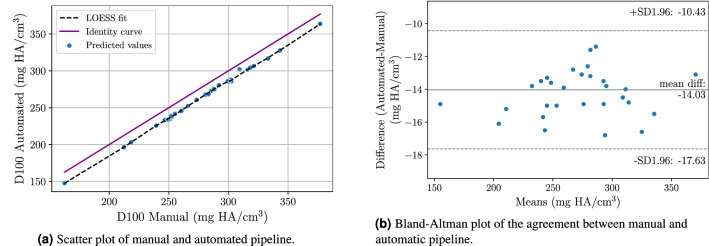
Arthritis patients develop hand bone loss, which leads to destruction and functional impairment of the affected joints. High resolution peripheral quantitative computed tomography (HR-pQCT) allows the quantification of volumetric bone mineral density (vBMD) and bone microstructure in vivo with an isotropic voxel size of 82 micrometres. However, image-processing to obtain bone characteristics is a time-consuming process as it requires semi-automatic segmentation of the bone. In this work, a fully automatic vBMD measurement pipeline for the metacarpal (MC) bone using deep learning methods is introduced. Based on a dataset of HR-pQCT volumes with MC measurements for 541 patients with arthritis, a segmentation network is trained. The best network achieves an intersection over union as high as 0.94 and a Dice similarity coefficient of 0.97 while taking only 33 s to process a whole patient yielding a speedup between 2.5 and 4.0 for the whole workflow. Strong correlation between the vBMD measurements of the expert and of the automatic pipeline are achieved for the average bone density with 0.999 (Pearson) and 0.996 (Spearman's rank) with [Formula: see text] for all correlations. A qualitative assessment of the network predictions and the manual annotations yields a 65.9% probability that the expert favors the network predictions. Further, the steps to integrate the pipeline into the clinical workflow are shown. In order to make these workflow improvements available to others, we openly share the code of this work.
关节炎患者会出现手部骨量流失,进而导致受影响关节的破坏和功能障碍。高分辨率外周定量计算机断层扫描(HR-pQCT)允许以 82 微米的各向同性体素大小对容积骨矿物质密度(vBMD)和骨微观结构进行体内定量。然而,为了获得骨特征,图像处理是一个耗时的过程,因为它需要对骨骼进行半自动分割。在这项工作中,引入了一种使用深度学习方法对掌骨(MC)进行全自动 vBMD 测量的流水线。基于包含 541 名关节炎患者 HR-pQCT 容积和 MC 测量值的数据集,训练了一个分割网络。最佳网络的交并比高达 0.94,骰子相似系数为 0.97,而处理整个患者只需 33 秒,整个工作流程的速度提高了 2.5 到 4.0 倍。专家和自动流水线的 vBMD 测量值之间具有很强的相关性,平均骨密度的相关系数为 0.999(皮尔逊)和 0.996(斯皮尔曼等级),所有相关系数的 [Formula: see text]。对网络预测和手动注释的定性评估得出专家倾向于网络预测的概率为 65.9%。此外,还展示了将流水线集成到临床工作流程中的步骤。为了使其他人能够利用这些工作流程的改进,我们公开共享这项工作的代码。