Lohr W David, Wanta Jonathon W, Baker Megan, Grudnikoff Eugene, Morgan Wynne, Chhabra Divya, Lee Terry
Division of Child and Adolescent Psychiatry, Department of Pediatrics, University of Louisville, Louisville, KY, United States.
Department of Psychiatry and Behavioral Sciences, University of Washington, Seattle, WA, United States.
Front Psychiatry. 2021 Apr 20;12:642798. doi: 10.3389/fpsyt.2021.642798. eCollection 2021.
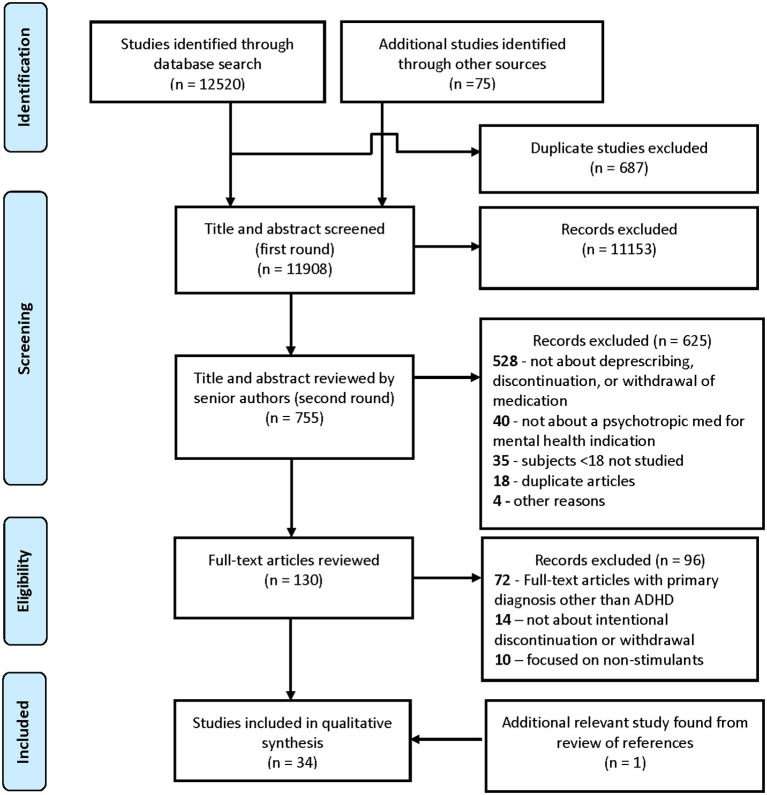
This paper reviews the literature on intentional discontinuation of psychostimulants in ADHD to summarize what is known about clinical course of controlled discontinuation and guide practitioners who are considering stopping these medications for youth with ADHD. A systematic search was executed in Cochrane CENTRAL, EMBASE, Psychinfo, and MEDLINE databases to identify all articles that addressed the topic of deprescribing of psychotropic medications in children and adolescents. Keywords and search strings were developed using "PICO" framework, involving Population of interest (<18 y.o.), Intervention ("discontinuation," "deprescribing," and synonyms), Comparator (continuation of specific medications), and Outcomes. Ten reviewers conducted the initial screen a single reviewer system. Articles that met a set of three inclusionary criteria were selected for full text review and identification as specific to discontinuation of stimulants in ADHD. The literature review identified 35 articles specifically addressing intentional deprescribing, discontinuation, tapering, or withdrawal of stimulants for children and adolescents with ADHD. In addition to providing broad support for the efficacy of stimulants to treat ADHD and reduce negative outcomes, there is a distinct population of children and adolescents with ADHD who do not relapse or deteriorate when taken off medications for ADHD. The majority of articles addressed either the re-emergence of ADHD symptoms or side effects, both desired and adverse, following discontinuation of stimulants. While confirming the ability of stimulants to treat ADHD in youth, our results support periodic consideration of trials of stopping medications to determine continued need. This systematic review summarizes the literature on deprescribing stimulants for ADHD in children and adolescents. Further research is needed to determine the optimal duration of treatment, identify patients that may benefit from medication discontinuation, and inform evidence-based guidelines for discontinuation when appropriate. More research is needed to understand and define the subgroup of youth who may succeed with stimulant discontinuation.
本文回顾了关于注意力缺陷多动障碍(ADHD)患者有意停用精神兴奋剂的文献,以总结关于有控制地停药的临床过程的已知情况,并为考虑为患有ADHD的青少年停用这些药物的从业者提供指导。在考克兰中央对照试验注册库、荷兰医学文摘数据库、心理学文摘数据库和医学文献数据库中进行了系统检索,以确定所有涉及儿童和青少年精神药物减停主题的文章。使用“PICO”框架制定关键词和检索词,包括目标人群(<18岁)、干预措施(“停药”“减停药物”及同义词)、对照(继续使用特定药物)和结局。十名评审员进行了初步筛选——采用单评审员系统。符合一组三项纳入标准的文章被选出来进行全文评审,并确定为专门针对ADHD患者停用兴奋剂的文章。文献综述确定了35篇专门论述为患有ADHD的儿童和青少年有意减停药物、停药、逐渐减量或撤药的文章。除了为兴奋剂治疗ADHD和减少负面结果的疗效提供广泛支持外,有一部分患有ADHD的儿童和青少年在停用ADHD药物后不会复发或病情恶化。大多数文章论述了停用兴奋剂后ADHD症状的再次出现或副作用,包括预期的和不良的。在证实兴奋剂治疗青少年ADHD能力的同时,我们的结果支持定期考虑进行停药试验以确定是否仍有持续用药的需求。这项系统综述总结了关于为儿童和青少年ADHD患者减停兴奋剂的文献。需要进一步研究以确定最佳治疗时长,确定可能从停药中获益的患者,并在适当时为停药提供循证指南。需要更多研究来了解和界定可能成功停用兴奋剂的青少年亚组。