Institute of Pediatrics, The Second Xiangya Hospital, Central South University, Changsha, China.
Laboratory of Pediatric Nephrology, Institute of Pediatrics, The Second Xiangya Hospital, Central South University, Changsha, China.
Front Immunol. 2021 Apr 20;12:676082. doi: 10.3389/fimmu.2021.676082. eCollection 2021.
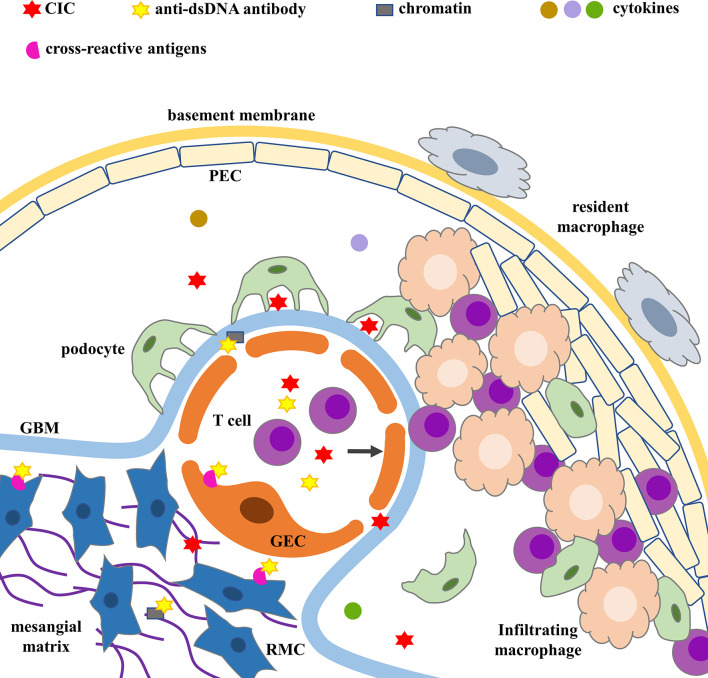
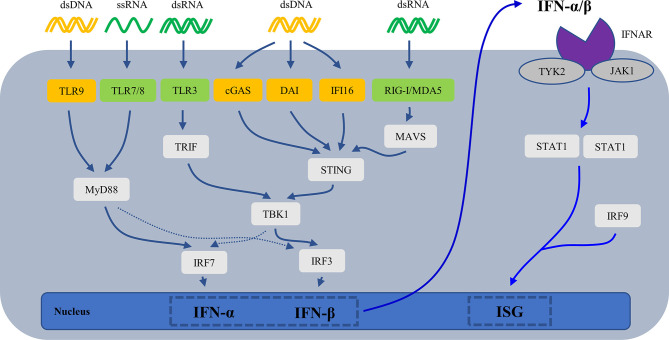
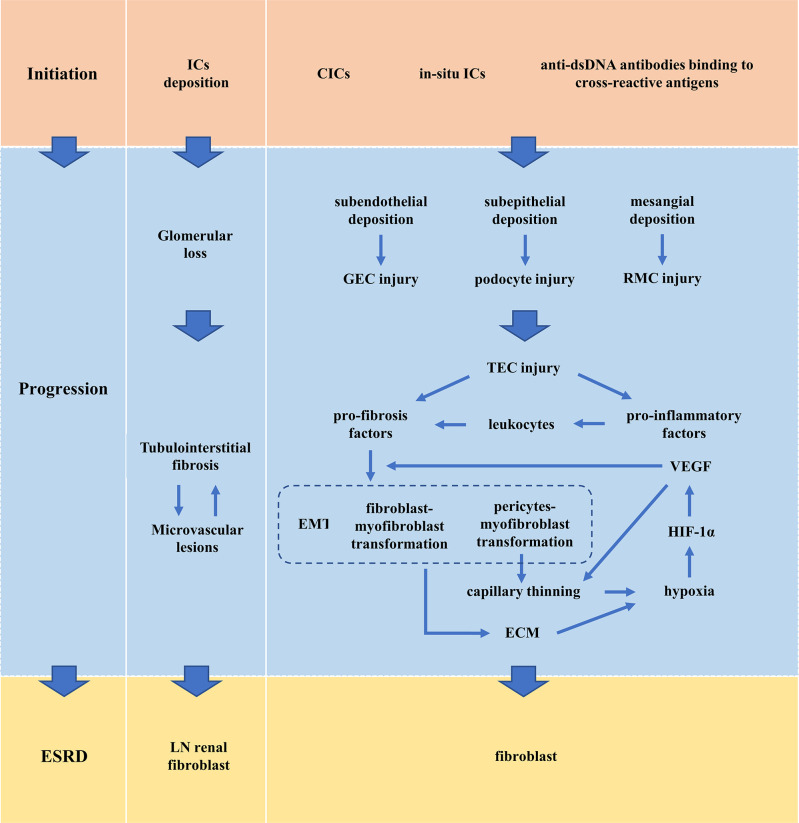
Lupus nephritis (LN) is a common complication of systemic lupus erythematosus (SLE) and a major risk factor for morbidity and mortality. The abundant cell-free nucleic (DNA/RNA) in SLE patients, especially dsDNA, is a key substance in the pathogenesis of SLE and LN. The deposition of DNA/RNA-immune complexes (DNA/RNA-ICs) in the glomerulus causes a series of inflammatory reactions that lead to resident renal cell disturbance and eventually renal fibrosis. Cell-free DNA/RNA is the most effective inducer of type I interferons (IFN-I). Resident renal cells (rather than infiltrating immune cells) are the main source of IFN-I in the kidney. IFN-I in turn damages resident renal cells. Not only are resident renal cells victims, but also participants in this immunity war. However, the mechanism for generation of IFN-I in resident renal cells and the pathological mechanism of IFN-I promoting renal fibrosis have not been fully elucidated. This paper reviews the latest epidemiology of LN and its development process, discusses the mechanism for generation of IFN-I in resident renal cells and the role of IFN-I in the pathogenesis of LN, and may open a new perspective for the treatment of LN.
狼疮肾炎 (LN) 是系统性红斑狼疮 (SLE) 的常见并发症,也是发病率和死亡率的主要危险因素。SLE 患者体内存在大量的无细胞游离核酸(DNA/RNA),特别是双链 DNA(dsDNA),是 SLE 和 LN 发病机制中的关键物质。DNA/RNA-免疫复合物(DNA/RNA-ICs)在肾小球中的沉积会引发一系列炎症反应,导致固有肾细胞紊乱,最终导致肾纤维化。无细胞游离 DNA/RNA 是诱导 I 型干扰素(IFN-I)的最有效物质。固有肾细胞(而非浸润免疫细胞)是肾脏中 IFN-I 的主要来源。IFN-I 反过来又会损伤固有肾细胞。固有肾细胞不仅是受害者,也是这场免疫战争的参与者。然而,固有肾细胞中 IFN-I 的产生机制以及 IFN-I 促进肾纤维化的病理机制尚未完全阐明。本文综述了 LN 的最新流行病学及其发展过程,讨论了固有肾细胞中 IFN-I 的产生机制以及 IFN-I 在 LN 发病机制中的作用,可能为 LN 的治疗开辟新的视角。