Zhao Meng, Qin Jianpin, Shen Wenting, Wu Aiping
Department of Pediatrics, Xiangyang Central Hospital, Affiliated Hospital of Hubei University of Arts and Science, Xiangyang, 441021 Hubei Province, China.
Biomed Res Int. 2021 Apr 17;2021:8835408. doi: 10.1155/2021/8835408. eCollection 2021.
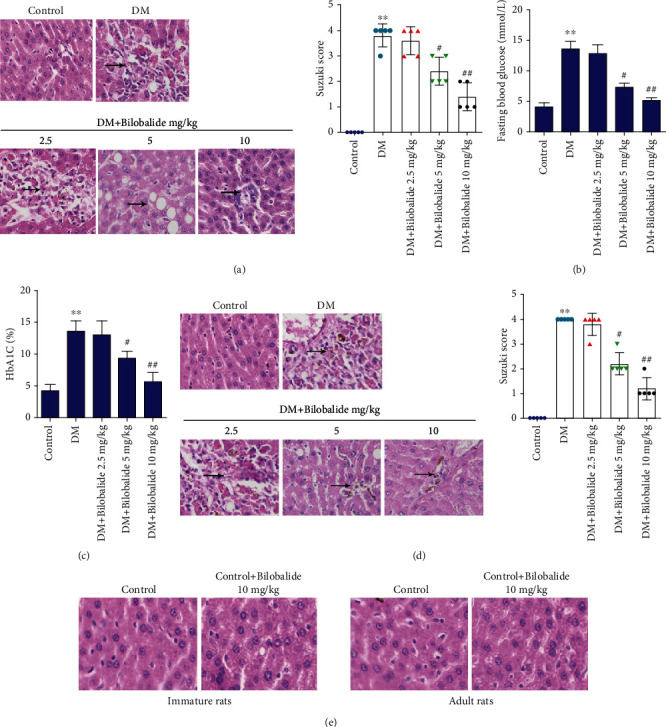
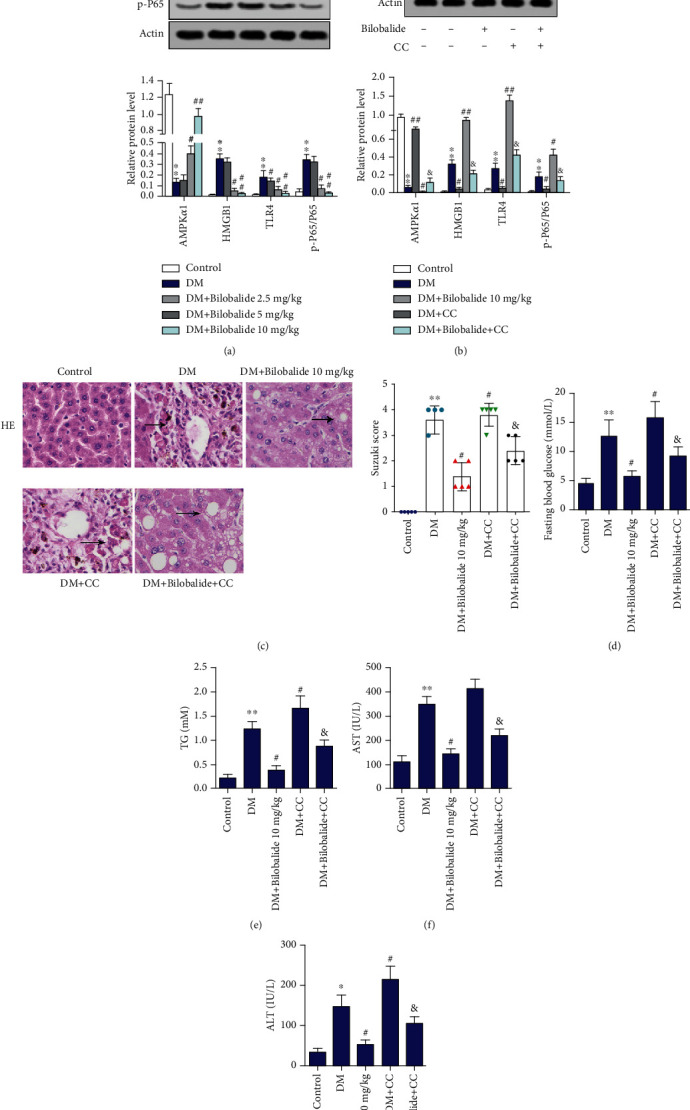
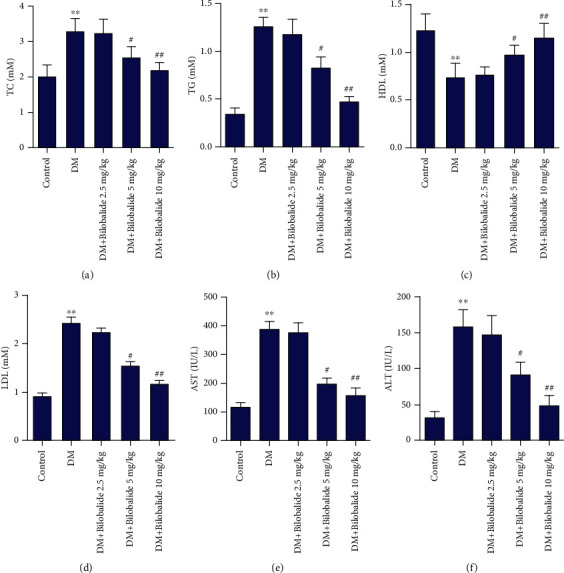
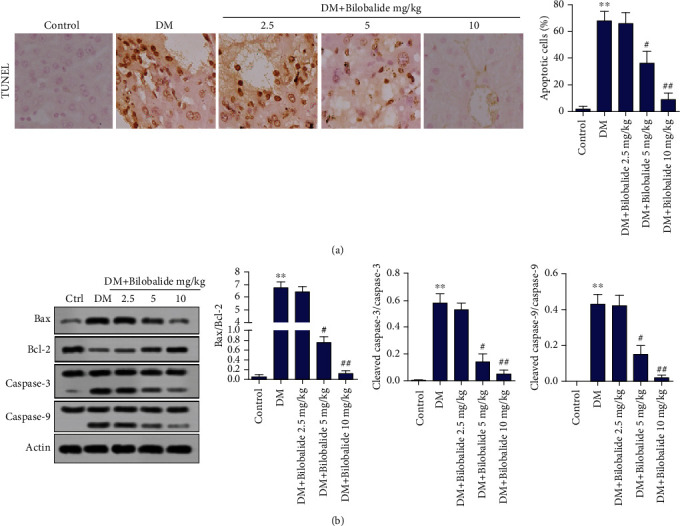
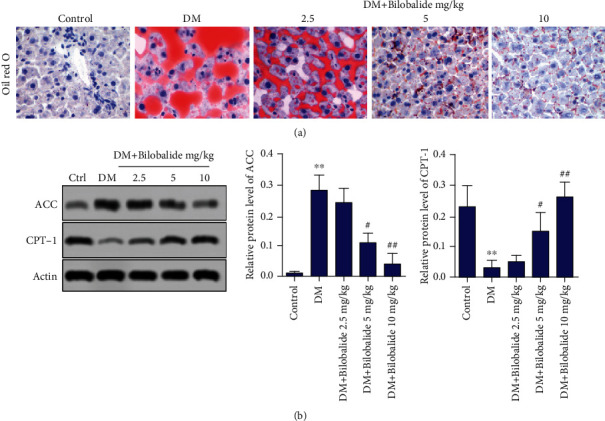
This study was aimed at examining the effect and underlying mechanisms of bilobalide (BB) on hepatic injury in streptozotocin- (STZ-) induced diabetes mellitus (DM) in immature rats. Immature rats (one day old) were randomly divided into five groups: group I, control nondiabetic rats; group II, STZ-induced, untreated diabetic rats; groups III/IV/V, STZ-induced and BB-treated diabetic rats, which were intraperitoneally injected with BB (2.5 mg/kg, 5 mg/kg, or 10 mg/kg) after 3 days followed by STZ treatment. We observed that BB improved the histopathological changes and maintained normal glucose metabolism, blood lipid, and liver function indicators, such as fasting blood glucose, obesity index, HbA1c, HOMA-IR, fast serum insulin, adiponectin, total cholesterol (TC), triglyceride (TG), high-density lipoprotein (HDL), low-density lipoprotein (LDL), aspartate transaminase (AST), and alanine transaminase (ALT) in STZ-induced DM in immature rats by a biochemical analyzer or ELISA. Meanwhile, Western blot analysis showed that in STZ-induced DM immature rats, BB decreased the expression of apoptosis-related proteins Bax, cleaved caspase-3, and cleaved caspase-9 while enhancing the Bcl-2 expression; BB downregulated the expression of ACC related to fat anabolism, while upregulating the expression of CPT-1 related to fat catabolism. Strikingly, treatment with BB significantly increased the expression of AMPK1 as well as inhibited HMGB1, TLR4, and p-P65 expression in hepatic tissues of immature DM rats. AMPK inhibitor (compound C, CC) cotreated with BB undermined the protective effect of BB on the liver injury. The results of the present study suggested BB may have a significant role in alleviating liver damage in the STZ-induced immature DM rats.
本研究旨在探讨白果内酯(BB)对链脲佐菌素(STZ)诱导的未成熟大鼠糖尿病(DM)肝损伤的影响及其潜在机制。将未成熟大鼠(1日龄)随机分为五组:第一组,对照非糖尿病大鼠;第二组,STZ诱导的未治疗糖尿病大鼠;第三/四/五组,STZ诱导且经BB治疗的糖尿病大鼠,在3天后腹腔注射BB(2.5mg/kg、5mg/kg或10mg/kg),随后进行STZ处理。我们观察到,通过生化分析仪或ELISA检测,BB改善了未成熟大鼠STZ诱导的DM中的组织病理学变化,并维持了正常的糖代谢、血脂和肝功能指标,如空腹血糖、肥胖指数、糖化血红蛋白(HbA1c)、胰岛素抵抗指数(HOMA-IR)、空腹血清胰岛素、脂联素、总胆固醇(TC)、甘油三酯(TG)、高密度脂蛋白(HDL)、低密度脂蛋白(LDL)、天冬氨酸转氨酶(AST)和丙氨酸转氨酶(ALT)。同时,蛋白质印迹分析表明,在STZ诱导的DM未成熟大鼠中,BB降低了凋亡相关蛋白Bax、裂解的半胱天冬酶-3和裂解的半胱天冬酶-9的表达,同时增强了Bcl-2的表达;BB下调了与脂肪合成代谢相关的乙酰辅酶A羧化酶(ACC)的表达,同时上调了与脂肪分解代谢相关的肉碱棕榈酰转移酶-1(CPT-1)的表达。引人注目的是,用BB治疗显著增加了未成熟DM大鼠肝组织中腺苷酸活化蛋白激酶1(AMPK1)的表达,并抑制了高迁移率族蛋白B1(HMGB1)、Toll样受体4(TLR4)和磷酸化P65的表达。与BB共同处理的AMPK抑制剂(化合物C,CC)削弱了BB对肝损伤的保护作用。本研究结果表明,BB可能在减轻STZ诱导的未成熟DM大鼠的肝损伤中发挥重要作用。