Clinic of Orthodontics and Pediatric Dentistry, Center of Dental Medicine, University of Zurich, Zurich, Switzerland.
J Oral Rehabil. 2021 Aug;48(8):945-954. doi: 10.1111/joor.13178. Epub 2021 May 24.
Mandibular collum fractures among growing patients can lead to abnormal growth, function, esthetics and ultimately quality of life. Among the proposed treatment alternatives, orthopaedic treatment with functional appliances has been suggested, with encouraging results. Aim of the present systematic review was to critically appraise existing evidence on the outcome of functional appliance treatment among growing patients with mandibular collum fractures.
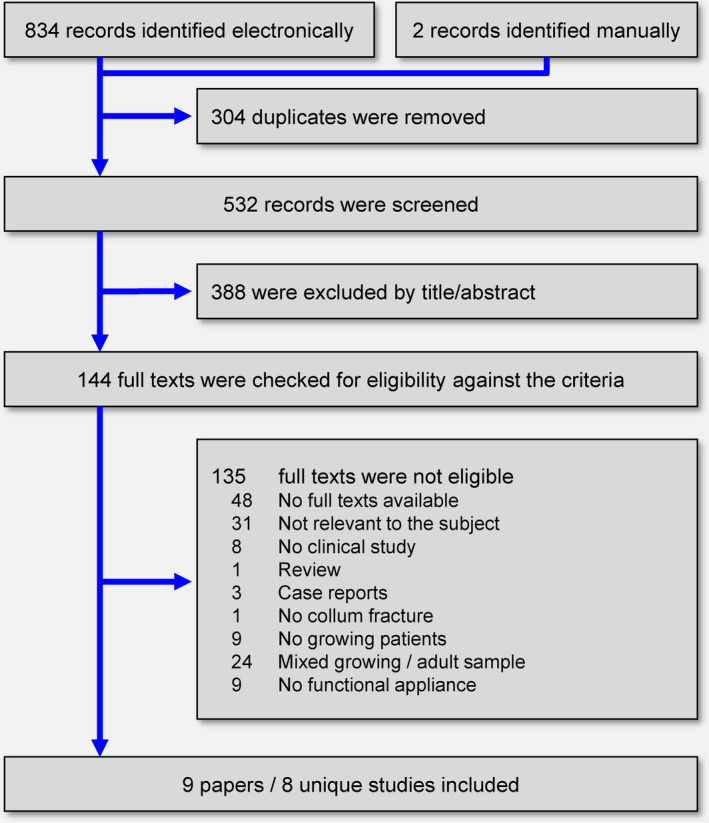
Eight databases were searched up to October 2020 for randomised and non-randomised clinical studies assessing functional appliance treatment outcome for children with mandibular fractures. After duplicate study selection, data extraction and risk of bias assessment, random effects meta-analyses of mean differences (MD) and their 95% confidence intervals (CIs) were performed, followed by assessment of the quality of evidence with GRADE.
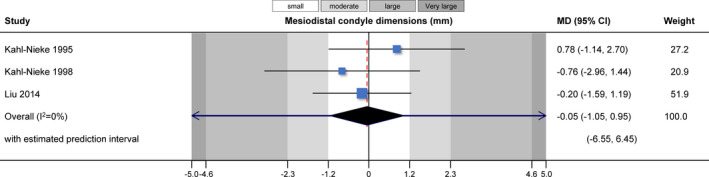
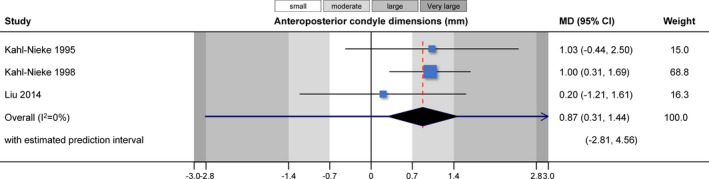
A total of 8 unique studies (one prospective and nine retrospective non-randomised) with 223 children could be identified. Functional appliance treatment was associated with greater anteroposterior condyle dimensions of the injured condyle compared with the contralateral healthy condyle (3 studies; MD = 0.87 mm; 95% CI = 0.30 to 1.45 mm; p = .003). No difference was found in the mesiodistal condyle size between the injured and the contralateral healthy joint (3 studies; MD = -0.05 mm; 95% CI = -1.05 to 0.95 mm; p = .92), but collum length was smaller at the injured side compared with the contralateral one (1 study; MD = -2.89 mm; 95% CI = -5.29 to -0.49 mm; p = .02). Treatment outcome might be influenced by patient age, patient sex and severity/localisation of the fracture, but the quality of evidence for all analyses was very low due to methodological limitations leading to bias.
While some evidence exists that functional appliances might lead to good clinical rehabilitation of fractured mandibular condyles, including considerable bone remodelling, available studies are small and have methodological weaknesses.
生长中的患者下颌骨颈骨折可导致生长、功能、美观和生活质量受到不良影响。在提出的治疗选择中,使用功能矫治器的矫形治疗已被证明具有令人鼓舞的效果。本系统评价的目的是批判性评估现有关于生长中下颌骨颈骨折患者使用功能矫治器治疗结果的证据。
直到 2020 年 10 月,在 8 个数据库中搜索了评估儿童下颌骨骨折使用功能矫治器治疗结果的随机和非随机临床研究。在重复研究选择、数据提取和偏倚风险评估后,对均值差(MD)及其 95%置信区间(CI)进行了随机效应荟萃分析,然后使用 GRADE 评估证据质量。
共确定了 8 项独特的研究(1 项前瞻性和 9 项回顾性非随机),共有 223 名儿童。与对侧健康下颌骨相比,功能矫治器治疗与受伤下颌骨髁的前后向髁突尺寸更大相关(3 项研究;MD=0.87mm;95%CI=0.30 至 1.45mm;p=0.003)。受伤关节和对侧健康关节的髁突近远尺寸无差异(3 项研究;MD=-0.05mm;95%CI=-1.05 至 0.95mm;p=0.92),但受伤侧的髁颈长度小于对侧(1 项研究;MD=-2.89mm;95%CI=-5.29 至-0.49mm;p=0.02)。治疗结果可能受到患者年龄、患者性别和骨折的严重程度/部位的影响,但由于方法学限制导致偏倚,所有分析的证据质量都非常低。
虽然有一些证据表明,功能矫治器可能导致骨折下颌骨髁的良好临床康复,包括相当大的骨重塑,但现有研究规模较小,且存在方法学上的缺陷。