• 文献检索
  • 文档翻译
  • 深度研究
  • 学术资讯
  • Suppr Zotero 插件Zotero 插件
  • 邀请有礼
  • 套餐&价格
  • 历史记录
应用&插件
Suppr Zotero 插件Zotero 插件浏览器插件Mac 客户端Windows 客户端微信小程序
定价
高级版会员购买积分包购买API积分包
服务
文献检索文档翻译深度研究API 文档MCP 服务
关于我们
关于 Suppr公司介绍联系我们用户协议隐私条款
关注我们

Suppr 超能文献

核心技术专利:CN118964589B侵权必究
粤ICP备2023148730 号-1Suppr @ 2026

文献检索

告别复杂PubMed语法,用中文像聊天一样搜索,搜遍4000万医学文献。AI智能推荐,让科研检索更轻松。

立即免费搜索

文件翻译

保留排版,准确专业,支持PDF/Word/PPT等文件格式,支持 12+语言互译。

免费翻译文档

深度研究

AI帮你快速写综述,25分钟生成高质量综述,智能提取关键信息,辅助科研写作。

立即免费体验

用于建模入境限制和旅行检疫对 COVID-19 输入风险的定量影响的综合框架。

An integrated framework for modelling quantitative effects of entry restrictions and travel quarantine on importation risk of COVID-19.

机构信息

Ping An Healthcare Technology, Beijing, China.

Tsinghua Clinical Research Institute (TCRI), School of Medicine, Tsinghua University, Beijing, China; Center for Global Health and Infectious Diseases, School of Medicine and Vanke School of Public Health, Tsinghua University, Beijing, China.

出版信息

J Biomed Inform. 2021 Jun;118:103800. doi: 10.1016/j.jbi.2021.103800. Epub 2021 May 7.

DOI:10.1016/j.jbi.2021.103800
PMID:33965636
原文链接:https://pmc.ncbi.nlm.nih.gov/articles/PMC8102072/
Abstract

OBJECTIVE

As the potential spread of COVID-19 sparked by imported cases from overseas will pose continuous challenges, it is essential to estimate the effects of control measures on reducing the importation risk of COVID-19. Our objective is to provide a framework of methodology for quantifying the combined effects of entry restrictions and travel quarantine on managing the importation risk of COVID-19 and other pandemics by leveraging different sets of parameters.

METHODS

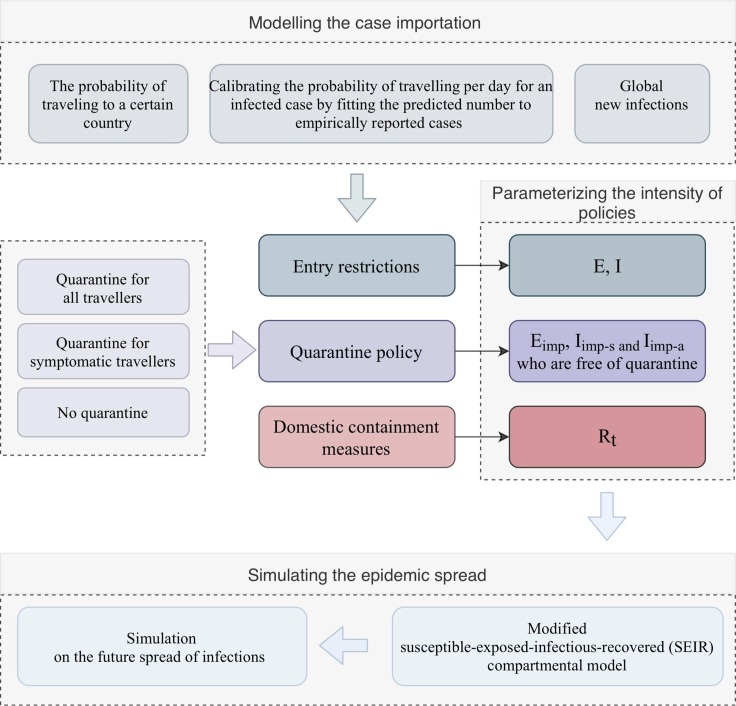
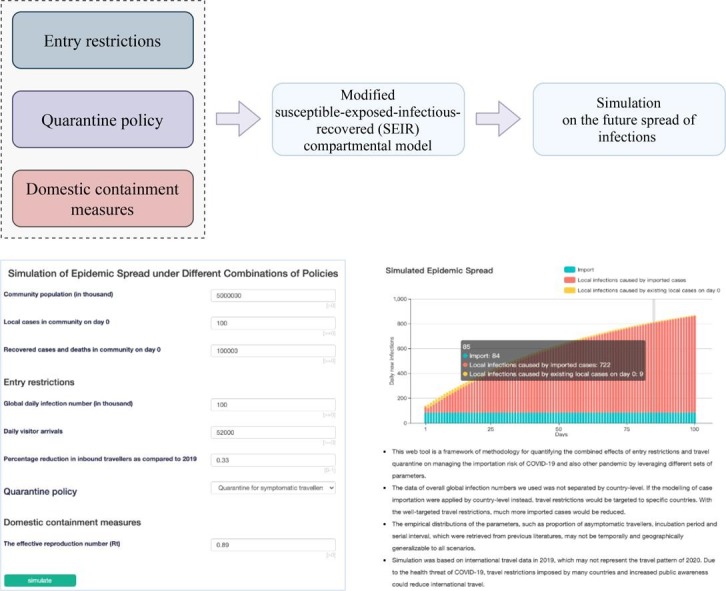
Three major categories of control measures on controlling importation risk were parameterized and modelled by the framework: 1) entry restrictions, 2) travel quarantine, and 3) domestic containment measures. Integrating the parameterized intensity of control measures, a modified SEIR model was developed to simulate the case importation and local epidemic under different scenarios of global epidemic dynamics. A web-based tool was also provided to enable interactive visualization of epidemic simulation.

RESULTS

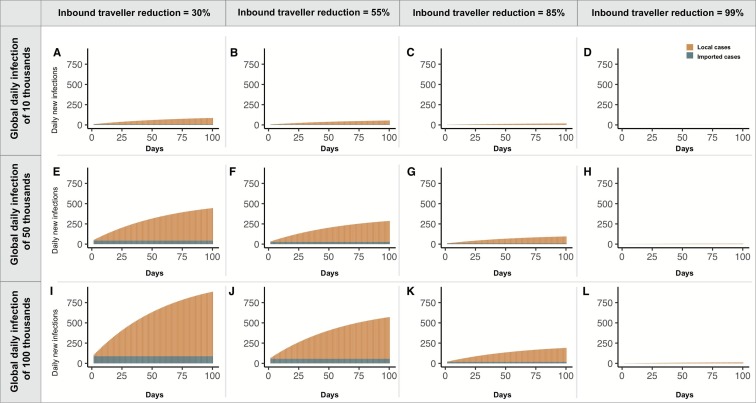
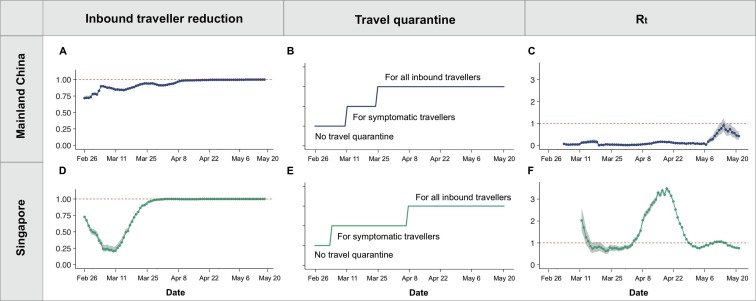
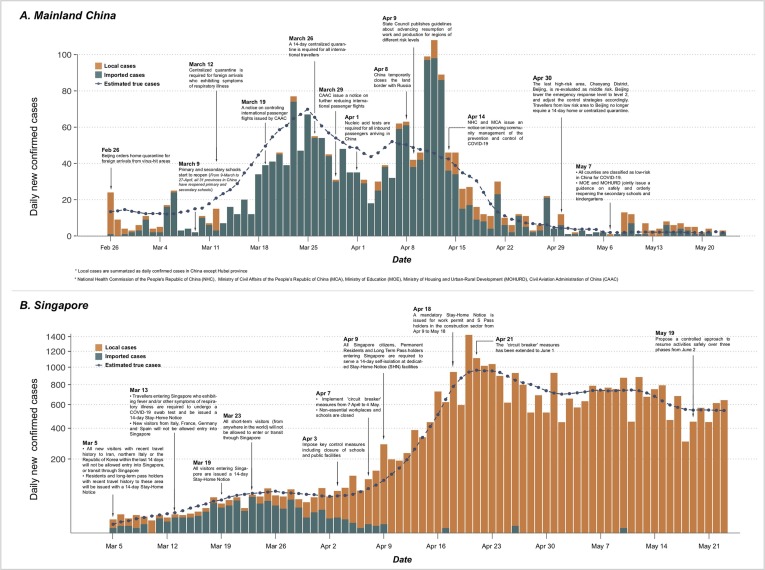
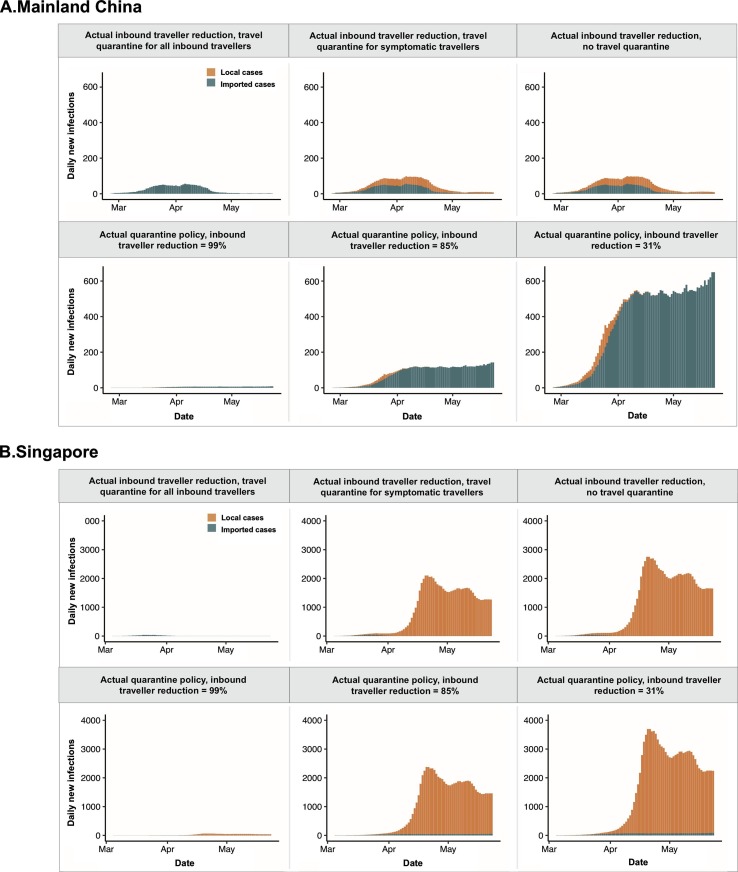
The simulated number of case importation and local spread modelled by the proposed framework of methods fitted well to the historical epidemic curve of China and Singapore. Based on the simulation results, the total numbers of infected cases when reducing 30% of visitor arrivals would be 88·4 (IQR 87·5-89·6) and 58·8 (IQR 58·3-59·5) times more than those when reducing 99% of visitor arrivals in mainland China and Singapore respectively, assuming actual time-varying R and travel quarantine policy. If the number of global daily new infections reached 100,000, 85%-91% of inbound travels should be reduced to keep the daily new infected number below 100 for a country with a similar travel volume as Singapore (daily 52,000 tourist arrivals in 2019). Whereas if the number was lower than 10,000, the daily new infected case would be less than 100 even with no entry restrictions.

DISCUSSIONS

We proposed a framework that first estimated the intensity of travel restrictions and local containment measures for countries since the first overseas imported case. Our approach then quantified the combined effects of entry restrictions and travel quarantine using a modified SEIR model to simulate the potential epidemic spread under hypothetical intensities of these control measures. We also developed a web-based system that enables interactive simulation, which could serve as a valuable tool for health system administrators to assess policy effects on managing the importation risk. By leveraging different sets of parameters, it could adapt to any specific country and specific type of epidemic.

CONCLUSIONS

This framework has provided a valuable tool to parameterize the intensity of control measures, simulate both the case importation and local epidemic, and quantify the combined effects of entry restrictions and travel quarantine on managing the importation risk.

摘要

目的

由于海外输入病例引发的 COVID-19 潜在传播将持续带来挑战,因此有必要评估控制措施对降低 COVID-19 输入风险的效果。我们的目标是提供一种方法框架,通过利用不同参数集,量化入境限制和旅行检疫等控制措施对管理 COVID-19 和其他大流行病输入风险的综合影响。

方法

通过该框架对控制输入风险的三大类控制措施进行参数化和建模:1)入境限制,2)旅行检疫,和 3)国内遏制措施。整合控制措施的参数化强度,开发了一个改良的 SEIR 模型,以模拟不同全球疫情动态情景下的病例输入和本地疫情。还提供了一个基于网络的工具,以实现疫情模拟的交互式可视化。

结果

所提出的方法框架模拟的病例输入和本地传播数量与中国和新加坡的历史疫情曲线拟合良好。基于模拟结果,当将游客入境人数减少 30%时,中国大陆和新加坡的感染总人数将分别比减少 99%时多出 88.4(IQR 87.5-89.6)和 58.8(IQR 58.3-59.5)倍,假设实际的时变 R 和旅行检疫政策。如果全球每日新增感染人数达到 10 万,那么对于一个旅行量与新加坡类似的国家(2019 年每天有 52000 名游客入境),应减少 85%-91%的入境旅行,以将每日新增感染人数控制在 100 以下。而如果每日新增感染人数低于 10000,则即使没有入境限制,每日新增感染人数也将少于 100。

讨论

我们提出了一个框架,首先根据首例海外输入病例以来的情况,估计各国的旅行限制和本地遏制措施的强度。然后,我们使用改良的 SEIR 模型来量化入境限制和旅行检疫的综合效果,以模拟这些控制措施的假设强度下的潜在疫情传播。我们还开发了一个基于网络的系统,支持交互式模拟,这可以作为卫生系统管理者评估管理输入风险的政策效果的有价值工具。通过利用不同的参数集,它可以适应任何特定国家和特定类型的疫情。

结论

该框架提供了一个有价值的工具,用于参数化控制措施的强度,模拟病例输入和本地疫情,并量化入境限制和旅行检疫对管理输入风险的综合影响。
https://cdn.ncbi.nlm.nih.gov/pmc/blobs/b0f3/8102072/ec4e6d53c8fb/gr5_lrg.jpg
https://cdn.ncbi.nlm.nih.gov/pmc/blobs/b0f3/8102072/4d10bc07653e/ga1_lrg.jpg
https://cdn.ncbi.nlm.nih.gov/pmc/blobs/b0f3/8102072/a8160772cae5/gr1_lrg.jpg
https://cdn.ncbi.nlm.nih.gov/pmc/blobs/b0f3/8102072/d238828d195e/gr2_lrg.jpg
https://cdn.ncbi.nlm.nih.gov/pmc/blobs/b0f3/8102072/1eb43a1d6592/gr3_lrg.jpg
https://cdn.ncbi.nlm.nih.gov/pmc/blobs/b0f3/8102072/c8c6d75f046f/gr4_lrg.jpg
https://cdn.ncbi.nlm.nih.gov/pmc/blobs/b0f3/8102072/ec4e6d53c8fb/gr5_lrg.jpg
https://cdn.ncbi.nlm.nih.gov/pmc/blobs/b0f3/8102072/4d10bc07653e/ga1_lrg.jpg
https://cdn.ncbi.nlm.nih.gov/pmc/blobs/b0f3/8102072/a8160772cae5/gr1_lrg.jpg
https://cdn.ncbi.nlm.nih.gov/pmc/blobs/b0f3/8102072/d238828d195e/gr2_lrg.jpg
https://cdn.ncbi.nlm.nih.gov/pmc/blobs/b0f3/8102072/1eb43a1d6592/gr3_lrg.jpg
https://cdn.ncbi.nlm.nih.gov/pmc/blobs/b0f3/8102072/c8c6d75f046f/gr4_lrg.jpg
https://cdn.ncbi.nlm.nih.gov/pmc/blobs/b0f3/8102072/ec4e6d53c8fb/gr5_lrg.jpg

相似文献

1
An integrated framework for modelling quantitative effects of entry restrictions and travel quarantine on importation risk of COVID-19.用于建模入境限制和旅行检疫对 COVID-19 输入风险的定量影响的综合框架。
J Biomed Inform. 2021 Jun;118:103800. doi: 10.1016/j.jbi.2021.103800. Epub 2021 May 7.
2
Travel-related control measures to contain the COVID-19 pandemic: a rapid review.旅行相关的控制措施以遏制 COVID-19 大流行:快速综述。
Cochrane Database Syst Rev. 2020 Oct 5;10:CD013717. doi: 10.1002/14651858.CD013717.
3
International travel-related control measures to contain the COVID-19 pandemic: a rapid review.国际旅行相关防控措施以遏制 COVID-19 大流行:快速综述。
Cochrane Database Syst Rev. 2021 Mar 25;3(3):CD013717. doi: 10.1002/14651858.CD013717.pub2.
4
Effect of internationally imported cases on internal spread of COVID-19: a mathematical modelling study.国际输入病例对 COVID-19 内部传播的影响:一项数学建模研究。
Lancet Public Health. 2021 Jan;6(1):e12-e20. doi: 10.1016/S2468-2667(20)30263-2. Epub 2020 Dec 7.
5
An evaluation of COVID-19 transmission control in Wenzhou using a modified SEIR model.温州 COVID-19 传播控制的评价:使用改进的 SEIR 模型。
Epidemiol Infect. 2021 Jan 8;149:e2. doi: 10.1017/S0950268820003064.
6
Risk Assessment of Importation and Local Transmission of COVID-19 in South Korea: Statistical Modeling Approach.韩国 COVID-19 输入和本地传播风险评估:统计建模方法。
JMIR Public Health Surveill. 2021 Jun 1;7(6):e26784. doi: 10.2196/26784.
7
Interventions to mitigate early spread of SARS-CoV-2 in Singapore: a modelling study.干预措施以减轻 SARS-CoV-2 在新加坡的早期传播:一项建模研究。
Lancet Infect Dis. 2020 Jun;20(6):678-688. doi: 10.1016/S1473-3099(20)30162-6. Epub 2020 Mar 23.
8
A measure to estimate the risk of imported COVID-19 cases and its application for evaluating travel-related control measures.一种评估输入性 COVID-19 病例风险的方法及其在评估旅行相关控制措施中的应用。
Sci Rep. 2022 Jun 9;12(1):9497. doi: 10.1038/s41598-022-13775-0.
9
Impact of travel ban implementation on COVID-19 spread in Singapore, Taiwan, Hong Kong and South Korea during the early phase of the pandemic: a comparative study.旅行禁令实施对大流行早期新加坡、中国台湾、中国香港和韩国 COVID-19 传播的影响:一项比较研究。
BMC Infect Dis. 2021 Aug 11;21(1):799. doi: 10.1186/s12879-021-06449-1.
10
Strategies at points of entry to reduce importation risk of COVID-19 cases and reopen travel.入境点策略以降低输入性新冠肺炎病例风险并重新开放旅行。
J Travel Med. 2020 Dec 23;27(8). doi: 10.1093/jtm/taaa141.

引用本文的文献

1
Modeling approaches to inform travel-related policies for COVID-19 containment: A scoping review and future directions.为制定与旅行相关的新冠疫情防控政策提供信息的建模方法:一项范围综述及未来方向
Travel Med Infect Dis. 2024 Nov-Dec;62:102730. doi: 10.1016/j.tmaid.2024.102730. Epub 2024 Jun 1.
2
Impact of vaccination and non-pharmacological interventions on COVID-19: a review of simulation modeling studies in Asia.疫苗接种和非药物干预对 COVID-19 的影响:亚洲模拟建模研究综述。
Front Public Health. 2023 Sep 25;11:1252719. doi: 10.3389/fpubh.2023.1252719. eCollection 2023.
3
International air travel-related control measures to contain the Covid-19 pandemic: A companion review to a Cochrane rapid review.

本文引用的文献

1
Quarantine and testing strategies in contact tracing for SARS-CoV-2: a modelling study.追踪 SARS-CoV-2 接触者中的隔离和检测策略:建模研究。
Lancet Public Health. 2021 Mar;6(3):e175-e183. doi: 10.1016/S2468-2667(20)30308-X. Epub 2021 Jan 21.
2
Physical distancing interventions and incidence of coronavirus disease 2019: natural experiment in 149 countries.物理隔离干预措施与 2019 年冠状病毒病发病率:149 个国家的自然实验。
BMJ. 2020 Jul 15;370:m2743. doi: 10.1136/bmj.m2743.
3
Estimating the undetected infections in the Covid-19 outbreak by harnessing capture-recapture methods.
为遏制新冠疫情而采取的与国际航空旅行相关的控制措施:Cochrane快速综述的配套综述
New Microbes New Infect. 2022 Nov-Dec;49:101054. doi: 10.1016/j.nmni.2022.101054. Epub 2022 Nov 25.
4
Novel informatics approaches to COVID-19 Research: From methods to applications.新冠病毒研究的新型信息学方法:从方法到应用
J Biomed Inform. 2022 May;129:104028. doi: 10.1016/j.jbi.2022.104028. Epub 2022 Feb 16.
利用捕获再捕获方法估计新冠疫情中的未检出感染。
Int J Infect Dis. 2020 Aug;97:197-201. doi: 10.1016/j.ijid.2020.06.009. Epub 2020 Jun 11.
4
Individual quarantine versus active monitoring of contacts for the mitigation of COVID-19: a modelling study.个体隔离与接触者主动监测在减轻 COVID-19 中的应用比较:一项建模研究。
Lancet Infect Dis. 2020 Sep;20(9):1025-1033. doi: 10.1016/S1473-3099(20)30361-3. Epub 2020 May 20.
5
Outbreak dynamics of COVID-19 in Europe and the effect of travel restrictions.欧洲新冠疫情的爆发动态及旅行限制的影响。
Comput Methods Biomech Biomed Engin. 2020 Aug;23(11):710-717. doi: 10.1080/10255842.2020.1759560. Epub 2020 May 5.
6
Effect of non-pharmaceutical interventions to contain COVID-19 in China.中国采取的非药物性干预措施对遏制 2019 冠状病毒病的效果。
Nature. 2020 Sep;585(7825):410-413. doi: 10.1038/s41586-020-2293-x. Epub 2020 May 4.
7
Early diagnosis and rapid isolation: response to COVID-19 outbreak in Korea.早期诊断与快速隔离:韩国应对新冠疫情的举措
Clin Microbiol Infect. 2020 Jul;26(7):805-807. doi: 10.1016/j.cmi.2020.04.025. Epub 2020 Apr 25.
8
Decreased Influenza Incidence under COVID-19 Control Measures, Singapore.新冠防控措施下新加坡流感发病率降低。
Emerg Infect Dis. 2020 Aug;26(8):1933-1935. doi: 10.3201/eid2608.201229. Epub 2020 Apr 27.
9
Impact assessment of non-pharmaceutical interventions against coronavirus disease 2019 and influenza in Hong Kong: an observational study.非药物干预措施对 2019 年冠状病毒病和流感在香港的影响评估:一项观察性研究。
Lancet Public Health. 2020 May;5(5):e279-e288. doi: 10.1016/S2468-2667(20)30090-6. Epub 2020 Apr 17.
10
First-wave COVID-19 transmissibility and severity in China outside Hubei after control measures, and second-wave scenario planning: a modelling impact assessment.中国湖北省以外地区采取控制措施后第一波 COVID-19 的传染性和严重程度,以及第二波疫情情景规划:模型影响评估。
Lancet. 2020 Apr 25;395(10233):1382-1393. doi: 10.1016/S0140-6736(20)30746-7. Epub 2020 Apr 8.