College of Coastal Agricultural Sciences, Guangdong Ocean University, Zhanjiang, China.
Beijing General Station of Animal Husbandry, Beijing, China.
Poult Sci. 2021 Jun;100(6):101111. doi: 10.1016/j.psj.2021.101111. Epub 2021 Mar 17.
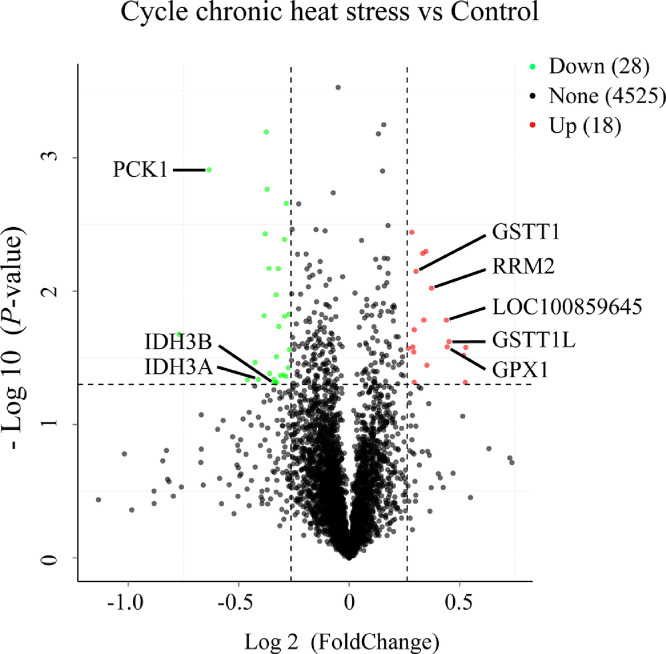
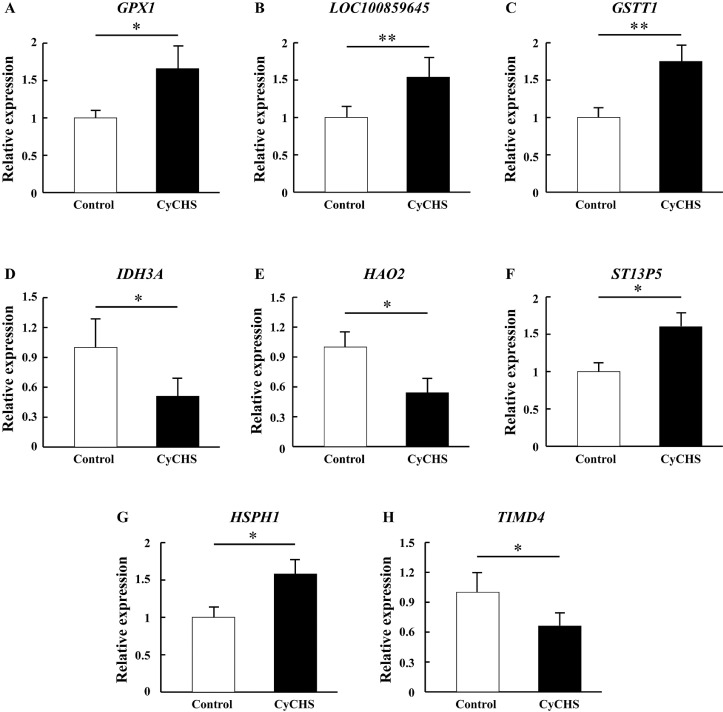
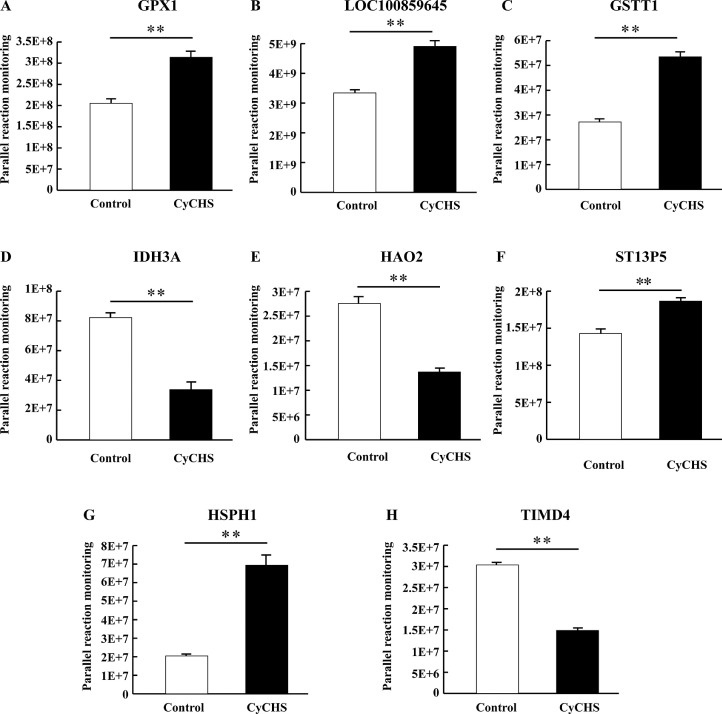
Heat stress (HS) is one of the main environmental factors affecting the efficiency of poultry production. The yellow-feather chickens (YFC) as an indigenous strain of chicken is a popular poultry breed in China. Our previous study used the RNA-seq to analyze the gene expression profiles of male YFC under HS and showed that the lipid and energy metabolism pathways are activated in livers of YFC exposed to acute HS (38°C, 4 h and 25°C recovery 2 h). In this study, we used quantitative proteome analysis based on iTRAQ to study the liver response of YFC to cycle chronic HS (38 ± 1°C, 8 h/d, 7 d, CyCHS). The male YFCs treatment used the CyCHS from 22 to 28 days of age. The liver tissue samples were collected at 28 d old. A total of 39,327 unique peptides matches were detected using iTRAQ analysis and 4,571 proteins exhibited a false discovery rate of 1% or less. Forty-six significant differentially expressed proteins (DEPs) were detected in the CyCHS group compared with the control group for the liver samples, including up- and down-regulated DEPs were 18 and 28, respectively. We found that the enriched biological process terms of the DEPs expressed in the liver were related to DNA metabolic process, oxidation-reduction process, oxidative stress and gluconeogenesis. In KEGG pathway analysis. Most of the hepatic DEPs were annotated to glutathione metabolism and TCA cycle in response to CyCHS. The up-regulation of 5 DEPs (GPX1, GSTT1, GSTT1L, RRM2, and LOC100859645) in the glutathione metabolism pathway likely reflects an attempt to deal with oxidative damage by CyCHS. The down-regulation of 3 DEPs (Isocitrate dehydrogenase [IDH3A], IDH3B, and phosphoenolpyruvate carboxykinase 1) in the TCA cycle pathway contributes to the regulation mechanism of energy metabolism and probably to cope with the balance of heat production and dissipation during CyCHS in order to adapt to high temperature environments. Our results provide insights into the potential molecular mechanism in heat-induced oxidative stress and energy in YFCs and future studies will investigate the functional genes associated with the response to HS.
热应激(HS)是影响家禽生产效率的主要环境因素之一。黄羽鸡(YFC)作为一种本土鸡种,是中国受欢迎的家禽品种。我们之前的研究使用 RNA-seq 分析了雄性 YFC 在 HS 下的基因表达谱,结果表明,暴露于急性 HS(38°C,4 小时和 25°C 恢复 2 小时)的 YFC 肝脏中激活了脂质和能量代谢途径。在这项研究中,我们使用基于 iTRAQ 的定量蛋白质组分析来研究 YFC 对周期性慢性 HS(38±1°C,8 小时/天,7 天,CyCHS)的肝脏反应。雄性 YFC 从 22 到 28 天龄进行 CyCHS 处理。在 28 天龄时采集肝脏组织样本。使用 iTRAQ 分析共检测到 39327 个独特的肽匹配,4571 种蛋白质的假发现率为 1%或更低。与对照组相比,CyCHS 组的肝脏样本中检测到 46 个显著差异表达蛋白(DEPs),包括上调和下调的 DEPs 分别为 18 和 28 个。我们发现,肝脏中表达的 DEPs 的富集生物过程术语与 DNA 代谢过程、氧化还原过程、氧化应激和糖异生有关。在 KEGG 途径分析中。大多数肝 DEPs 被注释为谷胱甘肽代谢和 TCA 循环,以响应 CyCHS。谷胱甘肽代谢途径中 5 个 DEPs(GPX1、GSTT1、GSTT1L、RRM2 和 LOC100859645)的上调可能反映了 CyCHS 引起的氧化损伤的处理尝试。TCA 循环途径中 3 个 DEPs(异柠檬酸脱氢酶 [IDH3A]、IDH3B 和磷酸烯醇丙酮酸羧激酶 1)的下调有助于能量代谢的调节机制,可能有助于在 CyCHS 期间平衡产热和散热,以适应高温环境。我们的结果提供了关于 YFC 中热诱导氧化应激和能量的潜在分子机制的见解,未来的研究将研究与 HS 反应相关的功能基因。