Department of Emergency Medicine, University of Nebraska Medical Center, Omaha, NE, United States of America.
Department of Microbiology/Pathology, University of Nebraska Medical Center, Omaha, NE, United States of America.
Am J Emerg Med. 2021 Sep;47:253-257. doi: 10.1016/j.ajem.2021.04.082. Epub 2021 Apr 30.
As a result of the COVID-19 pandemic and highly contagious nature of SARS-CoV-2, emergency departments (EDs) have been forced to implement new measures and protocols to minimize the spread of the disease within their departments. The primary objective of this study was to determine if the implementation of a designated COVID-19 cohort area (hot zone) within a busy ED mitigated the dissemination of SARS-CoV-2 throughout the rest of the department.
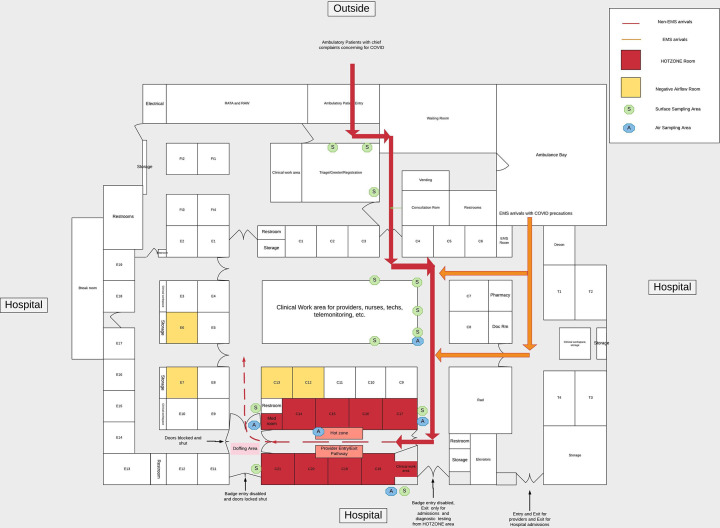
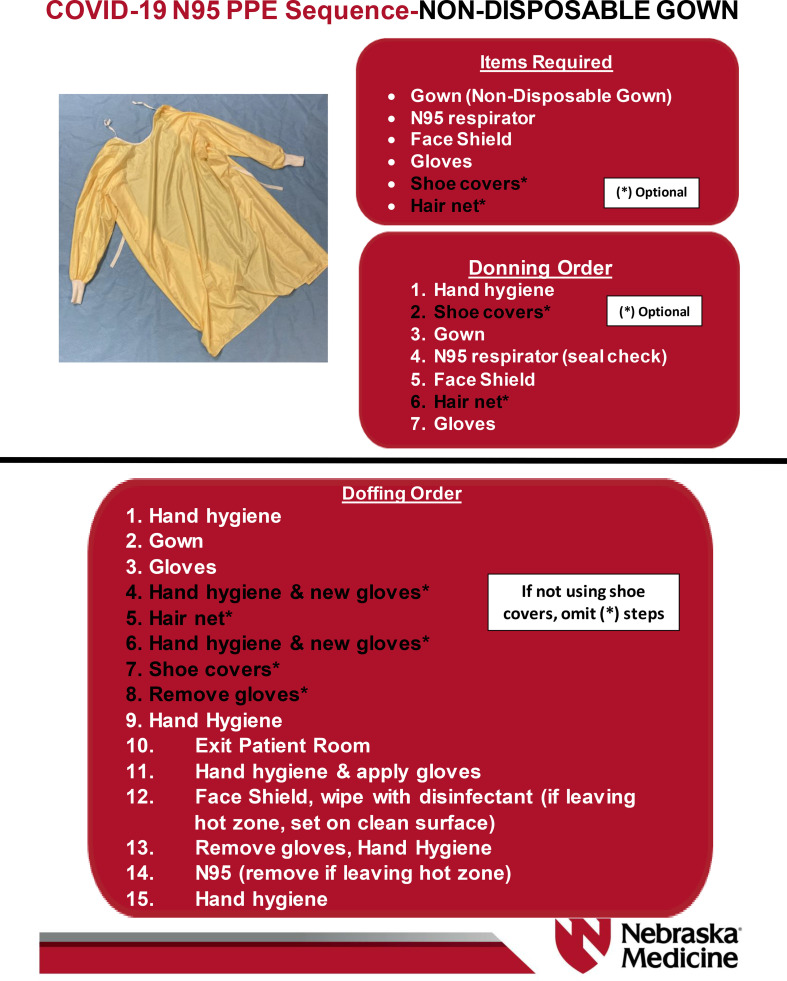
In an ED of a tertiary academic medical center, with 64,000 annual visits, an eight room pod was designated for known COVID-19 or individuals with high suspicion for infection. There was a single entry and exit for donning and doffing personal protective equipment (PPE). Health care workers (HCW) changed gowns and gloves between patients, but maintained their N-95 mask and face shield, cleaning the shield with a germicidal wipe between patients. Staffing assignments designated nurses and technicians to remain in this area for 4 h, where physicians regularly moved between the hot zone and rest of the ED. Fifteen surface samples and four air samples were taken to evaluate SARS-CoV-2 contamination levels and the effectiveness of infection control practices. Samples were collected outside of patient rooms in 3 primary ED patient care areas, the reception area, the primary nurses station, inside the cohort area, and the PPE donning and doffing areas immediately adjacent. Samples were recovered and analyzed for the presence of the E gene of SARS-CoV-2 using RT-PCR.
SARS-CoV-2 was not detected on any surface samples, including in and around the cohort area. All air samples outside the COVID-19 hot zone were negative for SARS-CoV-2, but air samples within the cohort area had a low level of viral contamination.
A designated COVID-19 cohort area resulted in no air or surface contamination outside of the hot zone, and only minimal air, but no surface contamination, within the hot zone.
由于 COVID-19 大流行和 SARS-CoV-2 的高传染性,急诊部(ED)被迫实施新措施和协议,以最大限度地减少疾病在部门内的传播。本研究的主要目的是确定在繁忙的 ED 内设立指定的 COVID-19 病房(热区)是否减轻了 SARS-CoV-2 在整个部门的传播。
在一个拥有 64000 次年度就诊量的三级学术医疗中心的 ED 中,指定了一个有八个房间的吊舱用于已知的 COVID-19 或高度怀疑感染的患者。只有一个入口和出口用于穿戴和脱下个人防护设备(PPE)。医护人员(HCW)在患者之间更换手术服和手套,但保持他们的 N-95 口罩和面罩,用杀菌擦拭巾在患者之间清洁面罩。工作人员分配指定护士和技术员在该区域工作 4 小时,医生则定期在热区和 ED 的其他区域之间移动。采集了 15 个表面样本和 4 个空气样本,以评估 SARS-CoV-2 污染水平和感染控制实践的效果。样本采集于 3 个 ED 患者护理区、接待区、初级护士站、病房区以及紧邻的 PPE 穿戴和脱卸区之外的患者房间外。使用 RT-PCR 从样本中回收并分析 SARS-CoV-2 的 E 基因的存在。
未在任何表面样本中检测到 SARS-CoV-2,包括在病房区内外。COVID-19 热区外的所有空气样本均未检测到 SARS-CoV-2,但病房区内的空气样本有低水平的病毒污染。
指定的 COVID-19 病房区未导致热区外的空气或表面污染,仅在热区内有轻微的空气,但无表面污染。