Shen Jialei, Kong Meng, Dong Bing, Birnkrant Michael J, Zhang Jianshun
Department of Mechanical and Aerospace Engineering, Syracuse University, 263 Link Hall, Syracuse, NY, 13244, USA.
Carrier Corporation, 6304 Thompson Road, East Syracuse, NY, 13057, USA.
Build Environ. 2021 Aug;200:107926. doi: 10.1016/j.buildenv.2021.107926. Epub 2021 Apr 30.
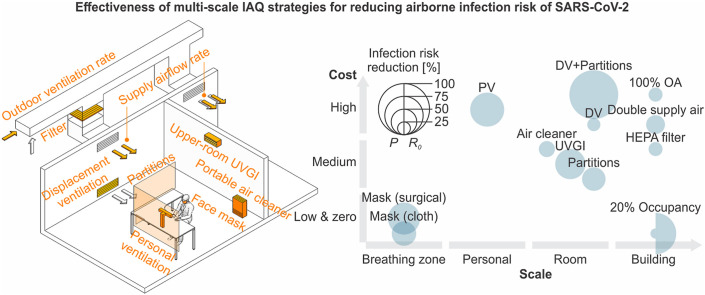
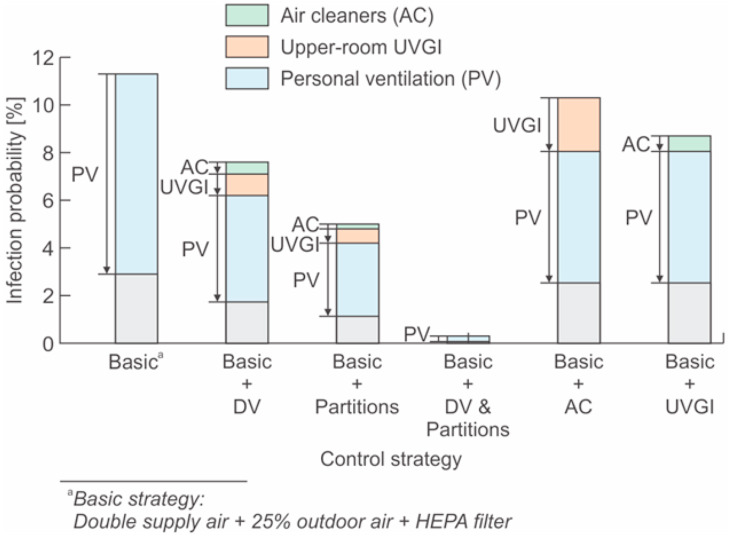
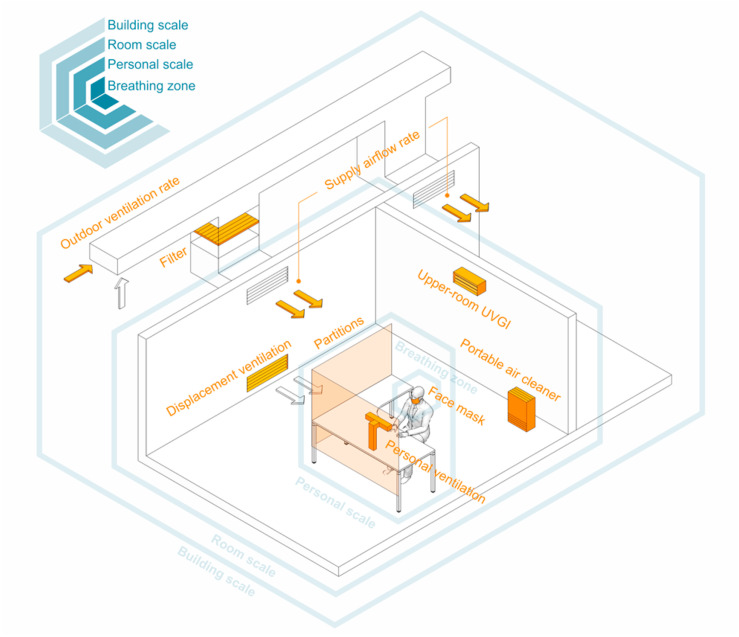
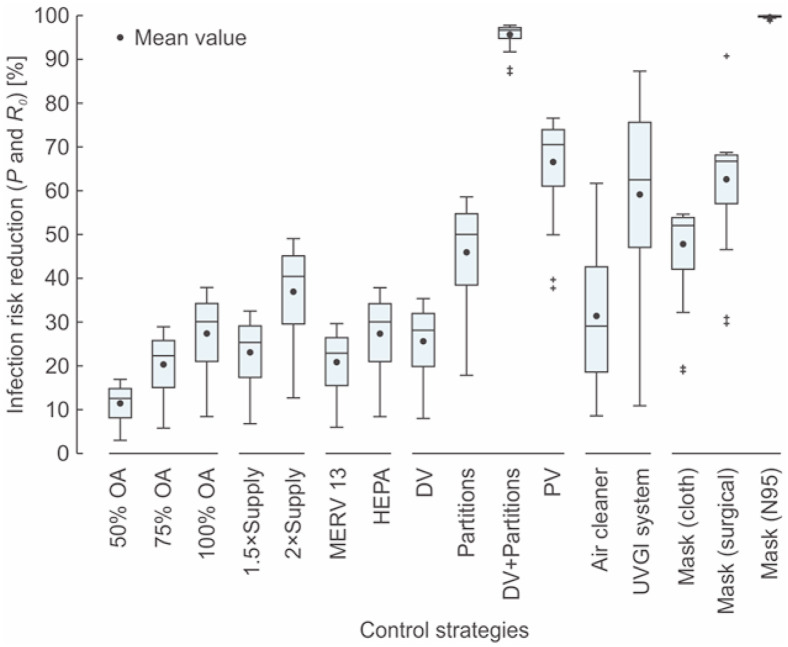
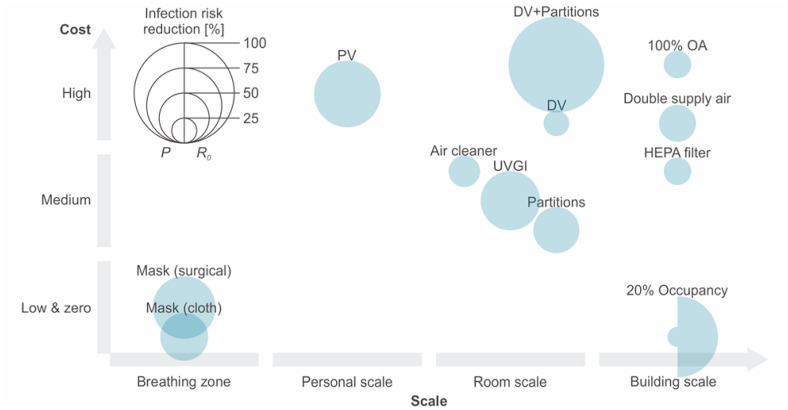
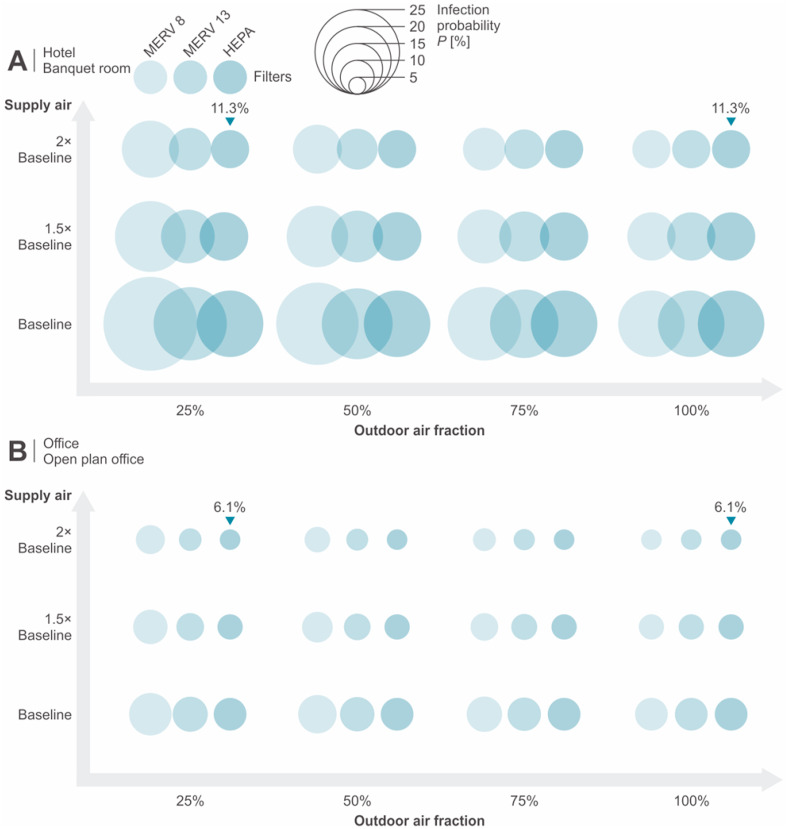
The unprecedented coronavirus disease 2019 (COVID-19) pandemic caused by the severe acute respiratory syndrome coronavirus 2 (SARS-CoV-2) has made more than 125 million people infected and more than 2.7 million people dead globally. Airborne transmission has been recognized as one of the major transmission routes for SARS-CoV-2. This paper presents a systematic approach for evaluating the effectiveness of multi-scale IAQ control strategies in mitigating the infection risk in different scenarios. The IAQ control strategies across multiple scales from a whole building to rooms, and to cubical and personal microenvironments and breathing zone, are introduced, including elevated outdoor airflow rates, high-efficiency filters, advanced air distribution strategies, standalone air cleaning technologies, personal ventilation and face masks. The effectiveness of these strategies for reducing the risk of COVID-19 infection are evaluated for specific indoor spaces, including long-term care facility, school and college, meat plant, retail stores, hospital, office, correctional facility, hotel, restaurant, casino and transportation spaces like airplane, cruise ship, subway, bus and taxi, where airborne transmission are more likely to occur due to high occupancy densities. The baseline cases of these spaces are established according to the existing standards, guidelines or practices. Several integrated mitigation strategies are recommended and classified based on their relative cost and effort of implementation for each indoor space. They can be applied to help meet the current challenge of ongoing COVID-19, and provide better preparation for other possible epidemics and pandemics of airborne infectious diseases in the future.
由严重急性呼吸综合征冠状病毒 2(SARS-CoV-2)引发的2019年新型冠状病毒病(COVID-19)大流行已导致全球超过1.25亿人感染,超过270万人死亡。空气传播已被确认为SARS-CoV-2的主要传播途径之一。本文提出了一种系统方法,用于评估多尺度室内空气质量(IAQ)控制策略在减轻不同场景下感染风险方面的有效性。介绍了从整栋建筑到房间、再到隔间和个人微环境以及呼吸区域的多尺度IAQ控制策略,包括提高室外气流速率、高效过滤器、先进的空气分布策略、独立空气净化技术、个人通风和口罩。针对特定室内空间评估了这些策略降低COVID-19感染风险的有效性,这些空间包括长期护理机构、中小学和大学、肉类加工厂、零售店、医院、办公室、惩教机构、酒店、餐厅、赌场以及飞机、游轮、地铁、公交车和出租车等交通空间,这些地方由于人员密集,空气传播更易发生。根据现有标准、指南或实践确定这些空间的基线情况。根据每个室内空间实施的相对成本和工作量,推荐并分类了几种综合缓解策略。它们可用于帮助应对当前COVID-19带来的挑战,并为未来其他可能的空气传播传染病疫情和大流行做好更好的准备。