School of Sport and Exercise Science, Liverpool John Moores University, Byrom Street, Liverpool, L3 3AF, UK.
Unilever Research & Development, Olivier van Noortlaan 120, 3133 AT, Vlaardingen, The Netherlands.
Eur J Appl Physiol. 2021 Aug;121(8):2285-2294. doi: 10.1007/s00421-021-04682-9. Epub 2021 May 10.
Cocoa flavanols (CF) may exert health benefits through their potent vasodilatory effects, which are perpetuated by elevations in nitric oxide (NO) bioavailability. These vasodilatory effects may contribute to improved delivery of blood and oxygen (O) to exercising muscle.
Therefore, the objective of this study was to examine how CF supplementation impacts pulmonary O uptake ([Formula: see text]) kinetics and exercise tolerance in sedentary middle-aged adults.
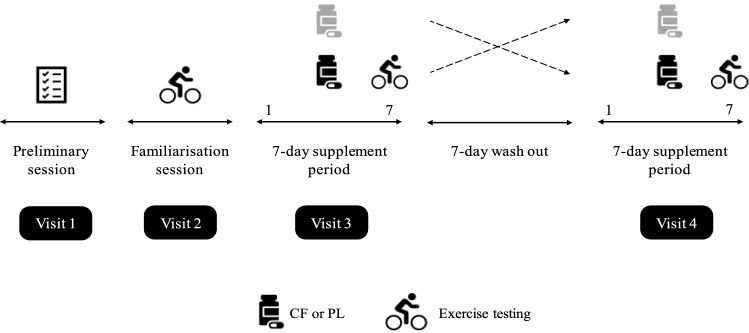
We employed a double-blind cross-over, placebo-controlled design whereby 17 participants (11 male, 6 female; mean ± SD, 45 ± 6 years) randomly received either 7 days of daily CF (400 mg) or placebo (PL) supplementation. On day 7, participants completed a series of 'step' moderate- and severe-intensity exercise tests for the determination of [Formula: see text] kinetics.
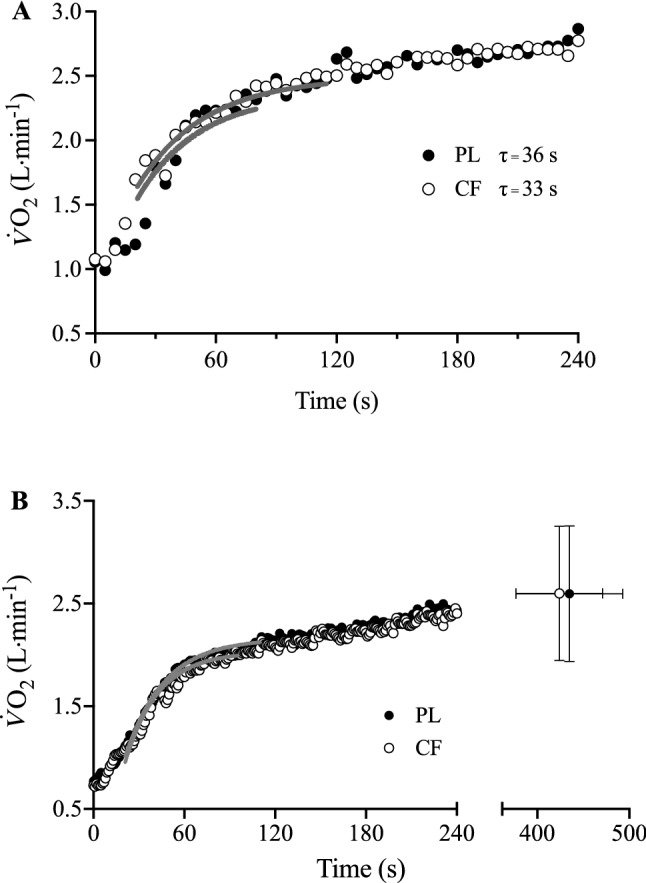
During moderate-intensity exercise, the time constant of the phase II [Formula: see text] kinetics ([Formula: see text]) was decreased by 15% in CF as compared to PL (mean ± SD; PL 40 ± 12 s vs. CF 34 ± 9 s, P = 0.019), with no differences in the amplitude of [Formula: see text] (A[Formula: see text]; PL 0.77 ± 0.32 l min vs. CF 0.79 ± 0.34 l min, P = 0.263). However, during severe-intensity exercise, [Formula: see text], the amplitude of the slow component ([Formula: see text]) and exercise tolerance (PL 435 ± 58 s vs. CF 424 ± 47 s, P = 0.480) were unchanged between conditions.
Our data show that acute CF supplementation enhanced [Formula: see text] kinetics during moderate-, but not severe-intensity exercise in middle-aged participants. These novel effects of CFs, in this demographic, may contribute to improved tolerance of moderate-activity physical activities, which appear commonly present in daily life.
Registered under ClinicalTrials.gov Identifier no. NCT04370353, 30/04/20 retrospectively registered.
可可黄烷醇(CF)通过增加一氧化氮(NO)的生物利用度来发挥其强大的血管舒张作用,从而带来健康益处。这些血管舒张作用可能有助于改善向运动肌肉输送血液和氧气(O)。
因此,本研究的目的是探讨 CF 补充如何影响久坐中年成年人的肺 O 摄取([Formula: see text])动力学和运动耐力。
我们采用双盲交叉、安慰剂对照设计,17 名参与者(11 名男性,6 名女性;平均±标准差,45±6 岁)随机接受 7 天的每日 CF(400mg)或安慰剂(PL)补充。在第 7 天,参与者完成了一系列“台阶”中度和重度强度运动测试,以确定[Formula: see text]动力学。
在中度强度运动期间,与 PL 相比,CF 使第二期[Formula: see text]动力学的时间常数([Formula: see text])降低了 15%(平均±标准差;PL 40±12 s 与 CF 34±9 s,P=0.019),但[Formula: see text]的幅度(A[Formula: see text])没有差异(PL 0.77±0.32 l min 与 CF 0.79±0.34 l min,P=0.263)。然而,在剧烈强度运动期间,[Formula: see text]、慢分量的幅度([Formula: see text])和运动耐力(PL 435±58 s 与 CF 424±47 s,P=0.480)在两种条件之间没有变化。
我们的数据表明,急性 CF 补充增强了中年参与者在中度强度但不是剧烈强度运动中的[Formula: see text]动力学。在这个人群中,CF 的这些新作用可能有助于提高对中度活动身体活动的耐受性,这些活动在日常生活中似乎很常见。
根据临床Trials.gov标识符 NCT04370353,于 2020 年 4 月 30 日进行了回顾性注册。