Yoo Seung Eun, Lee Ji Hyen, Lee Jung Won, Park Hye Sook, Lee Hye Ah, Kim Hae Soon
Department of Pediatrics, College of Medicine, Ewha Womans University, Seoul, Korea.
Department of Preventive medicine, College of Medicine, Graduate Program for System Health Science and Engineering, Ewha Womans University, Seoul, Korea.
Ann Pediatr Endocrinol Metab. 2022 Mar;27(1):60-68. doi: 10.6065/apem.2142068.034. Epub 2021 Oct 18.
Pediatric diabetes is a common health burden worldwide. This study aimed to investigate the prevalence of fasting hyperglycemia in Korean youth aged 10-18 years and to evaluate its association with metabolic indicators.
To assess the risk of diabetes in domestic children and adolescents, the prevalence of fasting hyperglycemia was calculated, a trend was evaluated using multi-year Korea National Health and Nutrition Examination Survey (KNHANES) data, and multivariate analysis was performed to evaluate the relationships between hyperglycemia and metabolic factors.
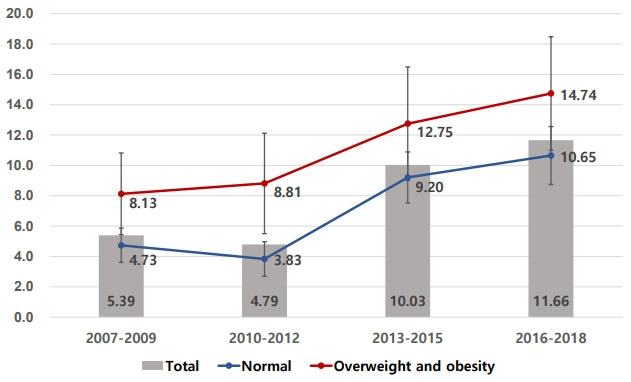
The prevalence of fasting hyperglycemia, defined as impaired fasting glucose (fasting glucose level > 100 mg/dL and < 125 mg/dL), or diabetes mellitus (fasting glucose ≥ 126 mg/dL) was estimated in Korean teenagers. The prevalence increased from the fourth (2007-2009) to the fifth (2010-2012), sixth (2013-2015), and seventh (2016-2018) KNHANES surveys, from 5.39 to 4.79, 10.03, and 11.66 per 100 persons, respectively. In multivariate analysis, systolic blood pressure and serum triglycerides were higher in the fasting hyperglycemia group; systolic blood pressures were 109.83 mmHg and 112.64 mmHg and serum triglycerides were 81.59 mg/dL and 89.60 mg/dL in the normal blood glucose and fasting hyperglycemia groups, respectively.
The prevalence of fasting hyperglycemia among children and adolescents has increased over the past decade, and this increase is potentially associated with metabolic abnormalities such as hypertension and hypertriglyceridemia. Effort is urgently required to reduce this chronic medical burden in adolescence.
儿童糖尿病是全球常见的健康负担。本研究旨在调查10 - 18岁韩国青少年空腹血糖升高的患病率,并评估其与代谢指标的关联。
为评估国内儿童和青少年患糖尿病的风险,计算空腹血糖升高的患病率,使用多年的韩国国家健康与营养检查调查(KNHANES)数据评估趋势,并进行多变量分析以评估高血糖与代谢因素之间的关系。
在韩国青少年中估计了空腹血糖升高的患病率,空腹血糖升高定义为空腹血糖受损(空腹血糖水平>100mg/dL且<125mg/dL)或糖尿病(空腹血糖≥126mg/dL)。患病率从第四次(2007 - 2009年)到第五次(2010 - 2012年)、第六次(2013 - 2015年)和第七次(2016 - 2018年)KNHANES调查有所增加,分别从每100人5.39例增至4.79例、10.03例和11.66例。在多变量分析中,空腹血糖升高组的收缩压和血清甘油三酯较高;正常血糖组和空腹血糖升高组的收缩压分别为109.83mmHg和112.64mmHg,血清甘油三酯分别为81.59mg/dL和89.60mg/dL。
在过去十年中,儿童和青少年空腹血糖升高的患病率有所增加,这种增加可能与高血压和高甘油三酯血症等代谢异常有关。迫切需要努力减轻青少年时期的这种慢性医疗负担。