Department of Psychology, University of Alabama at Birmingham, 1300 University Boulevard, Campbell Hall, Suite 237, Birmingham, AL, 35294, USA.
School of Nursing, Nurse Anesthesia Program, Department of Acute, Chronic, & Continuing Care, University of Alabama at Birmingham, Birmingham, USA.
BMC Musculoskelet Disord. 2021 May 10;22(1):429. doi: 10.1186/s12891-021-04306-5.
Biopsychosocial factors above and beyond pathoanatomical changes likely contribute to the severity of chronic low back pain. A pro-nociceptive endogenous pain modulatory balance (↓inhibition and ↑facilitation) may be an important contributor to chronic low back pain severity and physical function; however, additional research is needed to address this possibility. The objective of this study was to determine whether quantitative sensory tests of endogenous pain inhibition and facilitation prospectively predict movement-evoked pain and cLBP severity self-reported on a validated questionnaire.
One hundred thirty-four individuals with chronic low back pain were enrolled in this two-session study. During the first study session, temporal summation of mechanical pain and conditioned pain modulation were assessed at the lumbar spine to determine endogenous pain facilitation and inhibition, respectively. One week later, participants returned for a second study session whereby they reported their pain severity and pain interference using the Brief Pain Inventory-Short Form. Movement-evoked pain and physical function capacity were assessed upon completion of the balance, walking, and transition from sit to stand tests of the Short Physical Performance Battery.
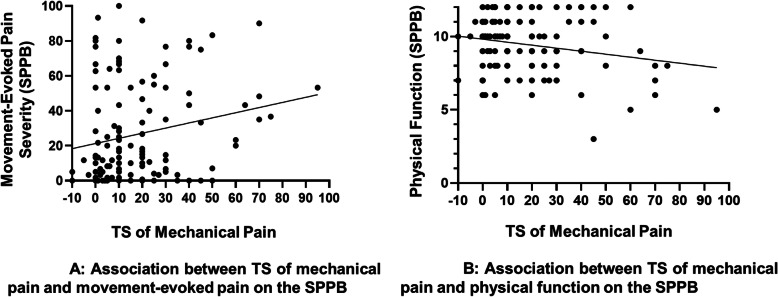
Temporal summation of mechanical pain, but not conditioned pain modulation, significantly and prospectively predicted greater movement-evoked pain and poorer physical function on the Short Physical Performance Battery. Neither temporal summation nor conditioned pain modulation were significantly related to self-reported pain severity or pain interference on the Brief Pain Inventory-Short Form.
Findings suggest that a pro-nociceptive pain modulatory balance characterized by enhanced pain facilitation may be an important driver of movement-evoked pain severity and poor physical function in individuals with chronic low back pain.
除了病理解剖学改变之外,生物心理社会因素可能导致慢性下腰痛的严重程度增加。促伤害性内源性疼痛调制平衡(↓抑制和↑易化)可能是慢性下腰痛严重程度和身体功能的一个重要影响因素;然而,需要进一步的研究来解决这个问题。本研究的目的是确定内源性疼痛抑制和易化的定量感觉测试是否能够前瞻性地预测运动诱发的疼痛和慢性下腰痛严重程度的自我报告,这些自我报告是基于经过验证的问卷得出的。
134 名慢性下腰痛患者参与了这项两阶段研究。在第一阶段研究中,在腰椎处评估机械性疼痛的时间总和和条件性疼痛调制,以分别确定内源性疼痛的易化和抑制。一周后,参与者返回进行第二阶段研究,在该研究中,他们使用简短疼痛量表-简表报告他们的疼痛严重程度和疼痛干扰。在完成平衡、行走和从坐姿到站姿转换的简短身体表现电池测试后,评估运动诱发的疼痛和身体功能能力。
机械性疼痛的时间总和,但不是条件性疼痛调制,显著且前瞻性地预测了更大的运动诱发的疼痛和更差的身体功能表现,这些结果在简短身体表现电池测试中得出。时间总和和条件性疼痛调制都与简短疼痛量表-简表上的自我报告的疼痛严重程度或疼痛干扰没有显著相关性。
研究结果表明,以增强的疼痛易化为特征的促伤害性疼痛调制平衡可能是慢性下腰痛患者运动诱发的疼痛严重程度和身体功能不良的一个重要驱动因素。