BC Cancer Research Centre, Vancouver, British Columbia, Canada
School of Population and Public Health, The University of British Columbia, Vancouver, British Columbia, Canada.
BMJ Open. 2021 May 10;11(5):e043301. doi: 10.1136/bmjopen-2020-043301.
To determine reference ranges of circulating long-chain (LC) omega-3 fatty acids: eicosapentaenoic acid (EPA), docosapentaenoic acid (DPA) and docosahexaenoic acid (DHA) in a nationally representative population of Americans. To provide context, serum concentrations of LC omega-3 were compared with concentrations associated with consuming the recommended amount of EPA and DHA by the Dietary Guidelines for Americans (DGA) and the Omega-3 Index (EPA+DHA).
Cross-sectional population-based study.
The National Health and Nutrition Examination Survey 2011-2012 cycle.
Participants with fatty acids measured in serum: 945 children, age 3-19 years, and 1316 adults, age 20 and older.
Serum EPA, DPA, DHA and sum of LC omega-3 fatty acids expressed as per cent of total fatty acids.
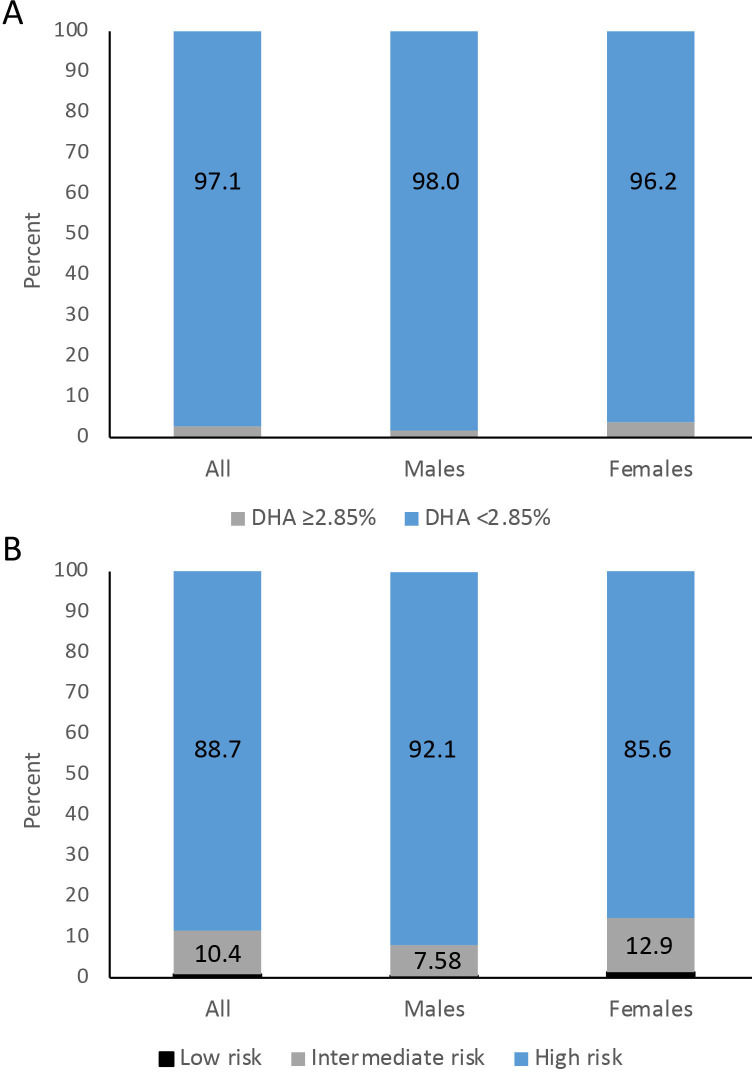
Among children, mean (SE) serum concentrations of EPA, DHA and omega-3s were 0.28% (0.01), 1.07% (0.02) and 1.75% (0.03). Among adults, mean (SE) of EPA, DHA and omega-3s were 0.61% (0.02), 1.38% (0.05) and 2.43% (0.08), all of which were significantly higher than corresponding serum fatty acid concentrations in children (p<0.001). Despite recommendations for higher intake, pregnant and/or breastfeeding women had mean (SE) EPA, DHA and LC omega-3 concentrations of 0.34% (0.07), 1.52% (0.08) and 2.18% (0.15), which were comparable to women of childbearing age; p=0.17, p=0.10 and p=0.73. Over 95% of children and 68% of adults had LC omega-3 concentrations below those associated with the DGA recommendation. Approximately 89% of adults had an Omega-3 Index in the high cardiovascular risk category.
Contemporary reference ranges for circulating LC omega-3s are critical for setting public health recommendations. Our findings show the need for continued emphasis on regular consumption of LC omega-3s among Americans, particularly considering the importance of LC omega-3s in cardiovascular health, brain health and development throughout life.
确定美国具有代表性的人群中环长链(LC)ω-3 脂肪酸(二十碳五烯酸(EPA)、二十二碳五烯酸(DPA)和二十二碳六烯酸(DHA)的参考范围。为了提供背景信息,将血清 LC ω-3 浓度与《美国人膳食指南(DGA)》和《ω-3 指数(EPA+DHA)》推荐的 EPA 和 DHA 摄入量相关联的浓度进行比较。
横断面人群基础研究。
2011-2012 年国家健康和营养检查调查周期。
血清中测量脂肪酸的参与者:945 名儿童,年龄 3-19 岁,和 1316 名成年人,年龄 20 岁及以上。
血清 EPA、DPA、DHA 和 LC ω-3 脂肪酸总和以总脂肪酸的百分比表示。
在儿童中,血清 EPA、DHA 和 ω-3 的平均(SE)浓度分别为 0.28%(0.01)、1.07%(0.02)和 1.75%(0.03)。在成年人中,血清 EPA、DHA 和 ω-3 的平均(SE)浓度分别为 0.61%(0.02)、1.38%(0.05)和 2.43%(0.08),均显著高于儿童相应的血清脂肪酸浓度(p<0.001)。尽管推荐摄入更高的量,但孕妇和/或哺乳期妇女的 EPA、DHA 和 LC ω-3 浓度分别为 0.34%(0.07)、1.52%(0.08)和 2.18%(0.15),与育龄妇女相当;p=0.17,p=0.10 和 p=0.73。超过 95%的儿童和 68%的成年人的 LC ω-3 浓度低于 DGA 推荐的水平。大约 89%的成年人的 ω-3 指数处于心血管高风险类别。
目前循环 LC ω-3 的参考范围对于制定公共卫生建议至关重要。我们的研究结果表明,美国人需要继续强调定期摄入 LC ω-3,特别是考虑到 LC ω-3 在心脑血管健康、大脑健康和整个生命周期的发育中的重要性。