National Research Centre for the Working Environment, Copenhagen, Denmark
Sport Sciences - Performance and Technology, Department of Health Science and Technology, Faculty of Medicine, Aalborg University, Aalborg, Denmark.
Occup Environ Med. 2021 Nov;78(11):829-834. doi: 10.1136/oemed-2020-107281. Epub 2021 May 10.
This study investigates the role of age for the prospective association between physical work demands and long-term sickness absence (LTSA).
We followed 69 117 employees of the general working population (Work Environment and Health in Denmark study 2012-2018), without LTSA during the past 52 weeks preceding initial interview, for up to 2 years in the Danish Register for Evaluation of Marginalisation. Self-reported physical work demands were based on a combined ergonomic index including seven different types of exposure during the working day. Using weighted Cox regression analyses controlling for years of age, gender, survey year, education, lifestyle, depressive symptoms and psychosocial work factors, we determined the interaction of age with physical work demands for the risk of LTSA.
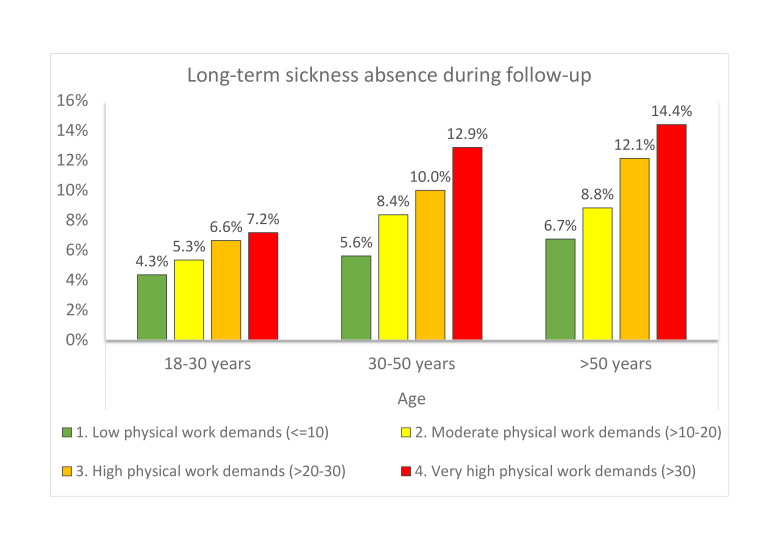
During follow-up, 8.4% of the participants developed LTSA. Age and physical work demands interacted (p<0.01). In the fully adjusted model, very high physical work demands were associated with LTSA with HRs of 1.18 (95% CI 0.93 to 1.50), 1.57 (95% CI 1.41 to 1.75) and 2.09 (95% CI 1.81 to 2.41) for 20, 40 and 60 years old (point estimates), respectively. Results remained robust in subgroup analyses including only skilled and unskilled workers and stratified for gender.
The health consequences of high physical work demands increase with age. Workplaces should consider adapting physical work demands to the capacity of workers in different age groups.
本研究旨在探讨年龄因素对体力工作需求与长期病假(LTSA)之间前瞻性关联的作用。
我们对一般劳动人口中的 69117 名员工(丹麦工作环境与健康研究 2012-2018 年)进行了随访,这些员工在初始访谈前的 52 周内没有 LTSA,随访时间最长可达 2 年。通过丹麦边缘化评估登记处进行登记。体力工作需求是基于一种综合的人体工程学指数,包括工作日期间七种不同类型的暴露。使用加权 Cox 回归分析控制年龄、性别、调查年份、教育程度、生活方式、抑郁症状和心理社会工作因素,我们确定了年龄与体力工作需求之间的相互作用对 LTSA 风险的影响。
在随访期间,有 8.4%的参与者发生了 LTSA。年龄和体力工作需求存在交互作用(p<0.01)。在完全调整的模型中,极高的体力工作需求与 LTSA 相关,HRs 分别为 1.18(95%CI 0.93 至 1.50)、1.57(95%CI 1.41 至 1.75)和 2.09(95%CI 1.81 至 2.41),对应的年龄分别为 20、40 和 60 岁(点估计值)。在包括熟练和非熟练工人的亚组分析和按性别分层的亚组分析中,结果仍然稳健。
高体力工作需求的健康后果随着年龄的增长而增加。工作场所应考虑根据不同年龄组工人的能力来调整体力工作需求。