Chair of Pharmacology, Faculty of Science and Medicine, University of Fribourg, 1700 Fribourg, Switzerland.
Chair of Pharmacology, Faculty of Science and Medicine, University of Fribourg, 1700 Fribourg, Switzerland
Proc Natl Acad Sci U S A. 2021 May 18;118(20). doi: 10.1073/pnas.2026245118.
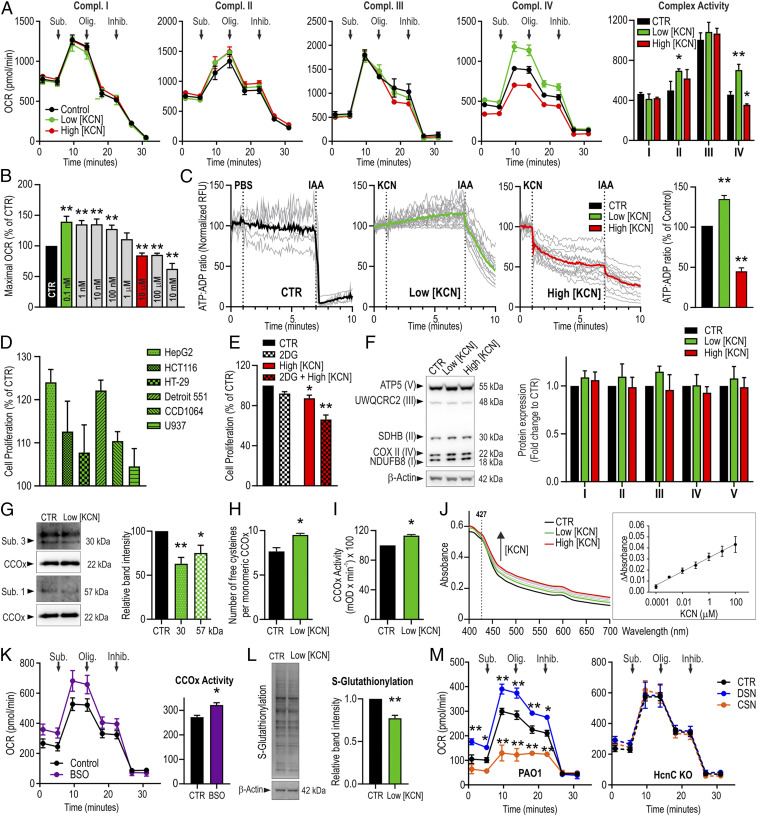
In mammalian cells, cyanide is viewed as a cytotoxic agent, which exerts its effects through inhibition of mitochondrial Complex IV (Cytochrome C oxidase [CCOx]). However, the current report demonstrates that cyanide's effect on CCOx is biphasic; low (nanomolar to low-micromolar) concentrations stimulate CCOx activity, while higher (high-micromolar) concentrations produce the "classic" inhibitory effect. Low concentrations of cyanide stimulated mitochondrial electron transport and elevated intracellular adenosine triphosphate (ATP), resulting in the stimulation of cell proliferation. The stimulatory effect of cyanide on CCOx was associated with the removal of the constitutive, inhibitory glutathionylation on its catalytic 30- and 57-kDa subunits. Transfer of diluted (a cyanide-producing bacterium) supernatants to mammalian cells stimulated cellular bioenergetics, while concentrated supernatants were inhibitory. These effects were absent with supernatants from mutant lacking its cyanide-producing enzyme. These results raise the possibility that cyanide at low, endogenous levels serves regulatory purposes in mammals. Indeed, the expression of six putative mammalian cyanide-producing and/or -metabolizing enzymes was confirmed in HepG2 cells; one of them (myeloperoxidase) showed a biphasic regulation after cyanide exposure. Cyanide shares features with "classical" mammalian gasotransmitters NO, CO, and HS and may be considered the fourth mammalian gasotransmitter.
在哺乳动物细胞中,氰化物被视为细胞毒性剂,通过抑制线粒体复合物 IV(细胞色素 C 氧化酶 [CCOx])发挥作用。然而,本报告表明,氰化物对 CCOx 的作用呈双相性;低浓度(纳摩尔到低微摩尔)刺激 CCOx 活性,而高浓度(高微摩尔)产生“经典”抑制作用。低浓度的氰化物刺激线粒体电子传递并提高细胞内三磷酸腺苷(ATP)水平,从而刺激细胞增殖。氰化物对 CCOx 的刺激作用与去除其催化 30-和 57-kDa 亚基的组成性抑制谷胱甘肽化有关。将稀释的 (一种产生氰化物的细菌)上清液转移至哺乳动物细胞中可刺激细胞生物能学,而浓缩的上清液则具有抑制作用。缺乏其产生氰化物酶的突变体的上清液则没有这些作用。这些结果提示,低水平的内源性氰化物可能在哺乳动物中具有调节作用。事实上,在 HepG2 细胞中证实了六种假定的哺乳动物氰化物产生和/或代谢酶的表达;其中一种(髓过氧化物酶)在暴露于氰化物后表现出双相调节。氰化物与“经典”的哺乳动物气体递质 NO、CO 和 HS 具有共同特征,可被视为第四种哺乳动物气体递质。