Department of Teaching, Research and Development, Schulthess Klinik, Lengghalde 2, 8008, Zurich, Switzerland.
Qual Life Res. 2021 Oct;30(10):2973-2982. doi: 10.1007/s11136-021-02849-7. Epub 2021 May 10.
The aim was to investigate the measurement properties of the EQ-5D-5L utility index in patients after arthroscopic rotator cuff repair (RCR), total shoulder arthroplasty (TSA) or thumb carpometacarpal (CMC I) arthroplasty.
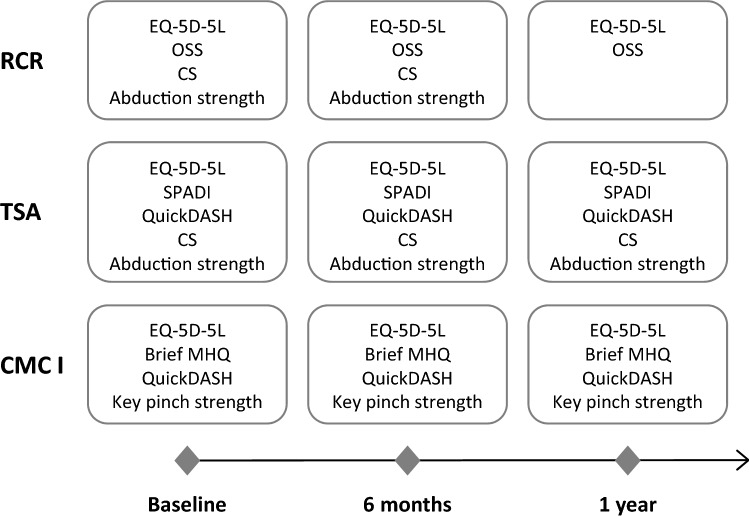
In this prospective study, all patients completed the EQ-5D-5L before surgery and 6 months and 1 year after surgery. In addition, RCR patients completed the Oxford Shoulder Score (OSS), TSA patients completed the Shoulder Pain and Disability Index (SPADI) and CMC I patients completed the brief Michigan Hand Outcomes Questionnaire (brief MHQ) at each designated time point. Construct validity (Pearson's correlation coefficient, r), responsiveness (effect size), minimal important difference (MID), minimal important change (MIC), and floor and ceiling effects of the EQ-5D-5L were determined. To test discriminative ability, EQ-5D-5L utility indices of patients who were in a patient acceptable symptom state (PASS) or not at follow-up were compared using the Mann-Whitney U test.
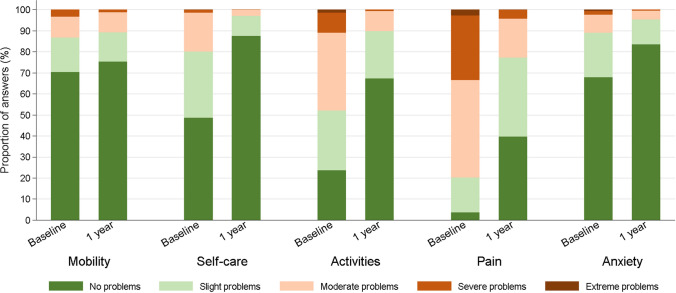
We included 153 RCR, 150 TSA, and 151 CMC I patients. The EQ-5D-5L utility index correlated with the OSS (r = 0.73), SPADI (r = - 0.65) and brief MHQ (r = 0.61). The effect sizes were 1.3 (RCR and CMC I group) and 1.1 (TSA). The MID and MIC ranged from 0.027 to 0.209. Ceiling effects were found. The EQ-5D-5L utility index differed significantly between patients being in a PASS versus patients who were not in a PASS.
The EQ-5D-5L utility index shows good construct validity, responsiveness and discriminative ability in patients after arthroscopic RCR, TSA and CMC I arthroplasty and is suitable to quantify quality of life.
This auxiliary analysis is part of a primary study that was originally registered at ClinicalTrials.gov (NCT01954433) on October 1, 2013.
旨在探讨 EQ-5D-5L 效用指数在关节镜肩袖修复术(RCR)、全肩关节置换术(TSA)或拇指腕掌关节(CMC I)置换术后患者中的测量特性。
在这项前瞻性研究中,所有患者在术前以及术后 6 个月和 1 年均完成了 EQ-5D-5L 量表的评估。此外,RCR 患者还完成了牛津肩袖评分(OSS),TSA 患者完成了肩部疼痛和残疾指数(SPADI),CMC I 患者在每个指定时间点完成了简明密歇根手功能问卷(brief MHQ)。确定了 EQ-5D-5L 的构念效度(Pearson 相关系数,r)、反应度(效应量)、最小重要差异(MID)、最小临床重要变化(MIC)以及 EQ-5D-5L 的Floor 和 Ceiling 效应。为了测试判别能力,使用 Mann-Whitney U 检验比较了在随访时处于可接受症状状态(PASS)和未处于 PASS 的患者的 EQ-5D-5L 效用指数。
共纳入 153 例 RCR、150 例 TSA 和 151 例 CMC I 患者。EQ-5D-5L 效用指数与 OSS(r=0.73)、SPADI(r=-0.65)和 brief MHQ(r=0.61)均呈正相关。效应量为 1.3(RCR 和 CMC I 组)和 1.1(TSA)。MID 和 MIC 范围为 0.027 至 0.209。存在天花板效应。EQ-5D-5L 效用指数在处于 PASS 状态的患者和未处于 PASS 状态的患者之间存在显著差异。
EQ-5D-5L 效用指数在关节镜 RCR、TSA 和 CMC I 关节置换术后患者中具有良好的构念效度、反应度和判别能力,适用于量化生活质量。
本辅助分析是一项原始研究的一部分,该研究最初于 2013 年 10 月 1 日在 ClinicalTrials.gov(NCT01954433)注册。