Office of Human Research Compliance, Clinical Research Branch and Division of Intramural Research, National Institute of Environmental Health Sciences, 111 T.W. Alexander Dr., Mail Drop CRU-02, Research Triangle Park, Durham, NC, 27709, USA.
Social & Scientific Systems, Inc., Silver Spring, MD, USA.
Curr Environ Health Rep. 2021 Jun;8(2):127-137. doi: 10.1007/s40572-021-00311-x. Epub 2021 May 11.
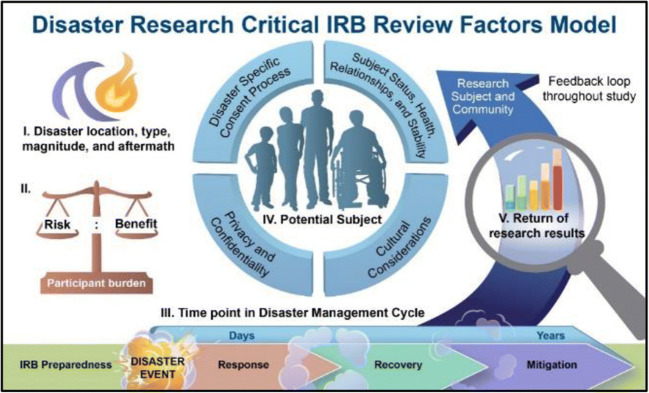
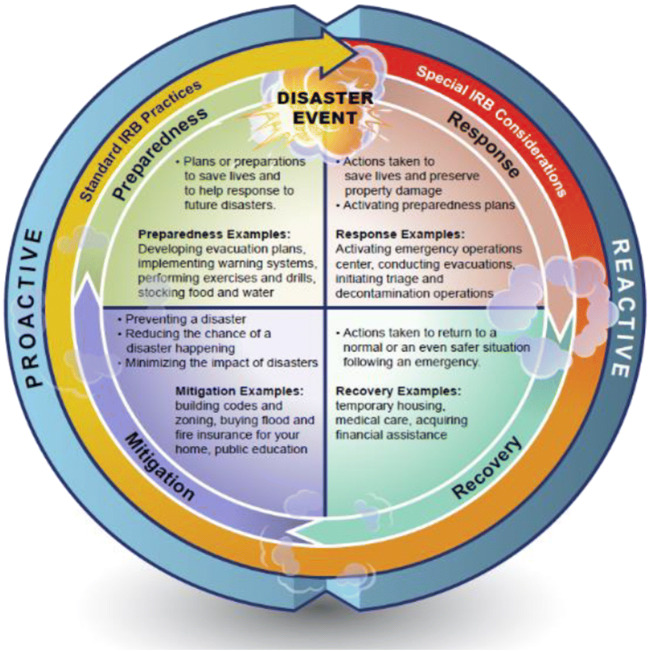
Disasters are becoming more common and challenge national and global resiliency and response efforts. As a result, government agencies have increased interest in disaster research to understand their environmental impact and health-related consequences. With the research field greatly expanding, Institutional Review Boards (IRBs) are being asked to review research protocols aimed at assessing health risks, exposures, and outcomes from disaster survivors. Few IRBs have experience reviewing disaster research protocols. This article describes approaches for IRB preparedness in reviewing disaster research.
From a human research protections perspective, primary attention has focused on vulnerability of individuals and/or populations affected by a disaster who may serve as research participants [3, 4]. From our review of the current literature, there is a lack of best practices and/or guidance for IRBs in the review of disaster research protocols. The growth of the disaster research field has brought more attention to potential ethical concerns of disaster research studies. Disaster survivors, responders, and those that assist in cleanup and remedial efforts may be left with significant unmet needs and long-term physical and emotional challenges as a result of their experiences. It is important for IRBs and investigators to collaboratively address how best to protect the welfare of individuals and communities affected by a disaster. A new approach is needed to systematically consider the various factors relevant to an assessment of human research protection issues following disasters.
灾害越来越频繁,对国家和全球的弹性和应对能力构成挑战。因此,政府机构增加了对灾害研究的兴趣,以了解其对环境的影响和与健康相关的后果。随着研究领域的极大扩展,机构审查委员会(IRB)被要求审查旨在评估灾害幸存者健康风险、暴露和结果的研究方案。很少有 IRB 有审查灾害研究方案的经验。本文介绍了 IRB 在审查灾害研究方面的准备方法。
从人类研究保护的角度来看,主要关注的是受灾害影响的个人和/或人群的脆弱性,他们可能成为研究参与者[3,4]。从我们对当前文献的回顾来看,IRB 在审查灾害研究方案方面缺乏最佳实践和/或指导。灾害研究领域的发展引起了更多对灾害研究研究中潜在伦理问题的关注。灾害幸存者、应对人员以及那些协助清理和补救工作的人员可能会因他们的经历而留下重大的未满足需求和长期的身体和情感挑战。IRB 和研究人员共同努力,以最好地保护受灾害影响的个人和社区的福利非常重要。需要一种新的方法来系统地考虑与灾害发生后评估人类研究保护问题相关的各种因素。