Institute of Pathology Enge, Hardturmstr. 133, CH-8055, Zurich, Switzerland.
County Hospital Thurgau, Frauenfeld, Switzerland.
Diagn Pathol. 2021 May 11;16(1):42. doi: 10.1186/s13000-021-01103-5.
Effective workflow management in a diagnostic pathology laboratory is critical to achieve rapid turnover while maintaining high quality. Fluorescence in situ hybridization analysis (FISH) is the preferred technique for detecting single chromosomal aberrations in diagnostic surgical pathology.
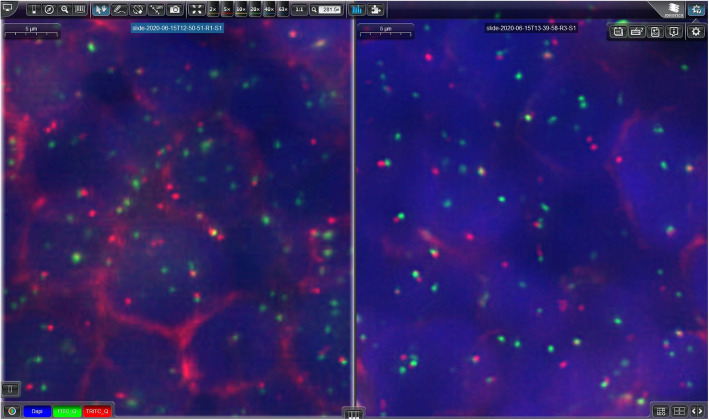
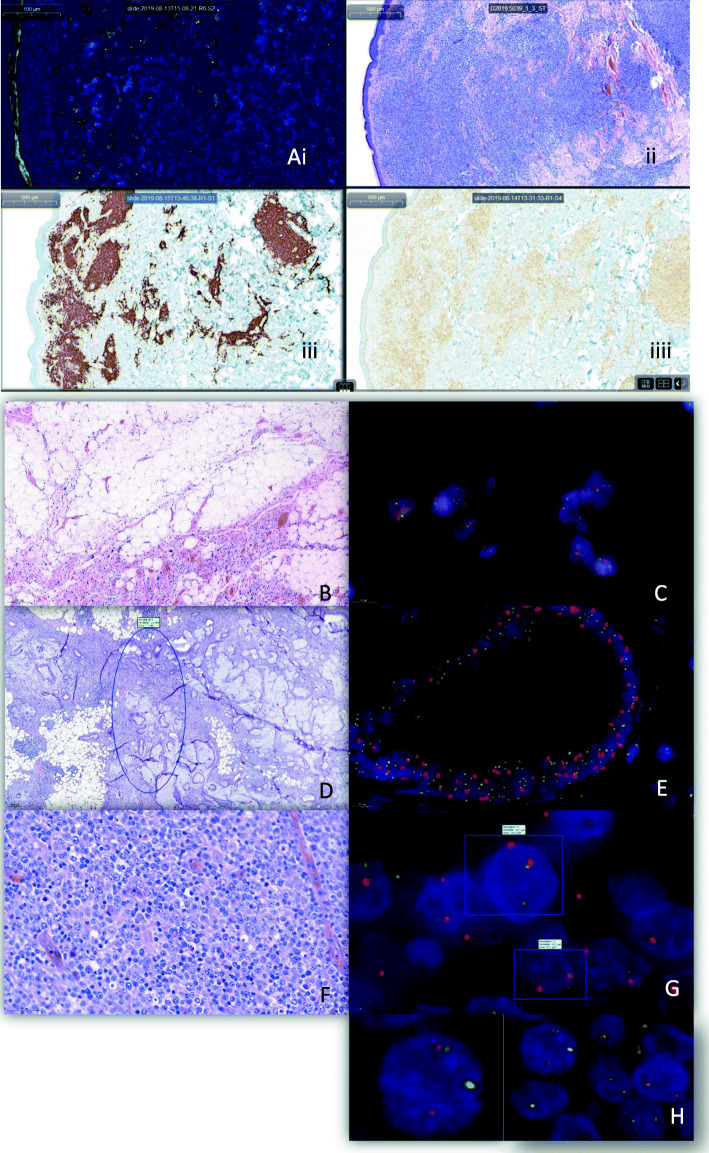
FISH analysis applying a rapid hybridization protocol and using an automated whole-slide fluorescence scanning device (3DHISTECH, Sysmex, Switzerland) were implemented in our workflow. By analyzing 42 diagnostic cases, effects of two different scanning profiles on scanning time, and device memory usage were investigated. Manual signal counting (CaseViewer) and software based signal counting (FISHQuant) were compared.
The two scanning profiles, both including a Z-stack function, differed in their exposure time and digital gain. The "low profile" setting (LP) resulted in a significantly shorter scanning time and lower storage volume compared to the "high profile" (HP) setting, making the LP ideal for routine applications. Both signal counting methods (manual versus software based) provided similar cut-offs on a test-cohort of 13 samples.
Scanning FISH slides provides good picture quality, reduces the analysis time and allows easy picture archiving and facilitates remote diagnostics, allowing an effective workflow.
在诊断病理学实验室中,有效的工作流程管理对于实现快速周转同时保持高质量至关重要。荧光原位杂交分析(FISH)是诊断外科病理学中单条染色体异常检测的首选技术。
我们在工作流程中实施了应用快速杂交方案和自动化全切片荧光扫描设备(3DHISTECH,Sysmex,瑞士)的 FISH 分析。通过分析 42 个诊断病例,研究了两种不同扫描方案对扫描时间和设备内存使用的影响。比较了手动信号计数(CaseViewer)和基于软件的信号计数(FISHQuant)。
两种扫描方案均包含 Z 堆叠功能,但曝光时间和数字增益不同。与“高配置”(HP)设置相比,“低配置”(LP)设置的扫描时间明显更短,存储量更低,因此 LP 非常适合常规应用。两种信号计数方法(手动与基于软件)在 13 个样本的测试队列上提供了相似的截止值。
扫描 FISH 载玻片可提供良好的图像质量,缩短分析时间,并允许轻松进行图像存档和远程诊断,从而实现有效的工作流程。