Namale Gertrude, Mayanja Yunia, Kamacooko Onesmus, Bagiire Daniel, Ssali Agnes, Seeley Janet, Newton Robert, Kamali Anatoli
MRC/UVRI and LSHTM Uganda Research Unit, P.O Box 49, Entebbe, Uganda.
London School of Hygiene &Tropical Medicine, London, United Kingdom.
Infect Agent Cancer. 2021 May 11;16(1):31. doi: 10.1186/s13027-021-00373-4.
Although cervical cancer is preventable, most women in sub-Saharan Africa (SSA) do not receive routine screening and few treatment options exist. Female Sex Workers (FSWs) are among the Ugandan female population at highest risk of acquiring sexually transmitted infections (STIs) including HIV and human papilloma viruses (HPV), the cause of cervical cancer. We report one-year experiences of visual inspection with acetic acid (VIA) positivity among FSWs in the early detection of pre-cancerous and cancerous cervical lesions in Kampala, Uganda.
Between June 2014 and July 2015, we enrolled FSWs into a cross-sectional study at a research clinic. The women were screened using the VIA method (application of 3-5 % acetic acid to the cervix). All VIA positive women were referred to a tertiary hospital for colposcopy, biopsy, and immediate treatment (if indicated) at the same visit according to national guidelines. Data on socio-demographic, sexual behaviour, sexual reproductive health and clinical characteristics were collected. We used logistic regression to identify factors associated with VIA positivity.
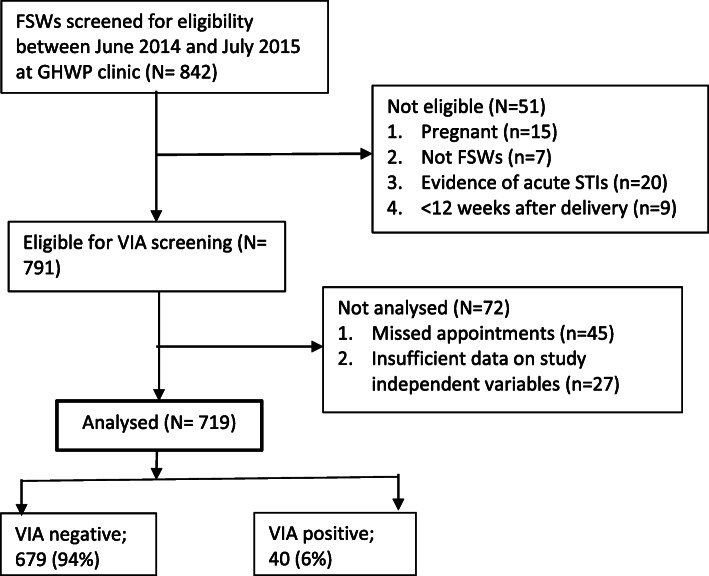
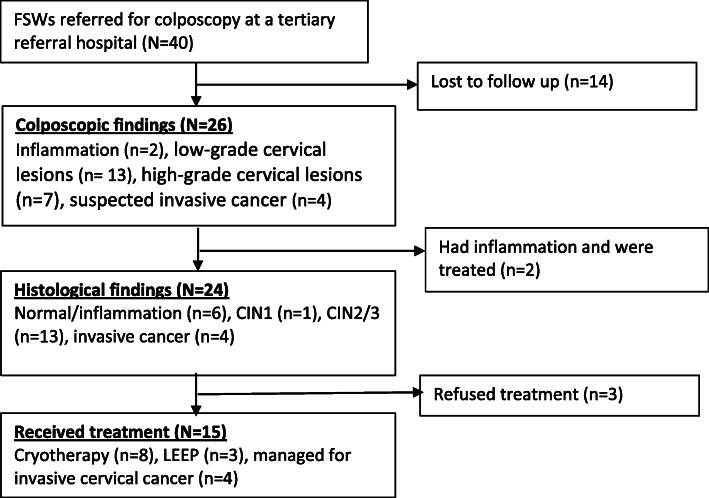
Of 842 women assessed for eligibility, 719 (85 %) of median age 30 (IQR 26, 35) were screened, and 40 (6 %) women were VIA positive. Of the 24 histology specimens analysed, 6 showed inflammation, only 1 showed cervical intraepithelial neoplasia (CIN) 1, 13 women showed CIN2/3, while 4 women already had invasive cervical cancer. The overall prevalence of HIV was 43 %, of whom only 35 % were receiving ART. In the age-adjusted analysis, VIA positivity was more likely among women who reported having > 100 life-time partners (aOR = 3.34, 95 %CI: 1.38-8.12), and HIV positive women (aOR = 4.55; 95 %CI: 2.12-9.84).
We found a relatively low proportion of VIA positivity in this population. The experience from our program implies that the VIA results are poorly reproducible even among a category of trained professional health workers. VIA positivity was more likely among women with a high number of sexual partners and HIV infection. Interventions for improving cervical cancer screening should be recommended as part of HIV care for FSWs to reduce the disease burden in this population.
尽管宫颈癌是可预防的,但撒哈拉以南非洲(SSA)的大多数女性未接受常规筛查,且治疗选择有限。女性性工作者(FSW)是乌干达女性中感染包括艾滋病毒和人乳头瘤病毒(HPV,宫颈癌病因)在内的性传播感染(STI)风险最高的人群之一。我们报告了在乌干达坎帕拉对女性性工作者进行醋酸肉眼观察法(VIA)阳性结果的一年经验,以早期发现宫颈癌前病变和癌性病变。
2014年6月至2015年7月期间,我们在一家研究诊所将女性性工作者纳入一项横断面研究。使用VIA方法(向宫颈涂抹3 - 5%的醋酸)对这些女性进行筛查。根据国家指南,所有VIA阳性的女性在同一次就诊时被转诊至一家三级医院进行阴道镜检查、活检及立即治疗(如需要)。收集了社会人口统计学、性行为、性生殖健康及临床特征方面的数据。我们使用逻辑回归来确定与VIA阳性相关的因素。
在842名评估是否符合条件的女性中,719名(85%)年龄中位数为30岁(四分位间距26,35)的女性接受了筛查,40名(6%)女性VIA阳性。在分析的24份组织学标本中,6份显示炎症,仅1份显示宫颈上皮内瘤变(CIN)1级,13名女性显示CIN2/3级,而4名女性已患有浸润性宫颈癌。艾滋病毒总体感染率为43%,其中只有35%的人正在接受抗逆转录病毒治疗(ART)。在年龄调整分析中,报告有超过100个终身性伴侣的女性(调整后比值比[aOR]=3.34,95%置信区间[CI]:1.38 - 8.12)以及艾滋病毒阳性女性(aOR = 4.55;95%CI:2.12 - 9.84)VIA阳性的可能性更高。
我们发现该人群中VIA阳性的比例相对较低。我们项目的经验表明,即使在一类经过培训的专业卫生工作者中,VIA结果的可重复性也很差。性伴侣数量多和感染艾滋病毒的女性VIA阳性的可能性更高。应建议将改善宫颈癌筛查的干预措施作为女性性工作者艾滋病毒护理的一部分,以减轻该人群的疾病负担。